Drug name
Last update: Oct 2026Lenacapavir Once-Yearly
Developer(s)
Drug information
Lenacapavir Once-Yearly
Investigational
Small molecule
Capsid inhibitor — Capsid inhibitor
Active / In Development (Phase 1/2/3)
Once yearly lenacapavir (LEN) is an investigational intramuscular injectable formulation currently in clinical development for potential once-yearly HIV pre-exposure prophylaxis (PrEP). A phase I trial evaluating two once-yearly formulations found that a single 5000 mg intramuscular dose of lenacapavir resulted in sustained median plasma concentrations above those of the twice-yearly subcutaneous formulation (927 mg) for at least 56 weeks. Notably, the median concentrations at weeks 52 and 56 for the intramuscular formulations (50.7-65.6 ng/mL) were higher than the median concentration at week 26 (23.4 ng/mL) observed in PURPOSE 1 and 2. Once-yearly intramuscular lenacapavir may therefore further improve PrEP adherence, persistence, and scalability by offering reduced dosing frequency.
Formulation is currently in clinical development and not yet approved in any jurisdiction. The direct progression to phase 3 for once‑yearly IM lenacapavir is justified scientifically and accepted by regulators because phase 1 data showed plasma exposures (and safety) that matched or exceeded the pivotal efficacy PK thresholds for the approved twice‑yearly SC regimen. Annual IM depot’s PK tail and implementation differences, unaddressed by PK bridging alone, will require real-world post-marketing/surveillance.
Formulation is currently in clinical development and not yet approved in any jurisdiction. Once-yearly intramuscular LEN maintained plasma concentrations higher than those associated with efficacy for twice-yearly subcutaneous LEN for PrEP for >12 months (plasma exposures at one year exceeded levels associated with protection in PURPOSE trials). Both yearly investigational formulations were safe and tolerable. Results from phase 1 support moving to Phase 3 study for once-yearly IM LEN for HIV PrEP. WHO guideline refers to offering long‑acting injectable PrEP options as part of combination approaches, explicitly accepting PK/efficacy bridging for schedule changes and new depot products, provided safety and concentration requirements are met.
Therapeutic area(s)
- HIV
- Pre-Exposure Prophylaxis (PrEP)
- Prevention
Administration route
Intramuscular
Associated long-acting platforms
Aqueous Solution
Use of drug
- Administered by a community health worker
- Administered by a nurse
- Administered by a specialty health worker
- To be determined
- Yearly
Dosage
3000 mg - 2x3mL intramuscular injections
5000 mg - 2x5mL intramuscular injections
Oral LEN 600 mg on Day 1 (with the IM injections) and Day 2 (The once‑yearly modality uses two investigational intramuscular (IM) formulations, distinct from the subcutaneous (SC) formulation used for twice‑yearly dosing)
Not provided
Once-yearly intramuscular lenacapavir (5000 mg) provided higher Ctrough levels than the twice-yearly subcutaneous formulation. Future development suggests a lower optimal dose for the intramuscular option. A significant difference in the Phase I trial was the absence of oral loading doses for the once-yearly intramuscular formulation, which were required for the twice-yearly subcutaneous version due to its slow initial release. The intramuscular formulation also exhibited a faster initial increase in lenacapavir blood plasma concentration.
Not provided
Related entries
Cabotegravir + Lenacapavir
GS-3242+LEN
lenacapavir + teropavimab + zinlirvimab
Lenacapavir 6-monthly
MK-8591D (Islatravir and Lenacapavir)
Additional information
Developer(s)
Gilead
Gilead Sciences, Inc. is a multinational biopharmaceutical company that develops and manufactures innovative medicines for life-threatening diseases, including anti-viral therapeutics for HIV/AIDS, Hepatitis B, Hepatitis C and Covid-19. Headquartered in Foster City, California, Gilead was originally founded in 1987 and is currently listed on both the S&P 500 and the NASDAQ Biotechnology Index.
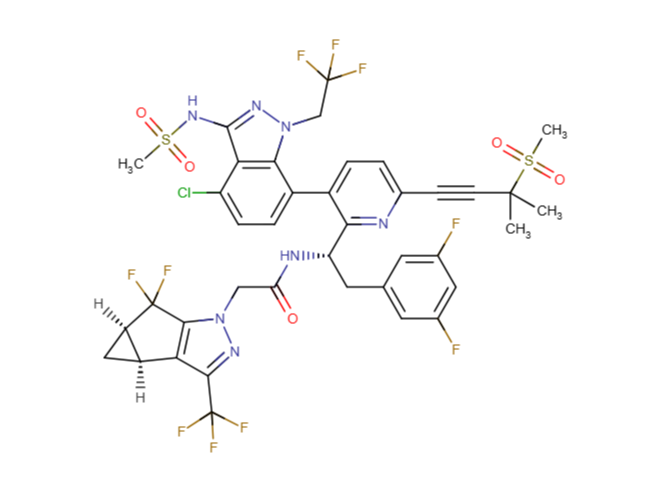
Drug structure
Scale-up and manufacturing prospects
LEN is already being manufactured at scale by Gilead for the twice-yearly SC product. For yearly IM, similar industrial processes will form the basis but with adaptations to the higher concentration and altered vehicle (ethanol content for IM depot). Equipment for injectable: Stainless steel pharmaceutical reactors, glass-lined reactors, rotary evaporator (rotovap), flash chromatography columns, stainless steel autoclave, cooling bath, silica gel chromatography columns, vacuum distillation apparatus, simulated moving bed chromatography system, Chiralpak columns.
Storage of injectable lenacapavir in borosilicate vials is contraindicated due to issues with chemical compatibility. Instead, it is recommended that vials are made from aluminosilicate glass. High-precision mixing tanks with capability for viscous, ethanol-containing solutions. Aseptic filling/isolation units compatible with ethanol/PEG vehicles.Sterile filtration units for low-volume injectables.Standard lyophilisation (if relevant to final formulation.
Vehicles with ethanol (often 5% or 10%) require specialised mixing times and solvent management to control viscosity and precipitation, which impact overall plant throughput and quality assurance. PEG and ethanol vehicles restrict direct steam sterilisation due to oxidation risk; sterile filtration is therefore preferred for terminal sterilisation—requiring high-quality, compatible filter assemblies with low extractable profiles.
Proton nuclear magnetic resonance (1H NMR), High-performance liquid chromatography (HPLC), Ultra-Performance Liquid Chromatography (UPLC). Container closure integrity testers (for glass vials or prefilled syringes). Stability chambers for long-term and accelerated conditions.
Excipients & delivery device(s)
Not provided
Not provided
Not provided
No delivery device
Safety, Efficacy and Evidence Summary
Not provided
Not provided
Not provided
Not provided