Drug name
Last update: Oct 2026Lenacapavir 6-monthly
Developer(s)
Drug information
Lenacapavir
Sunlenca
Small molecule
Capsid inhibitor — HIV-1 capsid inhibitor
Approved / Marketed
Six monthly lenacapavir (LEN) is a subcutaneous injectable formulation used for the treatment of multi-drug resistant HIV-1 infection in combination with other antiretrovirals and is currently being studied as potential HIV pre-exposure prophylaxis (PrEP). Two large Phase III clinical trials (PURPOSE 1 & 2) and three Phase II trials (PURPOSE 3, 4 & 5) are currently evaluating the safety and efficacy of subcutaneous lenacapavir for PrEP. Six-monthly LEN is administered subcutaneously every 26 weeks (+/- 2 weeks from date of last injection) following an initial two day oral-loading period of 600 mg (2 x 300-mg tablets). LEN was approved in the EU for the treatment of HIV-positive adults with multidrug resistance in Aug 2022, and received approval from the U.S. FDA in Dec 2022.
Lenacapavir (SUNLENCA) 463.5mg/3ml subcutaneous injection with 300mg oral lead-in tablets are approved for use in the United States, United Kingdom, Canada, UAE, South Korea, Hong Kong, Japan, Australia, Israel, and the European Union (27-member states of the European Union, as well as Norway, Iceland and Liechtenstein) for HIV-1 treatment under certain conditions. For PrEP: Gilead submitted an application to the US FDA for Lenacapavir in December 2024 and was granted priority review with a decision expected by June 19, 2025. It is also under review in Brazil, EU (+EEA) and South Africa.
US FDA granted Breakthrough Therapy Designation for SUNLENCA in combination with other antiretroviral drugs for heavily treatment-experienced patients (HTE) adults with multi-drug resistant (MDR) HIV-1 infection failing their current antiretroviral regimen due to resistance, intolerance, or safety considerations. A European Marketing Authorization was issued for the use of SUNLENCA and it has also been classified as ‘Fast-Track Reimbursement’ by the Ministry of Health, Labour and Welfare, Japan, and ‘Part 1- Schedule 1 & Schedule 3 Poison’ by the Department of Health, Hong Kong.
Therapeutic area(s)
- HIV
- Pre-Exposure Prophylaxis (PrEP)
- Treatment
Administration route
Subcutaneous, Oral
Associated long-acting platforms
Aqueous Solution, Oral solid form
Use of drug
- Administered by a nurse
- To be determined
- Every 6 months
Dosage
Oral lead-in LEN tablets 300 mg; Each injection contains 463.5 mg/1.5 mL (309 mg/mL) of lenacapavir in solution.
Not provided
For PrEP: (1) Initiation Option 1: Day 1: 927 mg by subcutaneous injection (2 x 1.5 mL injections) and 600 mg orally (2 x 300-mg tablets). Day 2: 600 mg orally (2 x 300-mg tablets). (2) Initiation Option 2: Day 1: 600 mg orally (2 x 300-mg tablets). Day 2: 600 mg orally (2 x 300-mg tablets). Day 8: 300 mg orally (1 x 300-mg tablet). Day 15: 927 mg by subcutaneous injection. Maintenance: 927 mg by subcutaneous injection every 26 weeks +/- 2 weeks from date of last injection. For the treatment indication, lenacapavir is administered as part of a full treatment regimen with the relevant associated medicines.
Combined Therapeutic Regimen, Single Agent / Monotherapy — Used alone for PrEP with oral loading dose (approved), and in combination with optimised background regimen (various agents, approved)
Not provided
Related entries
Cabotegravir + Lenacapavir
GS-3242+LEN
lenacapavir + teropavimab + zinlirvimab
Lenacapavir Once-Yearly
MK-8591D (Islatravir and Lenacapavir)
Additional information
Developer(s)
Gilead
Gilead Sciences, Inc. is a multinational biopharmaceutical company that develops and manufactures innovative medicines for life-threatening diseases, including anti-viral therapeutics for HIV/AIDS, Hepatitis B, Hepatitis C and Covid-19. Headquartered in Foster City, California, Gilead was originally founded in 1987 and is currently listed on both the S&P 500 and the NASDAQ Biotechnology Index.
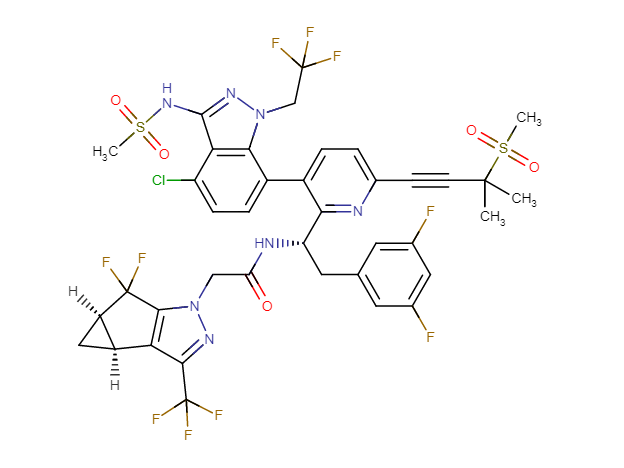
Drug structure
Scale-up and manufacturing prospects
Compound is commercially manufactured.
Equipment: Stainless steel pharmaceutical reactors, glass-lined reactors, rotary evaporator (rotovap), flash chromatography columns, stainless steel autoclave, cooling bath, silica gel chromatography columns, vacuum distillation apparatus, simulated moving bed chromatography system, Chiralpak columns.
Storage of injectable lenacapavir in borosilicate vials is contraindicated due to issues with chemical compatibility. Instead, it is recommended that vials are made from aluminosilicate glass.
Proton nuclear magnetic resonance (1H NMR), High-performance liquid chromatography (HPLC), Ultra-Performance Liquid Chromatography (UPLC).
Excipients & delivery device(s)
No proprietary excipient used
No novel excipient or existing excipient used
No residual solvent used
No delivery device
Safety, Efficacy and Evidence Summary
(1) Injection-site reactions (ISR) occurred in 65% of treated patients, and nausea occurred in 4%. (2) Among patients with ISR, the most common reactions were swelling (36%), pain (31%), erythema (31%), nodule (25%), induration (15%), pruritus (6%), extravasation (3%), and mass (3%). (3) 96% of adverse drug reactions were mild to moderate.
(1) After 52 weeks of SUNLENCA SC adminstration, 83% of the participants has HIV-1 RNA < 50 copies/mL. (2) Mean viral load was SUNLENCA SC - 1.93 log10 copies/mL Vs Placebo - 0.29 log10 copies/mL
Clinical studies of Lenacapavir six monthly SC injection indicate that the adverse events were mild - moderate with injection site reaction being the common ADR. In addition to that, LEN has demonstrated highly significant antiviral activity (83%) after 52 weeks of treatement. Overall, these findings indicate favourable risk benefit profile.