Type of technology
Silica microparticles; silica hydrogel; silica microparticles and silica hydrogel composite,, Biodegradable monolithic solid silica implant, Inorganic nanoparticles
Administration route
Subcutaneous, Intra-articular, intratumoral, intraocular, intrathecal and transtympanic, Intra-vitreal, Intramuscular, intratumoral, intraocular, intrathecal and transtympanic
Development state and regulatory approval
Entecavir (ETV)
Pre-clinical
No
Description
Long-acting injectables (parenteral administration) and topical eye drops drug delivery technology where the active substance is embedded and released in controlled manner from a biodegradable silica microparticle-silica hydrogel composite material, with release period tunable from a day to several weeks, months up to a year.
Developer(s)

DelSiTech
DelSiTech is the world technology leader in advanced biodegradable silica based controlled release materials
Technology highlight
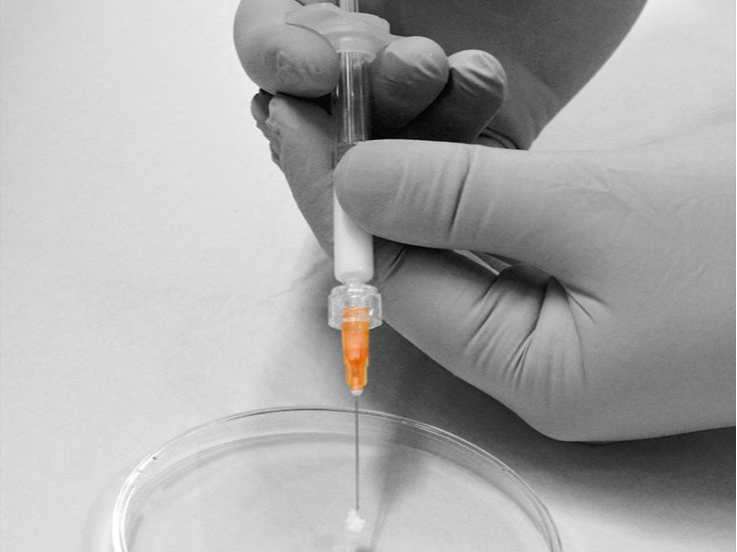
DelSiTech Silica Matrix long-acting drug delivery technology is adaptable to any therapeutic agents: from small molecules to peptides and complex biologics. The technology is compatible with high API loading, but also with poorly or highly soluble molecules. True controlled release that can be tuned from days up to a year, following zero-order release profile with no or limited burst release. The final dosage form is a ready to use prefilled syringe with 24 to 30G needle. Silica microparticle-silica hydrogel depot can be easily removed as one piece in case of adverse effects. With eyedrops the release can be adjusted from 24 to 48 hours with stable API concentration even overnight with a single drop.
Illustration(s)
Technology main components
The formulation contains only one main excipient silica (SiO2). in addition, WFI (water for injection), and pH controlling agents (in the hydrogel component).
Tetraethyl orthosilicate (TEOS) the silica precursor is widely available material used for various application.
Safety, Efficacy and Evidence Summary
Silica is inert, non-toxic and completely bio-dissolvable. The main degradation product is soluble silicic acid that is a natural component of the body. Silica is accepted for topical use and tox tolerability data available for injectables.
Not provided
Not provided
Not provided
APIs compatibility profile
Not provided
Not provided
APIs are stable in solid silica microparticles. There is no chemical/biological interaction with the Silica nor with external environment.
30-50 wt%
2 different APIs : No technical limits.
Not provided
Scale-up and manufacturing prospects
Spray-drying process is highly scalable process and widely used.
Mixer and pumping prior spray drying. Spray drying equipment. Fill and finish equipment
Normal manufacturing requirements for spray drying and aseptic fill and finish.
HPLC equipment, capability to perform immunoassays and the appropriate detection equipment required by the API. Dynamic light scattering (DLS) instrument for particle size distribution. Dissolution for release characteristics in water bath in shaking. Silica measurement with microwave plasma-atomic emission spectroscopy (MP-AES) or with spectrophotometric measurements. Rheometric analysis (oscillation and rotation), manual injectability and injection force measurement. SEM analysis for visualizing the particles. NMR for measuring silica condensation.
Excipients & delivery device(s)
No proprietary excipient used
Can be determined with a partner. Can be introduced during clinical studies.
No residual solvent used
No delivery device
Additional features
- Biodegradable
- Single-use
- Room temperature storage
- Monolithic
- Removable
- Other(s)
+4 to +8 degrees Celsius storage may be needed in some cases
Release time is adjustable: as fast as one day or as slow as one year. The release is based on surface erosion mechanic.
Silica microparticles-hydrogel depot has shear thinning properties and can be used with pain-free needles up to 30G.
The APIs is homogeneously dispersed and encapsulated in inert solid silica microparticles, maintaining high chemical stability and biological activity for the APIs
Room-temperature storage if encapsulated drug does not require refrigeration
Therapeutic area(s)
- Diabetes
- HBV
- Contraception
- Other(s) : "Ophthalmology (topical and parenteral delivery), infectious diseases, autoimmune disease, CNS, women´s health, hormone deficiency, vaccines, abuse deterrence & viral vectors"
- Multipurpose technology : "Possible to combine multiple APIs from poorly/highly soluble small molecules to sensitive biologics like antibodies and RNA."
- Malaria
- HIV
- Pain management (incl. joints, lower back, knee)
- Oncology
- Disease agnostic
- Pre-Exposure Prophylaxis (PrEP)
- Treatment
Potential associated API(s)
- Entecavir (ETV)
- Immunoglobulins
- Antivirals for systemic use , Cabotegravir (CAB) , Dolutegravir (DTG) , Islatravir (ISL)
- Genito-urinary system and sex hormones , Levonorgestrel (LNG) , Etonogestrel (ENG) , Oxytocin , Testosterone (T)
- Glucocorticoids , Dexamethasone
- Analgesics , Fentanyl , hydrocodone
- Antiparasitic products , Pyrimethamine , Antimalarials , Proguanil
- Drugs used in diabetes , Glucagon-like peptide-1 (GLP-1) analogues and associated (GLP-1)
- Musculo-skeletal system , Meloxicam
Use of technology
- Administered by a community health worker
- Administered by a nurse
- Administered by a specialty health worker
- To be determined
- Self-administered
Daily, Weekly, Monthly, Every 6 months, Yearly, Every 2 months
Targeted user groups
- Adults
- All
- Male
- Female
- Cisgender female
- Cisgender male
- Transgender female
- Transgender male
- Intersex
- Gender non-binary
Yes
Yes
Yes
Those who would benefit from longer dosing intervals or for whom adherence to current treatment might be challenging.
Entecavir (ETV)
antiviral
Pre-clinical
Not provided
Hepatitis B treatment
People living with hepatitis B chronic infection
2 months
No
Immunoglobulins
Monoclonal antibody
Pre-clinical
Not provided
HIV PrEP
Individuals at risk of contracting HIV
To be determined
-
Antivirals for systemic use , Cabotegravir (CAB) , Dolutegravir (DTG) , Islatravir (ISL)
Dolutegravir, cabotegravir, islatravir etc.
Pre-clinical
Not provided
HIV treatment and/or prevention
To be determined
To be determined
-
Genito-urinary system and sex hormones , Levonorgestrel (LNG) , Etonogestrel (ENG) , Oxytocin , Testosterone (T)
levonorgestrel, etonogestrel, testosterone, oxytocin, etc.
Not provided
Not provided
Not provided
Not provided
Not provided
Not provided
Glucocorticoids , Dexamethasone
Dexamethasone etc.
Not provided
Not provided
Not provided
Not provided
Not provided
Not provided
Analgesics , Fentanyl , hydrocodone
Hydrocodone, fentanyl etc.
Not provided
Not provided
Not provided
Not provided
Not provided
Not provided
Antiparasitic products , Pyrimethamine , Antimalarials , Proguanil
Pyrimethamine, proguanil etc
Pre-clinical
Not provided
Malaria treatment and/or prophylaxis
Not provided
to be determined
-
Drugs used in diabetes , Glucagon-like peptide-1 (GLP-1) analogues and associated (GLP-1)
GLP-1 receptor agonist
Not provided
Not provided
Not provided
Not provided
Not provided
Not provided
Musculo-skeletal system , Meloxicam
Not provided
Pre-clinical
Not provided
Targets post-operative pain management in cats
**Animal health**
Anticipated: release of meloxicam for 3 to 5 days after a single subcutaneous injection
-