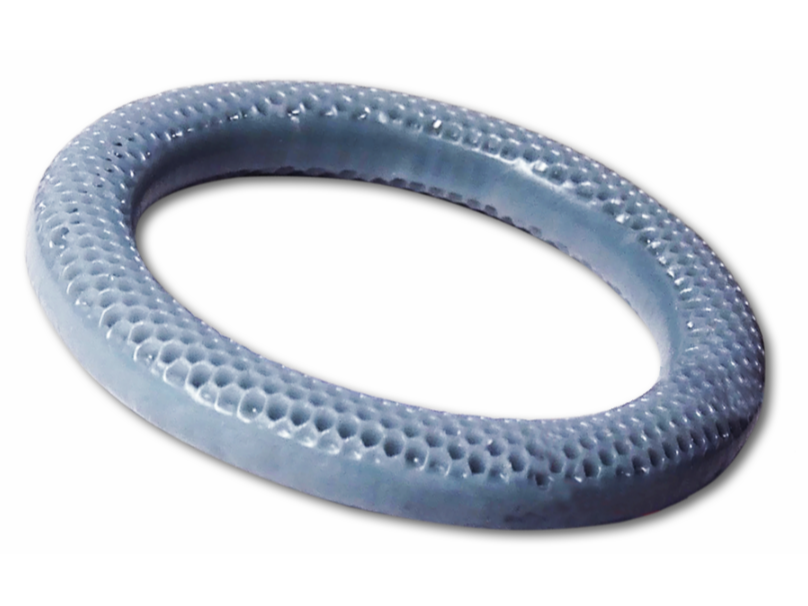
Technology name
Last update: Jul 20263D printed intravaginal rings
Developer(s)

Type of technology
Intra-vaginal ring
Administration route
Topical (Vaginal)
Development state and regulatory approval
Etonogestrel (ENG)
Pre-clinical
Not provided
Description
The 3D-printed intravaginal ring (IVR) represents a non-invasive, self-administered technology designed to provide localized, controlled drug release. This innovative device allows for the combination of various active pharmaceutical ingredients (APIs) within a single dosage form. Fabricated using a two-part silicone polyurethane resin (Silicone urethane from Carbon Inc.), the 3D IVR is capable of delivering drugs over an extended period of 8–10 weeks. The intricate geometries of the 3D-printed IVR enable precise and controlled drug release kinetics, enhancing its efficacy and reliability.
Developer(s)

AnnelleO
Anelleo, Inc. is located in Chapel Hill, North Carolina. Current support and funding is provided by NIH-NICHD (Phase I STTR) and strategic partners (Carbon, Inc. & undisclosed pharma partnerships) to allow AnelleO to complete prototyping, preclinical studies, and IND-enabling studies.
Technology highlight
1) Self-administration: The IVR can be easily administered by the user, enhancing convenience and compliance. 2) Initial Burst Release: Upon administration, the IVR provides an initial burst release of 15% of the API. 3) Customizable Structure: The IVR can be tailored based on shape, size, volume, API loading capacity, and surface area to meet specific therapeutic needs. 4) Low Systemic Toxicity: The localized drug delivery system minimizes systemic toxicity. 5) Controlled Pharmacokinetics: The IVR is designed to deliver drugs with controlled pharmacokinetics, ensuring sustained release rate. 6) Dual API Delivery: The IVR has the potential to deliver two different APIs simultaneously, each with its own distinct release rate.
Illustration(s)
Technology main components
1) Two part Polyurethane resin 2) 0.01 %wt Rhodamine 3) Pore forming agent (Eg: PEG 3000; PEG 6000; PEG 8000; Hydroxy cellulose; PVA 10000; PVA 10000) 4) Plasticizer 5) Stabilizer 6) Filler 7) API (added during or after 3D printing)
The polyurethane material and the three dimensional printing technology is obtained from Carbon Inc.
Safety, Efficacy and Evidence Summary
Mild neutrophil infiltrates were observed in animals treated with intravaginal rings containing hormones; however, no other toxicity was detected.
Not provided
Not provided
Not provided
APIs compatibility profile
Both hydrophobic and hydrophilic small molecules are suitable for Intravaginal ring (IVR), however molecules must be able to withstand the heat and pressure of the manufacturing process. The selected pharmacological classes of interest encompass antivirals, antiretrovirals, microbicides, contraceptives, antibiotics, and hormones.
The IVR formulation is designed to target macromolecular drugs, including dendrimers, biopharmaceuticals, chemotherapeutics, and biologics (e.g., antibodies, peptides).
Not provided
Not provided
75-90 wt%
1 single API :
Min: -1 Max: 5
Scale-up and manufacturing prospects
The manufacturing of IVR is multistep process which limits the scalability of these 3D printed IVRs in time and cost efficient process.
1) Hot melt extrusion - Single/ Twin Screw Extruder 2) Injection Molding - Injection Molding machine (Injection unit and clamping Unit)
The fabrication of the IVR involves either hot melt extrusion or injection molding, requiring at least 3-4 steps to complete the process. Key manufacturing considerations include: 1) The API must be miscible in the melted polymer. 2) The API must remain stable and not undergo phase separation upon cooling. 3) The API must withstand high temperatures, specifically 120°C at 90 psi for injection molding and 150-160°C for hot melt extrusion.
1) Environmental Scanning Electron Microscope (ESEM) 2) Fluorescence Microscope 3) Carbon CLIP Printer 4) Instron 5566 Universal Test System and 100N load cell 5) High Performance Liquid Chromatography (HPLC)
Excipients & delivery device(s)
No proprietary excipient used
No novel excipient or existing excipient used
No residual solvent used
No delivery device
Additional features
- Drug-eluting
- Removable
- 3d-printed
- Molded
- Reservoir-type
In vitro studies conducted on animal models have demonstrated that the release of the drugs was sustained over a period of 150 days, with all drugs exhibiting a minimal burst release within the first 24 hours. Furthermore, the release kinetics varied significantly between hydrophilic drugs, such as islatravir, and hydrophobic drugs, such as hormones.
This formulation is non-injectable.
Not provided
Not provided
Therapeutic area(s)
- HIV
- Contraception
- Other(s) : "Prevention of STD like HSV, HPV and other infections such as UTI, cystitis, chlamydia. Other indications are hormone replacement therapy, infertility, and other women health conditions."
- Pre-Exposure Prophylaxis (PrEP)
- Treatment
Potential associated API(s)
- Etonogestrel (ENG)
- Ethinylestradiol (EE)
- Islatravir (ISL)
- Dapivirine (DPV)
- Levonorgestrel (LNG)
Use of technology
- Self-administered
Weekly, Monthly
Targeted user groups
- Adults
- Older Adults
- Female
- Cisgender female
- Transgender female
Unspecified
Unspecified
Unspecified
Not provided
Etonogestrel (ENG)
Synthetic Progestrone
Pre-clinical
Not provided
Hormone replacement therapy
Not provided
Once monthly
Not provided
Ethinylestradiol (EE)
Synthetic estrogen
Pre-clinical
Not provided
Hormonal replacement therapy
Not provided
Once monthly
Not provided
Nucleoside Reverse Transcriptase Translocation Inhibitor
Pre-clinical
Not provided
HIV
Not provided
Once monthly
Not provided
Non-nucleoside Reverse transcriptase inhibitors
Pre-clinical
Not provided
HIV
Not provided
Once monthly
Not provided
Levonorgestrel (LNG)
Synthetic progestogen
Pre-clinical
Not provided
Contraceptive
Not provided
Once monthly
Not provided