Drug name
Last update: Oct 2026Dapivirine (DPV)
Developer(s)
Drug information
Not provided
Dapivirine
Not provided
Small molecule
NNRTI (Non-Nucleoside Reverse Transcriptase Inhibitor) — NNRTI
Active / In Development (Phase 1/2/3)
Dapivirine (DPV) is a diarylpyrimidine non-nucleoside reverse transcriptase inhibitor (NNRTI) marketed as a monthly intravaginal silicone ring for the prevention of HIV-1 infection. NNRTIs function by mechanistically binding to the HIV reverse transcriptase enzyme, thereby inhibiting viral replication. Other topical microbicide formulations of dapivirine include film and gel products that are applied directly to the rectum and/or vagina to prevent the sexual transmission of HIV. Long-acting DPV intravaginal rings are constructed from a malleable silicone elastomer matrix that releases DPV over a 28-day period. DPV intravaginal rings are self-inserted and provide women with a discreet HIV PrEP option that reduces the risk of HIV infection by 31-37% (IPM 027 & ASPIRE).
Dapivirine Vaginal Monthly Ring 25mg has received a positive opinion from European Union and it has received recommendation for its use outside EU. DVR has been approved as a HIV PrEP to reduce the risk of a woman getting infected with HIV-1 through vaginal intercourse in African countries such as South Africa, Zimbabwe, Malawi, Botswana, Zambia, Kenya, Uganda, Namibia, Rwanda, Eswatini and Lesotho. However, DVR has been rejected by United States and it is under clinical hold in United Republic of Tanzania.
Dapivirine Vaginal Ring 25mg monthly is a non-nucleoside reverse transcriptase inhibitor that was first approved by South African Health Products Regulatory Authority (SAHPRA) followed by other African regulatory bodies. DVR is indicated for use by cisgender women as a PrEP to reduce the risk of a woman getting infected by HIV-1 during vaginal intercourse.
Therapeutic area(s)
- HIV
- Pre-Exposure Prophylaxis (PrEP)
Administration route
Topical (Vaginal)
Associated long-acting platforms
Intra-vaginal ring
Use of drug
- Administered by a community health worker
- Administered by a nurse
- Self-administered
- Other/Variable/Unknown : once a month
Dosage
25 mg of dapivirine in the monthly ring
25 mg
Not provided
Not provided
Not provided
Related entries
3D printed intravaginal rings
Vaginal Film (MATRIX)
Dapivirine Monthly Vaginal Ring
Additional information
Developer(s)

Johnson & Johnson
Janssen Pharmaceuticals is a subsidiary company of Johnson & Johnson headquartered in Beerse, Belgium. They focus on manufacturing and developing pharmaceutical products for use in areas such as, Immunology, Infectious Diseases & Vaccines, Pulmonary Hypertension, Cardiovascular & Metabolism, Oncology, and Neuroscience.
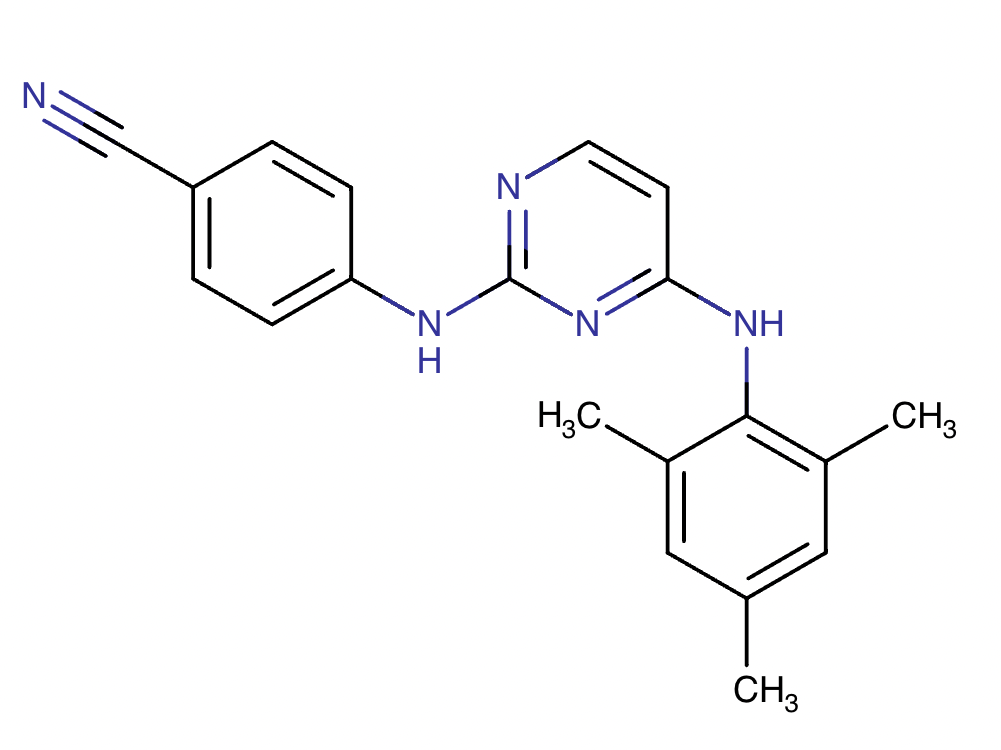
Drug structure
Scale-up and manufacturing prospects
DPV is manufactured commercially through a well-defined synthetic chemical process and undergoes a micronisation procedure to improve drug dispersion within the silicon intravaginal ring. The current DPV ring formulation (Ring-004) contains 25mg of micronised drug product and is produced with NuSil™ DDU-4870 silicone elastomer using addition-curing to prevent the formation of undesirable volatile alcohol by-products. This formulation provides high pharmacokinetic exposure with low overall manufacturing costs. Novel additive manufacturing techniques (e.g. APF) could provide new formulations.
For ring manufacture: Injection molding machine, mixer, automated inspection and packaging machines.
Manufacturing is a non-standard four stage workflow process: (1) preparation of the master batch, (2) pre-mix formation, (3) ring construction using injection addition-curing, and (4) packaging/inspection. For DPV Compound: stability testing indicates that the chemical compound can be stored for up to 6 months at 40ºC and 96 months at 25ºC in the pre-specified commercial packaging. DPV is photo-stable. For Finished Ring Product: stability testing shows that the product can be stored for 48 months at 30ºC. The DPV ring product is photosensitive and should be stored away from light sources.
For DPV Compound: HPLC (determine chemical purity), GC (residual solvents), laser diffraction (determine particle size), Karl Fischer titration (determine water content) and FT-IR & DSC (chemical identification). For Finished Ring Product: HPLC (determine dissolution, content uniformity and degradation products), compression testing machine (determine tensile and compression properties).
Excipients & delivery device(s)
DDU-4870 is a silicon elastomer product manufactured by NuSil™ Technology Inc. (Carpinteria, CA, USA). In 2016, NuSil Technology, Inc. merged with Avantor.
The novel excipient DDU-4870 is used in the final Ring-004 product formulation. DDU-4870 is contained and packaged within food-grade certified polyethylene pails, which have no effect on excipient quality. At room temperature (25ºC) DDU-4870 is estimated to maintain chemical stability for 12 months.
No residual solvent used
No delivery device
Safety, Efficacy and Evidence Summary
Not provided
Not provided
Not provided
Not provided