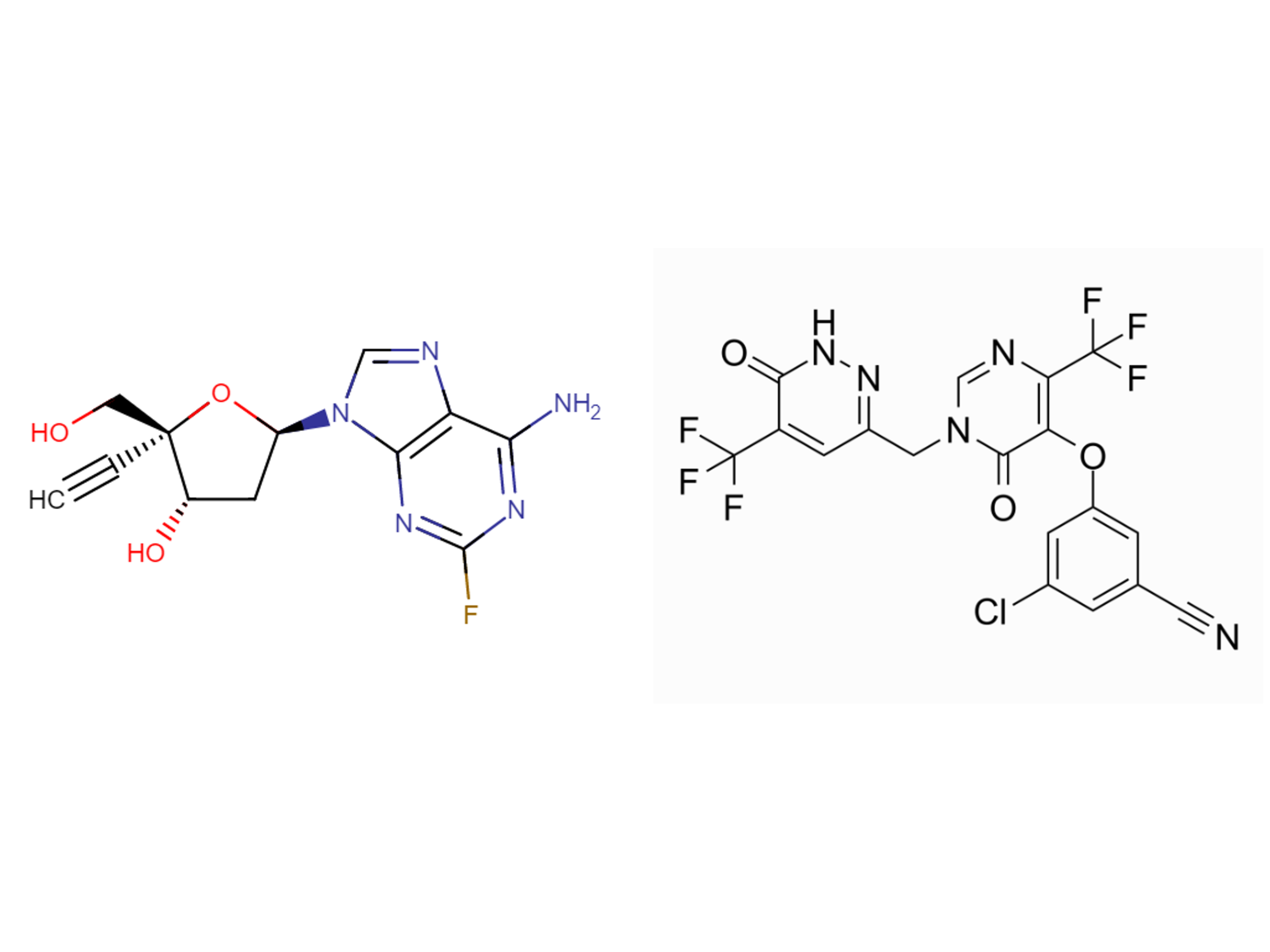
Drug name
Last update: Jul 2025Developer(s)
Not provided
Not provided
Not provided
Small molecule
NRTTI+NNRTI
Not provided
Unknown
Unknown
Oral
Oral solid form
Not provided
Not provided
Not provided
Not provided
Not provided
Not provided
Not provided
Not provided
Not provided
Not provided
Not provided
Not provided
Not provided
Not provided
No delivery device
Matthews RP, Patel M, Liu W, Liu Y, Rondón JC, Vargo RC, Stoch SA, Iwamoto M.2025.
Pharmacokinetics of islatravir in participants with moderate hepatic impairment.
Antimicrob Agents Chemother69:e01553-24.https://doi.org/10.1128/aac.01553-24
Islatravir (ISL) is a nucleoside reverse transcriptase translocation inhibitor in development for the treatment of HIV-1 infection. People living with HIV are at risk of liver disease. ISL is metabolized by adenosine deaminase (ADA), which is expressed in the liver; thus, ISL pharmacokinetics (PK) may be affected by hepatic impairment. This study evaluated the effect of moderate hepatic impairment on ISL PK. This nonrandomized, open-label, phase 1 study (MK-8591-030) evaluated the effects of a single oral dose of ISL 60 mg in HIV-seronegative adults with moderate hepatic insufficiency (n = 6) and matched healthy adult participants (n = 6). Blood samples for plasma ISL and 4′-ethynyl-2-fluoro-2′deoxyinosine (M4) and peripheral blood mononuclear cell (PBMC) ISL-triphosphate (ISL-TP) were collected at multiple time points through 672 h, and safety was monitored throughout. Modest decreases in maximum measured concentration (Cmax) and area under the concentration-time curve (AUC) of plasma ISL and AUC of PBMC ISL-TP were observed in participants with moderate hepatic impairment versus matched healthy participants, while ISL-TP Cmax was relatively unchanged. In contrast, plasma M4 was modestly increased in the moderate hepatic impairment group, suggesting that hepatic impairment may result in increased metabolism of ISL to M4 via ADA. The clinical relevance of the overall modest changes in M4, ISL, and ISL-TP levels with moderate hepatic impairment will be contextualized once exposure response data from ongoing clinical studies are available to elucidate the thresholds for clinical efficiency. A single oral dose of ISL 60 mg was generally well tolerated in both groups.
Schürmann D, Jackson Rudd D, Schaeffer A, et al. Single Oral Doses of MK-8507, a Novel Non-Nucleoside Reverse Transcriptase Inhibitor, Suppress HIV-1 RNA for a Week. J Acquir Immune Defic Syndr. 2022;89(2):191-198. doi:10.1097/QAI.0000000000002834
Background: MK-8507 is a novel HIV-1 non-nucleoside reverse transcriptase inhibitor being developed for treatment of HIV-1 infection. MK-8507 has high antiviral potency in vitro and pharmacokinetic (PK) properties that support once-weekly dosing.
Setting: A phase 1, open-label, proof-of-concept study was conducted in treatment-naive adults with HIV-1 infection to assess monotherapy antiviral activity.
Methods: In 3 sequential panels, participants aged 18-60 years with baseline plasma HIV-1 RNA ≥10,000 copies/mL and CD4+ T-cell count >200/mm3 received a single oral dose of 40, 80, or 600 mg MK-8507 in the fasted state. Participants were assessed for HIV-1 RNA for at least 7 days, PKs for 14 days, and safety and tolerability for 21 days postdose.
Results: A total of 18 participants were enrolled (6 per panel). The mean 7-day postdose HIV-1 RNA reduction ranged from ∼1.2 to ∼1.5 log10 copies/mL across the doses assessed. One patient had a viral rebound associated with emergence of an F227C reverse transcriptase variant (per chain-termination method sequencing) 14 days postdose; this variant was found in a second participant by ultra-deep sequencing as an emerging minority variant. MK-8507 PKs were generally dose-proportional and similar to observations in participants without HIV-1 infection in prior studies; mean MK-8507 half life was 56-69 hours in this study. MK-8507 was generally well tolerated at all doses.
Conclusions: The robust antiviral activity, PK, and tolerability of MK-8507 support its continued development as part of a complete once weekly oral regimen for HIV-1 treatment; combination therapy could mitigate the emergence of resistance-associated variants.
Ankrom W, Jackson Rudd D, Schaeffer A, et al. Pharmacokinetic and Safety Profile of the Novel HIV Nonnucleoside Reverse Transcriptase Inhibitor MK-8507 in Adults without HIV. Antimicrob Agents Chemother. 2021;65(12):e0093521. doi:10.1128/AAC.00935-21
MK-8507 is a novel HIV-1 nonnucleoside reverse transcriptase inhibitor in clinical development with potential for once-weekly oral administration for the treatment of HIV-1 infection. Two randomized, double-blind, placebo-controlled phase 1 studies in adults without HIV-1 evaluated the safety, tolerability, and pharmacokinetics of single and multiple doses of MK-8507; drug interaction with midazolam (a cytochrome P450 3A4 substrate) and food effect were also assessed. In study 1, 16 participants received oral ascending single doses of MK-8507 (2 to 400 mg) or placebo in an alternating fashion. In study 2, 24 participants received ascending single doses of MK-8507 (400 to 1,200 mg) or placebo and multiple doses (once weekly for 3 weeks) of MK-8507 (100 to 400 mg) or placebo. MK-8507 pharmacokinetics were approximately dose proportional at 2 to 1,200 mg. MK-8507 had a time to maximum concentration of 2 to 7 h and a mean terminal half-life of ∼58 to 84 h. MK-8507 doses of ≥100 mg achieved a plasma concentration at 168 h postdose (7 days) associated with antiviral efficacy. A high-fat meal had no clinically meaningful effect on MK-8507 pharmacokinetics, and MK-8507 400 mg once weekly had no clinically meaningful effect on midazolam pharmacokinetics. Single and multiple doses of MK-8507 were generally well tolerated. No trends with dose and no clinically meaningful changes were observed in vital signs, electrocardiograms, and laboratory safety tests. The pharmacokinetics and safety data are supportive of once-weekly oral administration and support further clinical investigation of MK-8507 for the treatment of HIV-1 infection.
Gillespie G, Jackson Rudd D, Zhang S, et al. Fluoride Pharmacokinetics in Urine and Plasma Following Multiple Doses of MK-8507, an Investigational, Oral, Once-Weekly Nonnucleoside Reverse Transcriptase Inhibitor. J Clin Pharmacol. 2022;62(2):199-205. doi:10.1002/jcph.1957
MK-8507 is an investigational HIV-1 nonnucleoside reverse transcriptase inhibitor being developed for the treatment of HIV-1 infection. MK-8507 contains 2 trifluoromethyl groups that may result in fluoride release through metabolism, but the extent of MK-8507-related fluoride release in humans has yet to be determined. This double-blind, placebo-controlled, 2-period, parallel-group, multiple-dose trial in healthy participants without HIV-1 who were administered a fluoride-restricted diet and once-weekly doses of MK-8507 aimed to estimate the relationship between MK-8507 dose and fluoride exposure. A total of 15 adult male and 3 adult female (of non-childbearing potential) participants were randomized to receive MK-8507 200 mg (n = 6), MK-8507 800 mg (n = 6), or placebo (n = 6). Change from baseline in mean daily fluoride excretion averaged over 7 days following the administration of MK-8507 200 mg resulted in a net mean increase of 19.8 μmol (90% confidence interval, 12.2-27.4) relative to placebo and did not exceed 57 μmol, a threshold related to the mean difference between the daily reference dose set by the US Environmental Protection Agency and the average dietary fluoride intake in the United States. However, daily urinary fluoride excretion exceeded the threshold following administration of 800 mg MK-8507 (75.1 μmol [90% confidence interval, 67.5-82.7]). Assuming a linear relationship between MK-8507 dose and estimated mean daily fluoride released at steady-state, data interpolation suggests that the US Environmental Protection Agency reference dose for fluoride would not be exceeded in most patients when administering MK-8507 at doses currently under clinical investigation (≤400 mg once weekly).
Consider on a case by case basis, collaborating on developing long acting products with potential significant public health impact, especially for low- and middle-income countries (LMICs), utilising the referred to long-acting technology
Provide necessary technical information to a potential partner, under confidentiality agreement, to enable preliminary assessment of whether specific medicines of public health importance in LMICs might be compatible with the referred to long-acting technology to achieve a public health benefit
In the event that a product using the referred to long-acting technology is successfully developed, the technology IP holder(s) will work with the Medicines Patent Pool towards putting in place the most appropriate strategy for timely and affordable access in low and middle-income countries, including through licensing