Drug name
Last update: Oct 2026Islatravir MAPs
Developer(s)
Drug information
Islatravir (MK-8591) Dissolving Microarray Patch (MAP)
Not applicable (investigational; no brand name assigned)
Small molecule
NRTTI (Nucleoside Reverse Transcriptase Translocation Inhibitor)
Preclinical / IND
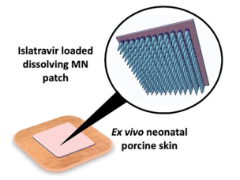
Islatravir-loaded dissolving microarray patch (MAP) for HIV-1 prevention or treatment, developed by QUB, with MSD funding. Islatravir crystalline drug is concentrated in the obelisk-shaped needle tips (polyvinyl alcohol/polyvinylpyrrolidone matrix, up to 87% total solids) on a dissolving PVP/glycerol baseplate. The lead formulation (F1) holds about 5.8 mg per 0.36 cm2 patch (16 x 16 needles); a scaled-up patch holds 25.5 mg per 1.76 cm2 (1,110 needles). Ex vivo (neonatal porcine skin): needles inserted to about 550 µm; the needle layer dissolved within 2 hours, leaving intradermal micro-depots. Franz cell delivery efficiency was around 46%. Rats (4 small MAPs, 24-hour wear): islatravir remained detectable in plasma for 3 months, with a pseudo-steady-state release rate of about 10 µg/day after an initial burst. Dose-normalised Cmax was about 10-fold lower than an intramuscular islatravir suspension (0.015 vs 0.157). Overall delivery was low and variable: 11.1% +/- 10.2% of the patch dose was cumulatively detected in plasma. Minipigs (10 large MAPs per animal): 24-hour wear delivered <1% of the dose; 48-hour wear delivered 6 to 57%.
The islatravir MAP is in preclinical development and is not approved in any jurisdiction. No clinical trial of this formulation was identified (October 2026). Islatravir itself is being developed in oral once-weekly combinations for HIV treatment, and is approved with doravirine for daily oral treatment of HIV.
Unknown
Therapeutic area(s)
- HIV
- Pre-Exposure Prophylaxis (PrEP)
- Treatment
- Prevention
Administration route
Transdermal
Associated long-acting platforms
Transdermal patch
Use of drug
- Administered by a community health worker
- Administered by a nurse
- Administered by a specialty health worker
- Self-administered
- Weekly
- Monthly
- Other/Variable/Unknown : To be determined
To be determined. No human data. The development rationale is avoidance of injection-site pain and reduced clinic burden. Factors likely to affect acceptability include a projected 20 cm2 patch size and a wear time of at least 48 hours (based on minipig data).
Dosage
Preclinical only. Small MAP (0.36 cm2, 256 needles): about 5.8 mg islatravir (F1). Large MAP (1.76 cm2, 1,110 needles): 25.5 mg. Projected human product: 322 mg in a 20 cm2 MAP.
Not established. Highest modelled human dose: 322 mg per 20 cm2 MAP (projection only).
Not established in humans. Animal regimens: rats, 4 small MAPs applied by thumb pressure, worn 24 hours; minipigs, 10 large MAPs on abdominal skin along the ribcage, worn 24 or 48 hours. Projected human use: a single 20 cm2 application about once a month.
Single Agent / Monotherapy
Wear time seems critical: in minipig skin the needle tips needed at least 48 hours to dissolve, and 24-hour wear delivered <1% of the dose. Inter-animal variability was high (up to about one order of magnitude in rat plasma levels). The authors note that higher islatravir doses have been associated with decreases in lymphocyte and CD4+ T-cell counts in clinical studies, so the projected 322 mg dose and its exposure profile will need safety evaluation.
Not provided
Related entries
MK-8591B (islatravir + ulonivirine)
MK-8591D (Islatravir and Lenacapavir)
Additional information
Developer(s)

Queen's University Belfast
The School of Pharmacy at Queen's University Belfast (Northern Ireland) hosts Professor Ryan Donnelly's microneedle group, which designed, fabricated and characterised the islatravir MAPs and ran the rat studies. The group also originated the dissolving microarray patch technology listed in LAPaL.

Merck/MSD
Merck & Co., Inc., Rahway, NJ, USA, is the developer of islatravir. Merck Sharp & Dohme LLC funded this work; Merck scientists co-designed the study, ran the intramuscular comparator and bioanalysis, and built the human dose projections. Minipig studies were run at Labcorp Early Development Limited.
Drug structure
Scale-up and manufacturing prospects
Scaled from a 0.36 cm2 patch (256 needles, 5.8 mg) to a 1.76 cm2 patch (1,110 needles, 25.5 mg) with constant drug mass per needle and retained mechanical strength (<10% needle height reduction under 32 N). The projected human product is a 20 cm2 patch (322 mg), comparable in area to marketed transdermal patches (Nicotinell 30 cm2; Duragesic 32 to 42 cm2). Production has been at laboratory scale only; the authors note that no MAP product has yet been marketed, largely because of manufacturing, quality-system and regulatory challenges.
• SpeedMixer DAC 150.1 FVZ-K (Hauschild) for drug-polymer blending • Silicone micromoulds (16 x 16 obelisk needles, 850 µm height, 300 µm base width, 300 µm interspacing; larger mould 1,110 needles, 100 µm interspacing) • Positive-pressure chamber (5 bar; Protima) • Centrifuge (3,500 rpm) for baseplate casting • Drying oven (37 to 37.5 °C) • 3D-printed MAP storage box, aluminium foil pouches and desiccant canisters for packaging
Double-casting method. (1) Needle layer: islatravir blended with an aqueous PVA/PVP solution (SpeedMixer, 3,000 rpm for 3 min), diluted with deionised water and mixed again; cast into silicone moulds; 5 bar pressure for 3 min to fill cavities; excess removed; a further 30 min at 5 bar; silicone ring fixed with 40% w/w PVA; air-dried 24 h at room temperature. (2) Baseplate: 850 µL of PVP/glycerol formulation cast on top, centrifuged at 3,500 rpm for 15 min, dried 24 h at 37.5 °C. Five tip formulations (F1 to F5) differing in drug and polymer content were made
• HPLC-UV (Agilent 1220 Infinity; Waters H-Class) with XBridge C18 column for drug content and impurities • LC-MS/MS (Sciex API 6500/6500+) for plasma and skin bioanalysis • Powder X-ray diffraction (Bruker D8 Advance) for crystallinity • Scanning electron microscopy (Hitachi TM3030) and stereo microscopy (Leica EZ4 D) • Optical coherence tomography (Michelson Diagnostics EX-101) for insertion depth • Texture analyser (Stable Micro Systems TA-XT2) for mechanical strength • Franz diffusion cells (PermeGear) for ex vivo delivery
Excipients & delivery device(s)
Not provided
Not provided
Not provided
Not provided
Safety, Efficacy and Evidence Summary
Not provided
Not provided
Not provided
Not provided
There are either no relevant patents or these were not yet submitted to LAPaL