
|
Developed by
|
Supported by
|
|
Queen's University Belfast Originator
https://www.qub.ac.uk/schools/SchoolofPharmacy/
United Kingdom The School of Pharmacy at Queen's University Belfast (Northern Ireland) hosts Professor Ryan Donnelly's microneedle group, which designed, fabricated and characterised the islatravir MAPs and ran the rat studies. The group also originated the dissolving microarray patch technology listed in LAPaL. |

|
Merck/MSD Originator
https://www.merck.com/
United States Merck & Co., Inc., Rahway, NJ, USA, is the developer of islatravir. Merck Sharp & Dohme LLC funded this work; Merck scientists co-designed the study, ran the intramuscular comparator and bioanalysis, and built the human dose projections. Minipig studies were run at Labcorp Early Development Limited. |

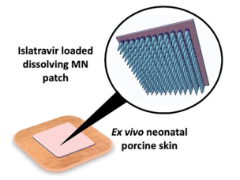
Insertion and dissolution of islatravir‐loaded MAPs in ex vivo neonatal porcine skin
Anjani et al., 2025
Transdermal patch
Transdermal
To be determined. No human data. The development rationale is avoidance of injection-site pain and reduced clinic burden. Factors likely to affect acceptability include a projected 20 cm2 patch size and a wear time of at least 48 hours (based on minipig data).
Preclinical only. Small MAP (0.36 cm2, 256 needles): about 5.8 mg islatravir (F1). Large MAP (1.76 cm2, 1,110 needles): 25.5 mg. Projected human product: 322 mg in a 20 cm2 MAP.
Not established. Highest modelled human dose: 322 mg per 20 cm2 MAP (projection only).
Not established in humans. Animal regimens: rats, 4 small MAPs applied by thumb pressure, worn 24 hours; minipigs, 10 large MAPs on abdominal skin along the ribcage, worn 24 or 48 hours. Projected human use: a single 20 cm2 application about once a month.
Single Agent / Monotherapy
Wear time seems critical: in minipig skin the needle tips needed at least 48 hours to dissolve, and 24-hour wear delivered <1% of the dose. Inter-animal variability was high (up to about one order of magnitude in rat plasma levels). The authors note that higher islatravir doses have been associated with decreases in lymphocyte and CD4+ T-cell counts in clinical studies, so the projected 322 mg dose and its exposure profile will need safety evaluation.
Not provided
Not provided
Scaled from a 0.36 cm2 patch (256 needles, 5.8 mg) to a 1.76 cm2 patch (1,110 needles, 25.5 mg) with constant drug mass per needle and retained mechanical strength (<10% needle height reduction under 32 N). The projected human product is a 20 cm2 patch (322 mg), comparable in area to marketed transdermal patches (Nicotinell 30 cm2; Duragesic 32 to 42 cm2). Production has been at laboratory scale only; the authors note that no MAP product has yet been marketed, largely because of manufacturing, quality-system and regulatory challenges.
• SpeedMixer DAC 150.1 FVZ-K (Hauschild) for drug-polymer blending • Silicone micromoulds (16 x 16 obelisk needles, 850 µm height, 300 µm base width, 300 µm interspacing; larger mould 1,110 needles, 100 µm interspacing) • Positive-pressure chamber (5 bar; Protima) • Centrifuge (3,500 rpm) for baseplate casting • Drying oven (37 to 37.5 °C) • 3D-printed MAP storage box, aluminium foil pouches and desiccant canisters for packaging
Double-casting method. (1) Needle layer: islatravir blended with an aqueous PVA/PVP solution (SpeedMixer, 3,000 rpm for 3 min), diluted with deionised water and mixed again; cast into silicone moulds; 5 bar pressure for 3 min to fill cavities; excess removed; a further 30 min at 5 bar; silicone ring fixed with 40% w/w PVA; air-dried 24 h at room temperature. (2) Baseplate: 850 µL of PVP/glycerol formulation cast on top, centrifuged at 3,500 rpm for 15 min, dried 24 h at 37.5 °C. Five tip formulations (F1 to F5) differing in drug and polymer content were made
• HPLC-UV (Agilent 1220 Infinity; Waters H-Class) with XBridge C18 column for drug content and impurities • LC-MS/MS (Sciex API 6500/6500+) for plasma and skin bioanalysis • Powder X-ray diffraction (Bruker D8 Advance) for crystallinity • Scanning electron microscopy (Hitachi TM3030) and stereo microscopy (Leica EZ4 D) • Optical coherence tomography (Michelson Diagnostics EX-101) for insertion depth • Texture analyser (Stable Micro Systems TA-XT2) for mechanical strength • Franz diffusion cells (PermeGear) for ex vivo delivery
Not provided
Not provided
Not provided
There are either no relevant patents or these were not yet submitted to LAPaL
Delivery of Islatravir via High Drug-Load, Long-acting Microarray Patches for the Prevention or Treatment of Human Immunodeficiency Virus.
Anjani QK, — Advanced Healthcare Materials — 2025-03-14
Link: https://advanced.onlinelibrary.wiley.com/doi/10.1002/adhm.202403615
This research focuses on developing and characterizing islatravir‐loaded dissolving microarray patches (MAPs) to provide an effective, minimally invasive treatment option for human immunodeficiency virus (HIV‐1) prevention and treatment. The research involves manufacturing these MAPs using a double‐casting approach, and conducting in vitro and in vivo evaluations. Results show that the MAPs have excellent needle fidelity, structural integrity, and mechanical strength. in vitro studies demonstrate that the MAPs can penetrate skin up to 580 µm and dissolve within 2 hours. Permeation studies reveal that the delivery efficiency of islatravir across the skin is around 40%. In rodent models, these dissolving MAPs sustain islatravir delivery for up to 3 months. Scaling up the MAPs and increasing drug loading produced detectable levels in minipig. Projections from animal data suggest that these dissolving MAPs can achieve effective islatravir levels for a month after a single application in humans. These findings indicate dissolving MAPs as a minimally invasive approach to sustained release of islatravir.
Evaluating Islatravir Administered Via Microneedle Array Patch for Long-Acting HIV Pre-exposure Prophylaxis Using Physiologically Based Pharmacokinetic Modelling
Hannah Kinvig — European Journal of Drug Metabolism and Pharmacokinetics — 2022-09-30
Link: https://link.springer.com/article/10.1007/s13318-022-00793-6
Technologies for long-acting administration of antiretrovirals (ARVs) for the prevention and treatment of HIV are at the forefront of research initiatives aiming to tackle issues surrounding drug adherence with the current standard of once-daily oral administration. Islatravir (ISL) is an emerging ARV that shows promising characteristics for long-acting prevention and treatment both orally as well as through alternative routes of administration. Microneedle array patches (MAPs) are a pain-free and discreet transdermal delivery technology that offer extended-release administration of nanoparticulate drugs. This study aimed to utilise physiologically based pharmacokinetic (PBPK) modelling to predict the pharmacokinetics resulting from ISL administered via MAP and to identify key MAP characteristics required to sustain effective concentrations over extended dosing intervals.
Methods
A PBPK model describing the conversion of ISL to ISL-triphosphate (ISL-TP) and its whole-body disposition was developed and verified against observed clinical data for orally administered ISL in healthy adults. An intradermal PBPK model was integrated with the ISL PBPK model to predict the dose and nanoparticle release rate required for MAP administration strategies capable of achieving a minimum ISL-TP target concentration of 0.05 pmol/106 PBMCs over extended dosing intervals. MAP design was limited to a maximum therapeutic area of 20 cm2 with a dose loading of 4.09 mg/cm2 and a minimum duration of 3 months. Due to the lack of available clinical data, a range of nanoparticle release rates and MAP bioavailability scenarios were simulated to provide an overview of potential clinical outcomes.
Results
The ISL PBPK model was successfully verified, with predicted vs observed ratios falling within 0.5–2-fold. ISL MAP doses ranging from 15 to 80 mg were predicted to sustain ISL-TP concentrations above the minimum target concentration at 3, 6 and 12 months after administration. Nanoparticle release rate and MAP bioavailability were found to have a major impact on whether dosing strategies achieved the criteria. Minimum doses of 15 mg and 60 mg with a nanoparticle release rate of 0.0005 h−1 and bioavailability ranging from 25 to 100% were predicted to achieve effective ISL-TP concentrations up to 3 and 6 months, respectively. Doses of 15 mg and 30 mg with a nanoparticle release rate of 0.0005 h−1 were also able to attain the target concentration up to 6 months after MAP administration, albeit with a minimum bioavailability of 75% and 50%, respectively. Furthermore, when simulating a bioavailability of 100%, an 80 mg ISL MAP was predicted to sustain ISL-TP concentrations above the minimum target concentration up to 12 months after administration.
Conclusions
The ISL PBPK model successfully predicted ISL and ISL-TP pharmacokinetics across a range of orally administered regimens. The integrated intradermal PBPK model outlined optimal MAP dose and nanoparticle release rates for effective ISL-TP concentrations up to 12 months, providing justification for further investigation of ISL as a candidate for MAP administration.
No documents were uploaded
There are no additional links