Drug name
Last update: Oct 2026VRC07-523LS (mAb) (TMB-380)
Drug information
VRS07-523LS; VRC-HIVMAB075-00-AB; TMB-380
Not applicable (investigational; no brand name assigned)
Biotherapeutic
mAb (Monoclonal antibody) — bNAb targeting gp120 on HIV-1 virus envelope
Active / In Development (Phase 1/2/3)
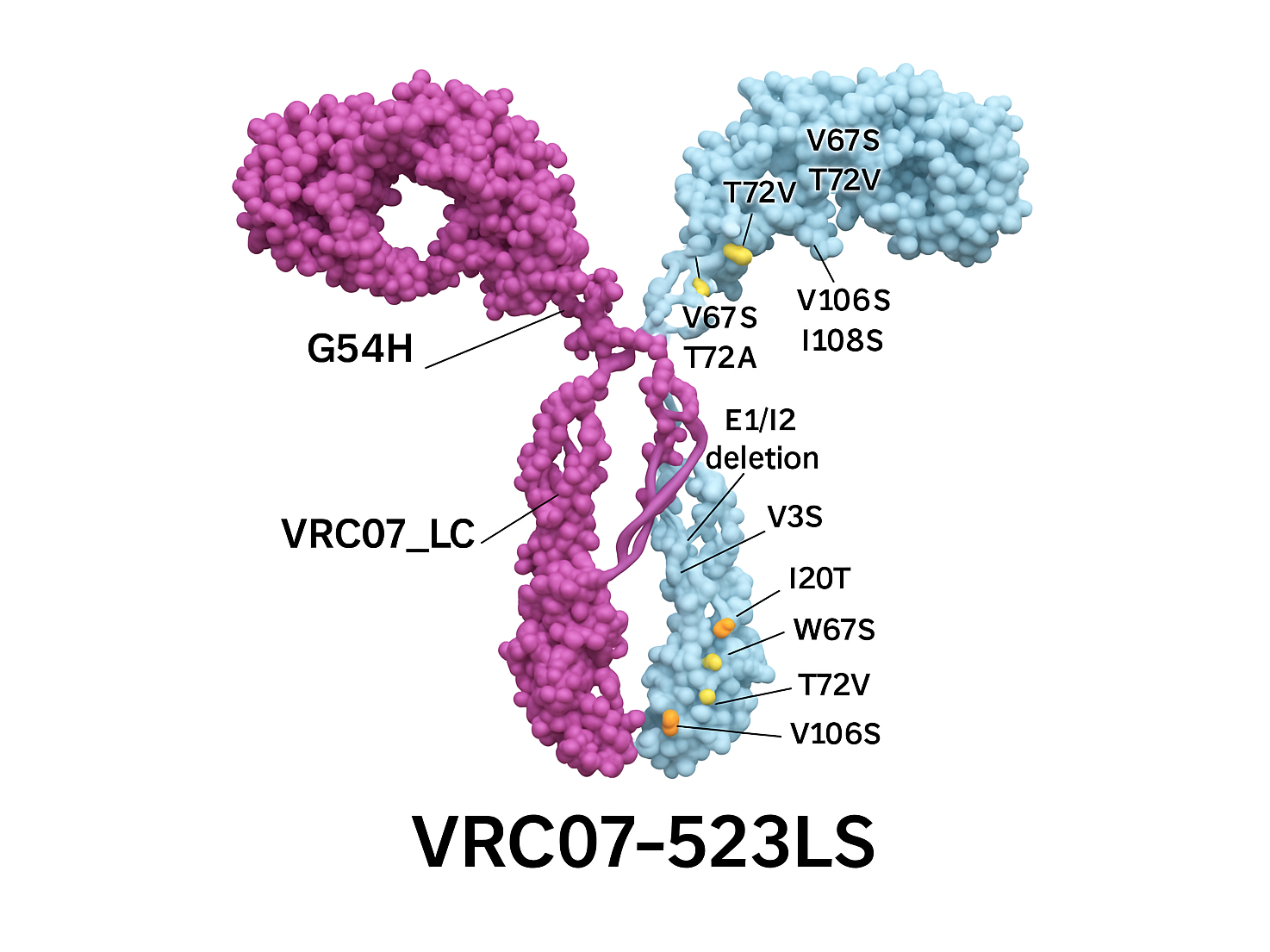
VRC07-523LS (VRC-HIVMAB075-00-AB; TMB-380) is a broadly neutralizing antibody (bNAb) engineered to target the CD4 binding site on HIV’s envelope protein gp120. It is a modified version of VRC01, with an LS mutation that extends its half-life, allowing less frequent dosing. Administered via IV, IM, SC, it has shown safety and tolerability in clinical trials. TaiMed develops TMB-380 as part of the antibody-only TMB-365/TMB-380 regimen at 4,800 mg IV every 8 weeks. VRC07-523LS is an engineered VRC01-class antibody with the LS Fc modification, neutralising 96% of strains at IC50 below 50 microgram/mL and 92% below 1 microgram/mL, with 5- to 8-fold greater potency than VRC01.
Not yet approved
Not yet approved
Therapeutic area(s)
- HIV
- Pre-Exposure Prophylaxis (PrEP)
- Treatment
Administration route
Intravenous, Subcutaneous, Intramuscular
Associated long-acting platforms
Monoclonal antibodies and antibody drug conjugates
Use of drug
- Administered by a nurse
- Administered by a specialty health worker
- Every 3 months
- Every 6 months
- Every 2 months
- Every 4 months
To be determined. In CAPRISA 012A (with PGT121), 86.7% of African women found two to three subcutaneous administrations per year acceptable for HIV prevention. Generally safe and well tolerated across phase 1 studies.
Dosage
Investigational: weight-based 5 to 40 mg/kg (5 mg/kg; 20mg/kg; 40mg/kg) IV or SC; fixed doses 400 mg to 3,200 mg IV; 1.2 g SC (CAPRISA 012C); 2,400, 3,200 and 4,800 mg IV (TaiMed programme).
40 mg/kg IV (phase 1); 4,800 mg IV fixed dose (as TMB-380)
No approved regimen. Examples: with CAB-LA (ACTG A5357); 1.2 g SC every 6 months with CAP256V2LS (CAPRISA 012C part B); 4,800 mg IV every 8 weeks with TMB-365 4,800 mg IV. ; VRC07-523LS 20 mg/kg IV Q12W- 3 doses ; VRC07-523LS 5 mg/kg SC Q12W- 3 doses
Not provided
Not provided
Related entries
Main compound
VRC01 (mAb)
Related compounds
VRC01.23LS (mAb)
VRC07-523LS (mAb) (TMB-380)
Additional information
Developer(s)
Vaccine Research Center, National Institute of Allergy and Infectious Diseases (NIAID)
The National Institute of Allergy and Infectious Diseases (NIAID) is a key institute within the National Institutes of Health (NIH) dedicated to advancing research on infectious, immunologic, and allergic diseases. Established over 60 years ago, NIAID conducts both basic and applied research aimed at improving understanding, diagnosis, treatment, and prevention of these diseases.

TaiMed Biologics
Drug structure
Scale-up and manufacturing prospects
Not provided
Bioreactors, incubators, filtration units, lyophilizers, and formulation vessels.
VRC07-5LS is a monoclonal antibody, and its production involves several key steps: VRC07-523LS is produced in a Chinese Hamster Ovary (CHO) DG44 cell line. Further information is not disclosed yet.
1. Bio-Plex Instrument (Bio-Rad) 2. Beckman Biomek Automation Platform 3. Surface-Plasmon-Resonance-(SPR)-Systeme 4. Dynamic Light Scattering, 5. Differential Scanning Calorimetry 6. Circular dichroism and isothermal chemical denaturation
Excipients & delivery device(s)
No proprietary excipient used
No novel excipient or existing excipient used
No residual solvent used
No delivery device
Safety, Efficacy and Evidence Summary
Not provided
Not provided
Not provided
Not provided
Antibody characteristics
Molecular identity
IgG monoclonal
IgG1
Kappa
Human (donor-derived)
CHO DG44
Not provided
The VRC07 heavy chain was identified from antibody transcripts of donor 45 (same donor from whom VRC01 was isolated). It is approximately 90% nucleotide-identical to the VRC01 heavy chain, differing at 15 amino acid positions with a four-amino-acid insertion in CDRH3, and was paired with the VRC01 light chain to create VRC07.
Epitope and engineering
VRC01-class
CD4-binding site
Not provided
LS (M428L/N434S)
2.3
The CD4 binding site is the most conserved of the major bNAb epitopes, which is why this class achieves the greatest breadth: 96% of a 179-virus panel at IC50 below 50 microgram/mL. VRC07-523 was engineered specifically to raise potency over VRC01, whose AMP trial result established that breadth without sufficient potency does not deliver population-level prevention efficacy.
Delivery
Not provided
Not provided
Not provided
Not provided
No
One injeciton for the 80 to 120 mg infant doses. For adults the VRC 605 protocol specified approximately 2.5 mL per injection site with up to four sites if clinically necessary, preferred site the abdomen with upper arm or thigh as alternatives and sites at least 2 inches apart. Fixed adult SC doses of 1.2 to 1.4 g exceed that four-site envelope at this concentration.
Neutralisation and resistance profile
Assay context
TZM-bl Env-pseudovirus
Not provided
179
Not provided
Not provided
Potency and breadth
Not provided
Not provided
Not provided
Not provided
Not provided
Not provided
Not provided
Not provided
Not provided
Not provided
Not provided
VRC07-523 neutralised 171 of 179 viruses (96%) at IC50 below 50 microgram/mL and 165 of 179 (92%) below 1 microgram/mL, with IC50 geometric means of 0.039 microgram/mL on neutralised viruses and 0.055 on all viruses. Equivalent VRC01 figures on the same panel were 89% and 77% with IC50 geometric means of 0.221 and 0.434, so the engineered molecule is 5.6- to 7.9-fold more potent.
Resistance and sensitivity
Under evaluation
Loop D is the principal escape hotspot for the VRC01 class, at positions 276, 279 and 280, with mutations N276T/I, D279G/Y/A and N280D. The N197 glycan and the beta23-V5 region also implicated
Partially
Not provided
Not reported for VRC07-523LS itself.
Transmitted/founder virus sensitivity
Not provided
Not provided
Not provided
Clade coverage
Not provided
VRC07-523LS antibody
Antibodies and antigen binding fragments that specifically bind to HIV-1 Env and neutralize HIV-1 are disclosed. Nucleic acids encoding these antibodies, vectors and host cells are also provided. Methods for detecting HIV-1 using these antibodies are disclosed. In addition, the use of these antibodies, antigen binding fragment, nucleic acids and vectors to prevent and/or treat an HIV-1 infection is disclosed.
WO2019165122
Compound
The United States of America
Not provided
February 21, 2039
Granted: US Pending: AU, CA, CN, EP, IN