Drug name
Last update: Oct 2026PGDM1400 (mAb)
Drug information
PGDM1400
investigational
Biotherapeutic
mAb (Monoclonal antibody) — bNAb targeting the V2-apex of the HIV-1 envelope trimer. Parental, unmodified.
Active / In Development (Phase 1/2/3)
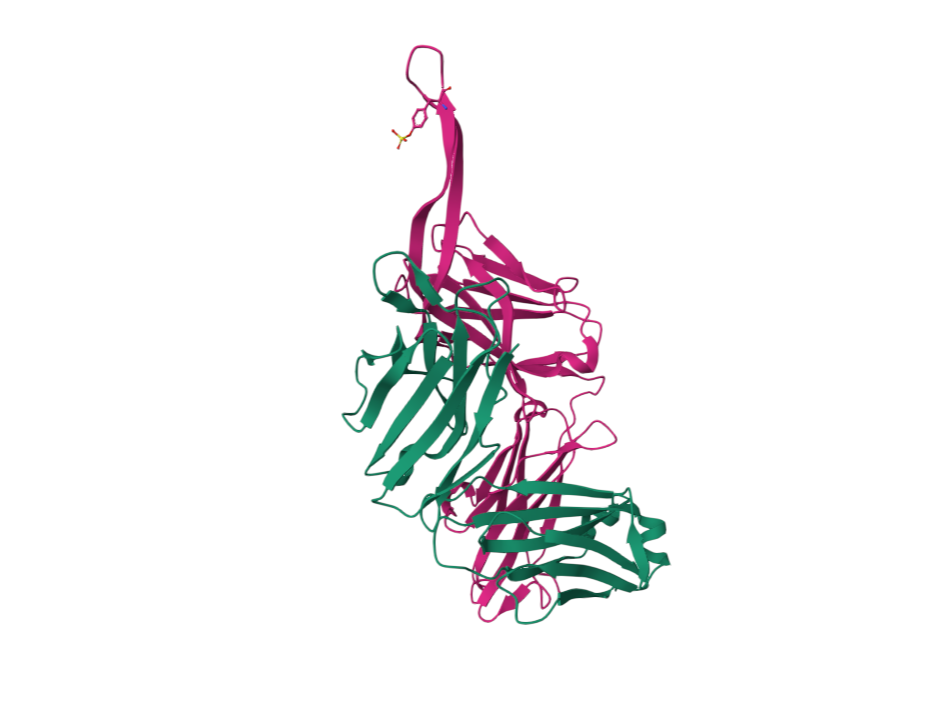
PGDM1400 is a naturally occurring broadly neutralizing antibody (bNAb) that targets the apex of the HIV-1 envelope (Env) trimer. Its mechanism of action includes inhibition of both cell-free and cell-to-cell viral entry, induction of phagocytosis by macrophages, and antibody-dependent cellular cytotoxicity (ADCC) mediated by natural killer (NK) cells. Additionally, PGDM1400 enhances dendritic cell maturation and activity. In a PK study comparing dual (PGDM1400 + VRC07-523LS) with triple (PGDM1400 + PGT121 + VRC07-523LS) bNAb therapy the estimated half-life of PGDM1400 was 25 days. Two of twelve participants had pre-existing mutations conferring PGDM1400 resistance, which is the key limitation of V2-apex coverage as monotherapy. PGDM1400 is the parental molecule. The clinical V2-apex programme has moved to PGDM1400LS, an LS-modified variant with a median half-life of 55 days, first evaluated in humans in HVTN 140/HPTN 101 Part A. IAVI separately pursued an affinity-matured variant, ePGDM1400v9, but reported in 2023 that low cell-line productivity had slowed its development and that it was superseded by PGDM1400.93LS (BIDMC/JustBio) for the paediatric programme.
Not yet approved
Not yet approved
Therapeutic area(s)
- HIV
- Pre-Exposure Prophylaxis (PrEP)
- Treatment
Administration route
Intravenous
Associated long-acting platforms
Solution, Monoclonal antibodies and antibody drug conjugates
Use of drug
- Administered by a nurse
- Administered by a specialty health worker
- Other/Variable/Unknown : Once (single-dose studies of the parental molecule)
Dosage
investigational doses only: IV doses of 3mg/kg; 10 mg/kg; 20 mg/kg and 30 mg/kg
30 mg/kg IV
No approved regimen. Parental PGDM1400 was studied as single IV doses of 3, 10, 20 or 30 mg/kg, alone and with PGT121 (IAVI T002, HVTN 130/HPTN 089).
Not provided
Not provided
Additional information
Developer(s)
National Institute of Allergy and Infectious Diseases (NIAID)
The National Institute of Allergy and Infectious Diseases (NIAID) is part of the U.S. National Institutes of Health (NIH) dedicated to advancing research on infectious, immunologic, and allergic diseases. Established over 60 years ago, NIAID conducts both basic and applied research aimed at understanding, diagnosing, treating, and preventing a wide range of diseases that impact global health.
Drug structure
Scale-up and manufacturing prospects
Not provided
Bioreactors
The synthesis of PGDM1400, is typically performed using recombinant DNA technology. 1. Gene Identification and Cloning: The heavy and light chain variable regions of PGDM1400 are identified from B cells of HIV-infected individuals with broad serum neutralization. These genes are then cloned into expression vectors with appropriate constant regions (e.g., IgG1). 2. Expression: HEK293 or CHO cells 3. Purification using protein A/G affinity chromatography
1. Protein A/G affinity chromatography 2. SDS-PAGE 3. HPLC 4. ELISA 5. Neutralization assay
Excipients & delivery device(s)
No proprietary excipient used
No novel excipient or existing excipient used
No residual solvent used
No delivery device
Safety, Efficacy and Evidence Summary
Not provided
Not provided
Not provided
Not provided
Antibody characteristics
Molecular identity
Not provided
Not provided
Not provided
Not provided
Not provided
Not provided
Epitope and engineering
Not provided
Not provided
Not provided
Not provided
Not provided
Delivery
Not provided
Not provided
Not provided
Not provided
Not provided
Broadly neutralizing antibody and uses thereof
The present invention relates to an exceptionally broad and potent neutralizing antibody which may comprise cross-clade neutralizing coverage of 83% at a median IC50 of 0.003 µg/ml, compositions containing the same and uses thereof.
EP2975053A1
Not provided
Cornell University Scripps Research Institute International AIDS Vaccine Initiative Inc
Not provided
June 10, 2035
Granted in US and EPO (AT, BE, CH, DE, FR, GB, LI, NL)