
|
Developed by 

|
Supported by 


|
PGDM1400 (mAb)
Developer(s)
|
National Institute of Allergy and Infectious Diseases (NIAID) Originator
https://www.niaid.nih.gov/
United States of America The National Institute of Allergy and Infectious Diseases (NIAID) is part of the U.S. National Institutes of Health (NIH) dedicated to advancing research on infectious, immunologic, and allergic diseases. Established over 60 years ago, NIAID conducts both basic and applied research aimed at understanding, diagnosing, treating, and preventing a wide range of diseases that impact global health. |
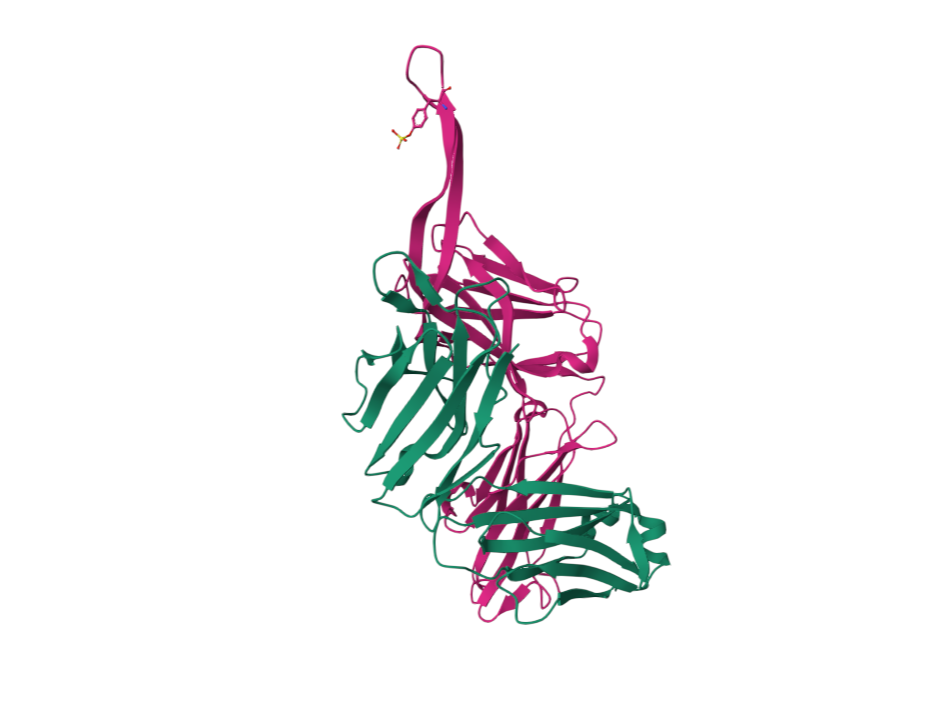
Drug structure
Crystal structure of human Fab PGDM1400, a broadly reactive and potent HIV-1 neutralizing antibody
Julien, J.-P., & Wilson, I. A. (2014). Crystal structure of human Fab PGDM1400, a broadly reactive and potent HIV-1 neutralizing antibody [PDB entry 4RQQ]. Protein Data Bank. https://doi.org/10.2210/p
Drug information
Associated long-acting platforms
Solution, Monoclonal antibodies and antibody drug conjugates
Administration route
Intravenous
Therapeutic area(s)
Use case(s)
Use of drug
Ease of administration
Frequency of administration
User acceptance
Dosage
Available dose and strength
investigational doses only: IV doses of 3mg/kg; 10 mg/kg; 20 mg/kg and 30 mg/kg
Maximum dose
30 mg/kg IV
Recommended dosing regimen
No approved regimen. Parental PGDM1400 was studied as single IV doses of 3, 10, 20 or 30 mg/kg, alone and with PGT121 (IAVI T002, HVTN 130/HPTN 089).
Additional comments
Not provided
Dosage link(s)
Not provided
Drug information
Generic name
Brand name
Compound type
Drug class/category
Lifecycle status
Summary
Approval status
Regulatory authorities
Safety
Efficacy
Evidence Summary
Delivery device(s)
No delivery device
Antibody profile
Antibody characteristics
Molecular identity
Epitope and engineering
Delivery
Scale-up and manufacturing prospects
Scale-up prospects
Not provided
Tentative equipment list for manufacturing
Bioreactors
Manufacturing
The synthesis of PGDM1400, is typically performed using recombinant DNA technology. 1. Gene Identification and Cloning: The heavy and light chain variable regions of PGDM1400 are identified from B cells of HIV-infected individuals with broad serum neutralization. These genes are then cloned into expression vectors with appropriate constant regions (e.g., IgG1). 2. Expression: HEK293 or CHO cells 3. Purification using protein A/G affinity chromatography
Specific analytical instrument required for characterization of formulation
1. Protein A/G affinity chromatography 2. SDS-PAGE 3. HPLC 4. ELISA 5. Neutralization assay
Clinical trials
IAVI T002
Identifier
NCT03205917
Link
https://clinicaltrials.gov/study/NCT03205917
Phase
Phase I
Status
Completed
Sponsor
International AIDS Vaccine Initiative
More details
This is a Phase 1 study to evaluate the safety, tolerability, pharmacokinetics and anti-viral efficacy of the PGDM1400 and PGT121 and VRC07-523LS mAbs for HIV prevention and therapy.
Purpose
A Clinical Trial of PGDM1400 and PGT121 and VRC07-523LS Monoclonal Antibodies in HIV-infected and HIV-uninfected Adults
Interventions
Intervention 1
Intervention 2
Intervention 3
Intervention 4
Intervention 5
Countries
Sites / Institutions
Not provided
Trials dates
Anticipated Start Date
Not provided
Actual Start Date
2017-10-23
Anticipated Date of Last Follow-up
2020-09-11
Estimated Primary Completion Date
Not provided
Estimated Completion Date
Not provided
Actual Primary Completion Date
2020-04-20
Actual Completion Date
2020-04-20
Studied populations
Age Cohort
- Adults
- Older Adults
Genders
- All
Accepts pregnant individuals
Unspecified
Accepts lactating individuals
Unspecified
Accepts healthy individuals
Yes
Comments about the studied populations
Groups 1 and 2 Inclusion Criteria: * HIV-uninfected males or females age 18-50 years old * Willing to maintain low risk behavior for HIV infection Groups 1 and 2 Exclusion Criteria: • Confirmed HIV-infection, pregnancy or lactation, significant acute or chronic disease and clinically significant laboratory abnormalities Group 3 Inclusion Criteria: * HIV-infected males or females age 18-65 years old * Not on antiretroviral therapy with HIV-1 RNA plasma level between 1,000 and 100,000 copies/ml, CD4 cell count ≥ 300 cells/uL Group 3 Exclusion Criteria: • Significant acute or chronic medical condition other than HIV infection, and clinically significant laboratory abnormalities
Health status
Not provided
Study type
Interventional (clinical trial)
Enrollment
29
Allocation
Randomized
Intervention model
Parallel Assignment
Intervention model description
Not provided
Masking
Double-blind masking
Masking description
Not provided
Frequency of administration
Studied LA-formulation(s)
Studied route(s) of administration
Use case
Treatment
Indication(s)
HIV
Key resources
IAVI T003
Identifier
NCT03721510
Link
https://clinicaltrials.gov/study/NCT03721510
Phase
Phase I/II
Status
Completed
Sponsor
International AIDS Vaccine Initiative
More details
This is a Phase 1/2a open label study to evaluate the safety, tolerability, pharmacokinetics and anti-viral activity of PGT121, VRC07-523LS and PGDM1400 for HIV prevention and therapy.
Purpose
A Phase 1/2a Study of PGT121, VRC07-523LS and PGDM1400 Monoclonal Antibodies in HIV-uninfected and HIV-infected Adults
Interventions
Intervention 1
Intervention 2
Countries
Sites / Institutions
Not provided
Trials dates
Anticipated Start Date
Not provided
Actual Start Date
2018-12-03
Anticipated Date of Last Follow-up
2022-05-06
Estimated Primary Completion Date
Not provided
Estimated Completion Date
Not provided
Actual Primary Completion Date
2021-10-25
Actual Completion Date
2022-05-02
Studied populations
Age Cohort
- Adults
- Older Adults
Genders
- All
Accepts pregnant individuals
Unspecified
Accepts lactating individuals
Unspecified
Accepts healthy individuals
Yes
Comments about the studied populations
1. Willing to comply with the requirements of the protocol and available for follow-up for the planned duration of the study. 2. In the opinion of the Principal Investigator or designee and based on Assessment of Informed Consent Understanding results, has understood the information provided and potential impact and/or risks linked to IV infusion and participation in the trial; written informed consent will be obtained from the volunteer before any study-related procedures are performed. 3. All volunteers born female engaging in sexual activity that could lead to pregnancy must commit to use an effective method of contraception from the day of the first IV infusion of investigational product until 6 months following the final investigational product administration 4. All sexually active vo
Health status
Not provided
Study type
Interventional (clinical trial)
Enrollment
19
Allocation
Not provided
Intervention model
Parallel Assignment
Intervention model description
Not provided
Masking
Open label
Masking description
Not provided
Frequency of administration
Studied LA-formulation(s)
Studied route(s) of administration
Use case
Treatment
Indication(s)
HIV
Key resources
IPCAVD014/HTX1004
Identifier
NCT04983030
Link
https://clinicaltrials.gov/study/NCT04983030
Phase
Phase I/II
Status
Completed
Sponsor
Boris Juelg, MD PhD
More details
A multicenter, randomized, parallel-group, placebo-controlled, double-blind, Phase 1/2a clinical study to investigate the safety, tolerability, immunogenicity and exploratory efficacy of a vaccine regimen consisting of an Ad26.Mos4.HIV prime and a boost with Modified Vaccinia Ankara (MVA)-BN-HIV in combination with broadly neutralizing antibodies (bNAb) PGT121, PGDM1400, and VRC07-523LS in human immunodeficiency virus type 1 (HIV-1)-infected study participants on suppressive anti-retroviral therapy (ART).
Purpose
Safety, Immunogenicity, Efficacy of Ad26.Mos4.HIV, MVA-BN-HIV and PGT121, PGDM1400, and VRC07-523LS in HIV-1-Infected Adults
Interventions
Intervention 1
Intervention 2
Intervention 3
Intervention 4
Intervention 5
Countries
Sites / Institutions
Not provided
Trials dates
Anticipated Start Date
Not provided
Actual Start Date
2022-04-01
Anticipated Date of Last Follow-up
2026-05-27
Estimated Primary Completion Date
2026-02-28
Estimated Completion Date
2026-04-30
Actual Primary Completion Date
2026-02-23
Actual Completion Date
2026-02-23
Studied populations
Age Cohort
- Adults
- Older Adults
Genders
- All
Accepts pregnant individuals
Unspecified
Accepts lactating individuals
Unspecified
Accepts healthy individuals
No
Comments about the studied populations
Inclusion Criteria: 1. Each potential study participant must pass the Test of Understanding (TOU), indicating that he or she understands the purpose of, and procedures required for the study, after reading the informed consent and after the investigator or designee has provided detailed information on the study and has answered the potential study participant's questions. Each study participant must subsequently sign the ICF, indicating that he or she is willing to participate in the study. 2. Each study participant must be willing and able to adhere to the prohibitions and restrictions specified in this protocol. 3. Study participants are ≥18 to ≤70 years old on the day of signing the ICF. 4. Each study participant must have documented HIV-1 infection. 5. Must be on suppressive ART for a
Health status
Not provided
Study type
Interventional (clinical trial)
Enrollment
28
Allocation
Randomized
Intervention model
Parallel Assignment
Intervention model description
Not provided
Masking
Double-blind masking
Masking description
Not provided
Frequency of administration
Studied LA-formulation(s)
Studied route(s) of administration
Use case
Treatment
Indication(s)
HIV
Key resources
Excipients
Proprietary excipients used
No proprietary excipient used
Novel excipients or existing excipients at a concentration above Inactive Ingredients Database (IID) for the specified route of administration
No novel excipient or existing excipient used
Residual solvents used
No residual solvent used
Patent info
Description
Broadly neutralizing antibody and uses thereof
Brief description
The present invention relates to an exceptionally broad and potent neutralizing antibody which may comprise cross-clade neutralizing coverage of 83% at a median IC50 of 0.003 µg/ml, compositions containing the same and uses thereof.
Representative patent
EP2975053A1
Category
Not provided
Patent holder
Cornell University Scripps Research Institute International AIDS Vaccine Initiative Inc
Exclusivity
Not provided
Expiration date
June 10, 2035
Status
Granted in US and EPO (AT, BE, CH, DE, FR, GB, LI, NL)
Supporting material
Publications
Sobieszczyk, M. E., Mannheimer, S., Paez, C. A., Yu, C., Gamble, T., Theodore, D. A., Chege, W., Yacovone, M., Hanscom, B., Heptinstall, J., Seaton, K. E., Zhang, L., Miner, M. D., Eaton, A., Weiner, J. A., Mayer, K., Kalams, S., Stephenson, K., Julg, B., Caskey, M., … HVTN 130/HPTN 089 Study Team (2023). Safety, tolerability, pharmacokinetics, and immunological activity of dual-combinations and triple-combinations of anti-HIV monoclonal antibodies PGT121, PGDM1400, 10-1074, and VRC07-523LS administered intravenously to HIV-uninfected adults: a phase 1 randomised trial. The lancet. HIV, 10(10), e653–e662. https://doi.org/10.1016/S2352-3018(23)00140-6
Link: https://doi.org/10.1016/S2352-3018(23)00140-6
Background: Preclinical and clinical studies suggest that combinations of broadly neutralising antibodies (bnAbs) targeting different HIV envelope epitopes might be required for sufficient prevention of infection. We aimed to evaluate the dual and triple anti-HIV bnAb combinations of PGDM1400 (V2 Apex), PGT121 (V3 glycan), 10-1074 (V3 glycan), and VRC07-523LS (CD4 binding site).
Methods: In this phase 1 trial (HVTN 130/HPTN 089), adults without HIV were randomly assigned (1:1:1) to three dual-bnAb treatment groups simultaneously, or the triple-bnAb group, receiving 20 mg/kg of each antibody administered intravenously at four centres in the USA. Participants received a single dose of PGT121 + VRC07-523LS (treatment one; n=6), PGDM1400 + VRC07-523LS (treatment two; n=6), or 10-1074 + VRC07-523LS (treatment three; n=6), and two doses of PGDM1400 + PGT121 + VRC07-523LS (treatment four; n=9). Primary outcomes were safety, pharmacokinetics, and neutralising activity. Safety was determined by monitoring for 60 min after infusions and throughout the study by collecting laboratory assessments (ie, blood count, chemistry, urinalysis, and HIV), and solicited and unsolicited adverse events (via case report forms and participant diaries). Serum concentrations of each bnAb were measured by binding antibody assays on days 0, 3, 6, 14, 28, 56, 112, 168, 224, 280, and 336, and by serum neutralisation titres against Env-pseudotyped viruses on days 0, 3, 28, 56, and 112. Pharmacokinetic parameters were estimated by use of two-compartment population pharmacokinetic models; combination bnAb neutralisation titres were directly measured and assessed with different interaction models. This trial is registered with ClinicalTrials.gov, NCT03928821, and has been completed.
Findings: 27 participants were enrolled from July 31, to Dec 20, 2019. The median age was 26 years (range 19-50), 16 (58%) of 27 participants were assigned female sex at birth, and 24 (89%) participants were non-Hispanic White. Infusions were safe and well tolerated. There were no statistically significant differences in pharmacokinetic patterns between the dual and triple combinations of PGT121, PGDM1400, and VRC07-523LS. The median estimated elimination half-lives of PGT121, PGDM1400, 10-1074, and VRC07-523LS were 32·2, 25·4, 27·5, and 52·9 days, respectively. Neutralisation coverage against a panel of 12 viruses was greater in the triple-bnAb versus dual-bnAb groups: area under the magnitude-breadth curve at day 28 was 3·1, 2·9, 3·0, and 3·4 for treatments one to four, respectively. The Bliss-Hill multiplicative interaction model, which assumes complementary neutralisation with no antagonism or synergism among the bnAbs, best described combination bnAb titres in the dual-bnAb and triple-bnAb groups.
Interpretation: No pharmacokinetic interactions among the bnAbs and no loss of complementary neutralisation were observed in the dual and triple combinations. This study lays the foundation for designing future combination bnAb HIV prevention efficacy trials.
Additional documents
Useful links
There are no additional links