Drug name
Last update: Oct 2026Lenacapavir pacfosacil (GS-4182)
Developer(s)
Drug information
Not provided
Lenacapavir pacfosacil (GS-4182)
investigational
Small molecule
Capsid inhibitor — Prodrug of lenacapavir (capsid inhibitor)
Active / In Development (Phase 1/2/3) — to be clarified whether development of GS-4182 will continue
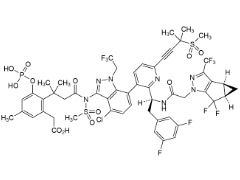
GS-4182 is an investigational lenacapavir prodrug with improved bioavailability and potential for oral weekly administration. The chemical structure of GS-4182 is not yet available in the public domain. GS-4182 is studied in combination with GS-1720, a new oral INSTI. Phase II/III WONDERS trials are currently underway using the GS-4182+GS-1720 combination. If successful, a weekly oral HIV treatment could provide a valuable alternative for PLHIV.
GS-4182 is currently in clinical development and not yet approved in any jurisdiction.
GS-4182 is currently in clinical development and not yet approved in any jurisdiction.
Therapeutic area(s)
- HIV
- Treatment
Administration route
Oral
Associated long-acting platforms
Oral solid form
Use of drug
- Self-administered
- Other/Variable/Unknown : once a week oral dosing with GS-1720 is the investigated schedule
- Weekly
Dosage
300mg is the investigated dose
600mg is the investigated loading dose (2 tablets)
In the phase 2/3 study (NCT06613685), participants will receive a 1-day loading dose of GS-1720 (1300 mg) and GS-4182 (600 mg) on Day 1.Thereafter, participants will take weekly doses of single agent GS-1720 (650 mg) and GS-4182 (300 mg) co-administered for at least 48 weeks.
Not provided
Not provided
Related entries
Main compound
Lenacapavir pacfosacil (GS-4182)
Related compounds
lepetegravir (GS-1720)
Additional information
Developer(s)
Gilead
Gilead Sciences, founded in 1987 by Dr. Michael Riordan, began with a focus on oligonucleotide-based therapies. It evolved into a leader in antiviral research, developing breakthrough treatments for HIV, hepatitis B and C, and COVID-19. Headquartered in Foster City, California, Gilead also invests in oncology, inflammation, and cell therapy.
Drug structure
Scale-up and manufacturing prospects
Detailed manufacturing information is not currently available for this compound.
Detailed manufacturing information is not currently available for this compound.
Detailed manufacturing information is not currently available for this compound.
Detailed manufacturing information is not currently available for this compound.
Excipients & delivery device(s)
Not provided
Not provided
Not provided
Not provided
Safety, Efficacy and Evidence Summary
Not provided
Not provided
Not provided
Not provided
GS-4182 (lenacapavir pacfosacil) and GS-1720 (lepetegravir) combination and tablet formulation
The disclosure provides methods of treating and/or preventing HIV infections using a Compound 1, or a pharmaceutically acceptable salt thereof, and a Compound 2, or a pharmaceutically acceptable salt thereof. The disclosure further provides pharmaceutical formulations, particularly solid oral dosage forms comprising a Compound 1, or a pharmaceutically acceptable salt thereof, and a Compound 2, or a pharmaceutically acceptable salt thereof.
WO2026020086
Combination, formulation
Gilead
Not provided
July 18, 2045
Not yet in national phase
Lenacapavir pacfosacil tablet formulation
The present disclosure relates to pharmaceutical formulations comprising a HIV capsid inhibitor and methods for the treatment or prevention of a human immunodeficiency virus (HIV) infection in a patient.
WO2026006521
Formulation
Gilead
Not provided
June 26, 2045
Not yet in national phase
Lenacapavir pacfosacil preparation process (Formula I)
The present disclosure relates generally to processes for preparing a compound useful in the prevention or treatment of a Retroviridae viral infection, including an infection caused by the human immunodeficiency virus (HIV).
WO2024249672
Process
Gilead
Not provided
May 30, 2044
Pending: AU, BR, CA, CN, EP, IN, JP, KR, US
Polymorphs of lenacapavir pacfosacil (Compound 1)
The present disclosure relates to solid forms of compounds and pharmaceutical compositions thereof, which are useful in the treatment and prevention of a Retroviridae viral infection including an infection caused by the HIV virus
WO2024249573
Polymorphs
Gilead
Not provided
May 30, 2044
Pending: AU, BR, CA, CN, EP, IN, JP, KR, US
Lenacapavir pacfosacil compound and analogues
The present disclosure relates generally to certain compounds, pharmaceutical compositions comprising said compounds, and methods of making and using said compounds and pharmaceutical compositions. The compounds and compositions provided herein may be used for the treatment or prevention of a Retroviridae infection, including an HIV infection.
WO2023102239
Compound
Gilead
Not provided
December 2, 2042
Granted: US Pending: AE, AP, AR, AU, BH, BR, CA, CO, CL, CN, CR, DO, EA, EG, EP, GT, HK, ID, IN, IL, JP, KR, KW, MX, MY, NG, NZ, OM, PA, PE, PH, QA, TH, TW, UA, VN, ZA