
|
Developed by 

|
Supported by 


|
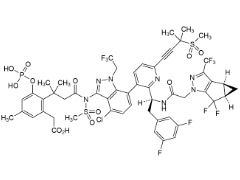
Lenacapavir pacfosacil (GS-4182)
Developer(s)
|
Gilead Originator
https://www.gilead.com/
United States Gilead Sciences, founded in 1987 by Dr. Michael Riordan, began with a focus on oligonucleotide-based therapies. It evolved into a leader in antiviral research, developing breakthrough treatments for HIV, hepatitis B and C, and COVID-19. Headquartered in Foster City, California, Gilead also invests in oncology, inflammation, and cell therapy. |
Drug structure
lenacapavir pacfosacil chemical structure
WHO Drug Information, Vol. 39, No. 2, 2025 Proposed INN: List 133 International Nonproprietary Names for Pharmaceutical Substances (INN)
Drug information
Associated long-acting platforms
Oral solid form
Administration route
Oral
Therapeutic area(s)
Use case(s)
Use of drug
Ease of administration
Frequency of administration
User acceptance
Dosage
Available dose and strength
300mg is the investigated dose
Maximum dose
600mg is the investigated loading dose (2 tablets)
Recommended dosing regimen
In the phase 2/3 study (NCT06613685), participants will receive a 1-day loading dose of GS-1720 (1300 mg) and GS-4182 (600 mg) on Day 1.Thereafter, participants will take weekly doses of single agent GS-1720 (650 mg) and GS-4182 (300 mg) co-administered for at least 48 weeks.
Additional comments
Not provided
Dosage link(s)
Not provided
Drug information
Drug's link(s)
Not provided
Generic name
Brand name
Compound type
Drug class/category
Lifecycle status
Summary
Approval status
Regulatory authorities
Safety
Efficacy
Evidence Summary
Delivery device(s)
Not provided
Scale-up and manufacturing prospects
Scale-up prospects
Detailed manufacturing information is not currently available for this compound.
Tentative equipment list for manufacturing
Detailed manufacturing information is not currently available for this compound.
Manufacturing
Detailed manufacturing information is not currently available for this compound.
Specific analytical instrument required for characterization of formulation
Detailed manufacturing information is not currently available for this compound.
Clinical trials
WONDERS2
Identifier
NCT06613685
Link
https://clinicaltrials.gov/study/NCT06613685
Phase
Phase II/III
Status
Terminated
Sponsor
Gilead Sciences
More details
The goal of this clinical study is to learn more about the experimental drugs GS-1720 (an oral, long-acting integrase strand transfer inhibitor (INSTI)) and GS-4182 (a prodrug of Lenacapavir (LEN)); to compare the combination of GS-1720 and GS-4182 with the current standard-of-care treatment bictegravir/emtricitabine/tenofovir alafenamide (B/F/TAF) (Biktarvy), to see if the combination of GS-1720 and GS-4182 is safe and if it works for treating human immunodeficiency virus type 1 (HIV-1) infection in treatment-naive people with HIV-1 (PWH). This study has two phases: Phase 2 and Phase 3. The primary objectives of this study are: Phase 2: To evaluate the efficacy of oral weekly GS-1720 coadministered with GS-4182 versus continuing Biktarvy (BVY) in treatment-naive PWH at Week 24. Phase
Purpose
Study of Oral Weekly GS-1720 and GS-4182 Compared With Biktarvy in People With HIV-1 Who Have Not Been Treated
Interventions
Intervention 1
Intervention 2
Intervention 3
Intervention 4
Intervention 5
Countries
Sites / Institutions
Not provided
Trials dates
Anticipated Start Date
Not provided
Actual Start Date
2024-10-21
Anticipated Date of Last Follow-up
2026-03-26
Estimated Primary Completion Date
2029-01-01
Estimated Completion Date
2030-08-01
Actual Primary Completion Date
2026-03-16
Actual Completion Date
2026-03-16
Studied populations
Age Cohort
- Adults
- Older Adults
Genders
- All
Accepts pregnant individuals
Unspecified
Accepts lactating individuals
Unspecified
Accepts healthy individuals
No
Comments about the studied populations
Key Inclusion Criteria: * HIV-1 RNA ≥ 500 copies/mL at screening. * Antiretroviral (ARV) treatment-naive, except the use of oral pre-exposure prophylaxis (PrEP) or postexposure prophylaxis (PEP) with emtricitabine/tenofovir disoproxil fumarate (FTC/TDF) or F/TAF, up to 1 month prior to screening. Key Exclusion Criteria: * Prior use of any long acting parenteral antiretrovirals (ARVs) such as monoclonal antibodies, broadly neutralizing antibodies targeting HIV-1, LEN, injectable cabotegravir (including oral cabotegravir lead-in), and/or injectable rilpivirine. * Documented resistance to the integrase strand-transfer inhibitor class, specifically, resistance-associated mutations E92G/Q, G118R, F121Y, Y143C/H/R, S147G, Q148H/K/R, N155H/S, or R263K in the integrase gene. * Any of the follow
Health status
Study type
Interventional (clinical trial)
Enrollment
73
Allocation
Randomized
Intervention model
Sequential assignment
Intervention model description
Not provided
Masking
Double-blind masking
Masking description
Not provided
Frequency of administration
Studied LA-formulation(s)
Studied route(s) of administration
Use case
Treatment
Indication(s)
HIV
Key resources
| Type | Title | Content | Link |
|---|---|---|---|
| Link | Study of Oral Weekly GS-1720 and GS-4182 Compared With Biktarvy in People With HIV-1 Who Have Not Been Treated (WONDERS2) - Gilead's clinical trials website | https://www.gileadclinicaltrials.com/study?nctid=NCT06613685 | |
| Link | Gilead Provides Update on Clinical Studies Evaluating GS-1720 and/or GS-4182 for the Treatment of HIV-1 Infection - on hold | https://www.gilead.com/company/company-statements/2025/gilead-provides-update-on-clinical-studies-evaluating-gs-1720-and-or-gs-4182-for-the-treatment-of-hiv-1-infection |
WONDERS1
Identifier
NCT06544733
Link
https://clinicaltrials.gov/study/NCT06544733
Phase
Phase II/III
Status
Active, not recruiting
Sponsor
Gilead Sciences
More details
The goal of this clinical study is to learn more about the experimental drugs GS-1720 and GS-4182; to compare the combination of GS-1720 and GS-4182 with the current standard-of-care treatment bictegravir/emtricitabine/tenofovir alafenamide (B/F/TAF, BVY), to see if the combination of GS-1720 and GS-4182 is safe and if it works for treating human immunodeficiency virus type 1 (HIV-1) infection. This study has two phases: Phase 2 and Phase 3. The primary objectives of this study are: Phase 2: To evaluate the efficacy of switching to oral weekly GS-1720 in combination with GS-4182 versus continuing BVY in virologically suppressed people with HIV-1 (PWH) at Week 24. Phase 3: To evaluate the efficacy of switching to oral weekly GS-1720/GS-4182 Fixed-dose combination (FDC) tablet regimen ve
Purpose
Study of Oral Weekly GS-1720 and GS-4182 Versus Biktarvy in People With HIV-1 Who Are Virologically Suppressed
Interventions
Intervention 1
Intervention 2
Intervention 3
Intervention 4
Intervention 5
Countries
Sites / Institutions
Not provided
Trials dates
Anticipated Start Date
Not provided
Actual Start Date
2024-08-20
Anticipated Date of Last Follow-up
2026-04-14
Estimated Primary Completion Date
2028-01-01
Estimated Completion Date
2029-06-01
Actual Primary Completion Date
Not provided
Actual Completion Date
Not provided
Studied populations
Age Cohort
- Adults
- Older Adults
Genders
- All
Accepts pregnant individuals
Unspecified
Accepts lactating individuals
Unspecified
Accepts healthy individuals
No
Comments about the studied populations
Key Inclusion Criteria: * Documented plasma HIV-1 RNA \< 50 copies/mL for ≥ 24 weeks before and at screening. * Receiving BVY for ≥ 24 weeks prior to screening. Key Exclusion Criteria: * Prior use of, or exposure to LEN, GS-1720, or GS-4182. * History of virologic failure while on an integrase strand-transfer inhibitor (INSTI)-based regimen. * Documented integrase strand-transfer inhibitor (INSTI) resistance, specifically, resistance-associated mutations (RAMs) E92G/Q, G118R, F121Y, Y143C/H/R, S147G, Q148H/K/R, N155H/S, or R263K in the integrase gene. * Prior use of any long-acting (LA) parenteral antiretrovirals (ARV) such as monoclonal antibodies (mAbs) or broadly neutralizing antibodies (bNAbs) targeting HIV-1, injectable cabotegravir (including oral cabotegravir lead-in), or injecta
Health status
Not provided
Study type
Interventional (clinical trial)
Enrollment
675
Allocation
Randomized
Intervention model
Sequential assignment
Intervention model description
Not provided
Masking
Double-blind masking
Masking description
Not provided
Frequency of administration
Studied LA-formulation(s)
Studied route(s) of administration
Use case
Treatment
Indication(s)
HIV
Key resources
Excipients
Proprietary excipients used
Not provided
Novel excipients or existing excipients at a concentration above Inactive Ingredients Database (IID) for the specified route of administration
Not provided
Residual solvents used
Not provided
Patent info
Description
GS-4182 (lenacapavir pacfosacil) and GS-1720 (lepetegravir) combination and tablet formulation
Brief description
The disclosure provides methods of treating and/or preventing HIV infections using a Compound 1, or a pharmaceutically acceptable salt thereof, and a Compound 2, or a pharmaceutically acceptable salt thereof. The disclosure further provides pharmaceutical formulations, particularly solid oral dosage forms comprising a Compound 1, or a pharmaceutically acceptable salt thereof, and a Compound 2, or a pharmaceutically acceptable salt thereof.
Representative patent
WO2026020086
Category
Combination, formulation
Patent holder
Gilead
Exclusivity
Not provided
Expiration date
July 18, 2045
Status
Not yet in national phase
Description
Lenacapavir pacfosacil tablet formulation
Brief description
The present disclosure relates to pharmaceutical formulations comprising a HIV capsid inhibitor and methods for the treatment or prevention of a human immunodeficiency virus (HIV) infection in a patient.
Representative patent
WO2026006521
Category
Formulation
Patent holder
Gilead
Exclusivity
Not provided
Expiration date
June 26, 2045
Status
Not yet in national phase
Description
Lenacapavir pacfosacil preparation process (Formula I)
Brief description
The present disclosure relates generally to processes for preparing a compound useful in the prevention or treatment of a Retroviridae viral infection, including an infection caused by the human immunodeficiency virus (HIV).
Representative patent
WO2024249672
Category
Process
Patent holder
Gilead
Exclusivity
Not provided
Expiration date
May 30, 2044
Status
Pending: AU, BR, CA, CN, EP, IN, JP, KR, US
Description
Polymorphs of lenacapavir pacfosacil (Compound 1)
Brief description
The present disclosure relates to solid forms of compounds and pharmaceutical compositions thereof, which are useful in the treatment and prevention of a Retroviridae viral infection including an infection caused by the HIV virus
Representative patent
WO2024249573
Category
Polymorphs
Patent holder
Gilead
Exclusivity
Not provided
Expiration date
May 30, 2044
Status
Pending: AU, BR, CA, CN, EP, IN, JP, KR, US
Description
Lenacapavir pacfosacil compound and analogues
Brief description
The present disclosure relates generally to certain compounds, pharmaceutical compositions comprising said compounds, and methods of making and using said compounds and pharmaceutical compositions. The compounds and compositions provided herein may be used for the treatment or prevention of a Retroviridae infection, including an HIV infection.
Representative patent
WO2023102239
Category
Compound
Patent holder
Gilead
Exclusivity
Not provided
Expiration date
December 2, 2042
Status
Granted: US Pending: AE, AP, AR, AU, BH, BR, CA, CO, CL, CN, CR, DO, EA, EG, EP, GT, HK, ID, IN, IL, JP, KR, KW, MX, MY, NG, NZ, OM, PA, PE, PH, QA, TH, TW, UA, VN, ZA
Supporting material
Publications
Hoffmann C, Rockstroh JK. Standardisation of monitoring routines for new long-acting antiretrovirals in development. Lancet HIV. 2026;13(4):e282-e286. doi:10.1016/S2352-3018(25)00329-7
Link: https://pubmed.ncbi.nlm.nih.gov/41429134/
The US Food and Drug Administration's clinical hold on Gilead Sciences' once-weekly combination of GS-1720 and GS-4182 due to unexpected CD4 T-cell and lymphocyte count declines represents a key safety signal in long-acting HIV therapy development. This event parallels the earlier islatravir trials, in which similar immunological effects led to a downsized development programme with lower doses of the drug. The current safety signal must involve different mechanisms, as the combination contains an integrase inhibitor and a capsid inhibitor rather than a nucleoside reverse transcriptase translocation inhibitor. Although GS-1720 appears well tolerated in early studies, the high doses used might have contributed to toxicity. As GS-4182 is a prodrug that converts to lenacapavir, the parent compound warrants careful evaluation, particularly given lenacapavir's anticipated widespread use for HIV prevention. Existing lenacapavir data show favourable safety profiles. However, CD4 T-cell reporting has been inconsistent across trials, and different study populations and dosing regimens might not fully capture all potential immunological effects. CD4 T-cell declines represent a key concern for people with HIV. Future trials should implement standardised monitoring protocols with individual participant trajectories, predefined decline thresholds, and clear discontinuation criteria. As long-acting antiretroviral therapy advances, maintaining rigorous immunological surveillance becomes essential to balance dosing convenience against potential immunological risks.
Additional documents
No documents were uploaded