Technology name
Last update: Jul 2026Tunable Biodegradable Ultra-Long-Acting Polymeric Solid Implant (PSI)
Developer(s)

Type of technology
Polymeric implant
Administration route
Subcutaneous
Development state and regulatory approval
Dolutegravir (DTG)
Pre-clinical
None
Description
Ultra-long-acting (ULA) biodegradable polymeric solid implant (PSI) that can accommodate one or more APIs (e.g. ARVs) at translatable human doses in a single implant, in a form of single or multi-layer multi-drug PSI. Administered subcutaneously, PSIs are well tolerated in vivo and effectively delivered drug(s) over 180 days, achieving plasma concentrations above therapeutic targets. While biodegradable, these PSIs can safely be removed to terminate the treatment if required. The versatility of this technology makes it attractive as an ULA drug delivery platform for HIV and other applications.
Developer(s)

University of North Carolina at Chapel Hill
Our research at the Benhabbour Lab focuses on engineering novel tunable delivery platforms and polymer-based devices that can treat or prevent a disease. Our work combines the elegance of polymer chemistry with the versatility of engineering and formulation development to design and fabricate efficient and translatable delivery systems for a wide range of applications.
Technology highlight
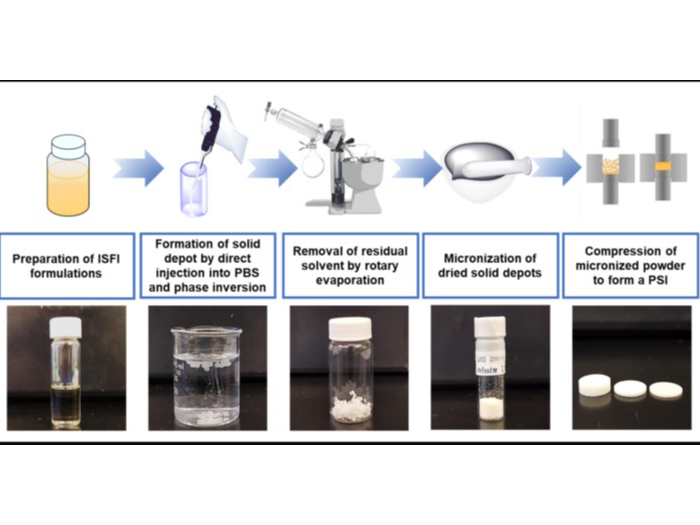
Biodegradable polymeric solid implants (PSIs) are fabricated using phase inversion of drug-loaded polymer-based solution in combination with a compression technique that allows fabrication of PSIs with high drug loading (up to 85 wt%) and compact sizes. The fabrication of these PSIs is accomplished using a simple and scalable stepwise process of (1) phase inversion of a drug-loaded polymer-based solution to form an initial in-situ forming solid implant in an aqueous medium, (2) micronization of dried drug-loaded solid implants, and (3) compression of micronized drug-loaded solid powder. The resulting PSIs are solvent-free and consist of only the biodegradable polymer and drug(s). The manufacturing process does not require high heat or high pressure and can be easily scalable.
Illustration(s)
Technology main components
Poly(DL-lactide-co-glycolide (PLGA) or other biodegradable polymers (e.g. PLA, PCL)
Raw materials are readily available on the market
Safety, Efficacy and Evidence Summary
Well tolerated in vivo (BALB/c mice) over six months. No signs of toxicity, behavioural changes, water consumption, weight loss. Histological staining analysis shows minor inflammation, substantially decreasing 2 weeks after injection. Plasma cytokines showed no systemic acute or chronic inflammation observed.
Not provided
Not provided
Not provided
APIs compatibility profile
Dolutegravir, Rilpivirine, Cabotegravir
Confidential
Confidential
Not provided
Not provided
75-90 wt%
2 different APIs : at least 2
Not provided
Scale-up and manufacturing prospects
Scalability anticipated. Additional information needed.
Additional information needed
New fabrication process using phase inversion and compression. Does not use high heat, high pressure or large volumes of organic solvents. Additional information needed.
Additional information needed
Excipients & delivery device(s)
No proprietary excipient used
No novel excipient or existing excipient used
Dimethyl Sulfoxide (DMSO)
No delivery device
Additional features
- Biodegradable
- Drug-eluting
- Monolithic
- Removable
- Single-use
- Room temperature storage
- At least 1 year shelf life
Slow diffusion of the drugs through degradation of the PLGA matrix by hydrolysis of ester linkages in the presence of water, with minimal initial burst.
Additional data needed
Additional data needed
Additional data needed
Therapeutic area(s)
- Disease agnostic
- HIV
- HBV
- TB
- COVID 19
- Contraception
- Multipurpose technology : "Prevention of STIs and unplanned pregnancy"
- Pain management (incl. joints, lower back, knee)
- Oncology
- Diabetes
- Pre-Exposure Prophylaxis (PrEP)
- Treatment
Potential associated API(s)
- Dolutegravir (DTG)
- Rilpivirine (RPV)
- Rilpivirine (RPV) , Dolutegravir (DTG)
- Cabotegravir (CAB)
Use of technology
- Administered by a community health worker
- Administered by a nurse
- To be determined
Every 6 months
Targeted user groups
- Adults
- All
- Male
- Female
- Cisgender female
- Cisgender male
- Transgender female
- Transgender male
- Intersex
- Gender non-binary
Yes
Yes
Unspecified
To be further investigated
Dolutegravir (DTG)
antiretroviral
Pre-clinical
Not provided
HIV treatment
Not provided
Not provided
None
Not provided
Pre-clinical
Not provided
Not provided
Not provided
Not provided
None
Rilpivirine (RPV) , Dolutegravir (DTG)
Antiretrovirals
Pre-clinical
Not provided
HIV PrEP/ART
PLHIV and people at risk of HIV
6 months
None
antiretroviral
Pre-clinical
Not provided
HIV PrEP
Not provided
Not provided
Not provided