Technology name
Last update: Apr 2026Refillable Nanofluidic Implant
Developer(s)
Sponsor(s)

Type of technology
Titanium implant
Administration route
Transdermal
Development state and regulatory approval
Islatravir (ISL)
Pre-clinical
Not provided
Description
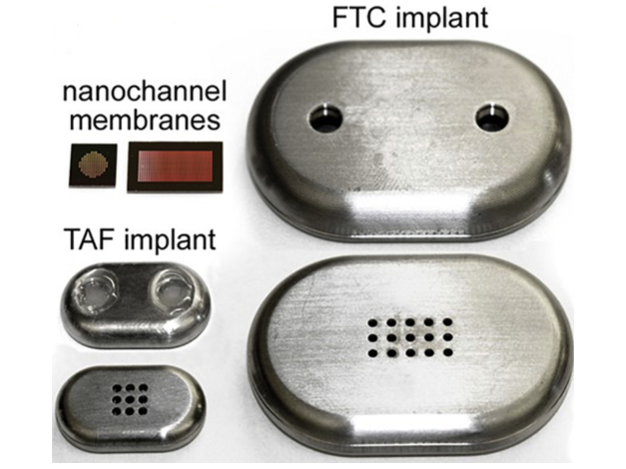
Refillable nanofluidic implants have been designed as an innovative solution for the long-acting delivery of pre-exposure prophylaxis (PrEP) against HIV. Each implant is composed of a titanium reservoir with a volume capacity of 570 μl, integrated with two self-sealing silicone ports to facilitate drug loading and refilling processes. The nanofluidic design incorporates a titanium structure coated to enable the controlled elution of the API over a duration of up to four months. Notably, the refillable nature of these implants supports the efficient loading of solid drug particles.
Developer(s)

Houston Methodist Research Institute
Houston Methodist Research Institute (HMRI), founded in 2004, is the academic arm of Houston Methodist Hospital in Texas. It focuses on translational research, bridging lab discoveries to clinical applications. HMRI specializes in areas like regenerative medicine, nanomedicine, oncology, and artificial intelligence in healthcare. Its state-of-the-art facilities include a dedicated nanomedicine lab
Technology highlight
1) The API exhibits zero-order kinetics, ensuring a constant release rate, even at low dose concentrations. 2) Steady-state drug levels are achieved within 48 hours of administration. 3) The size of the drug microparticles does not influence the release kinetics, demonstrating robust and uniform performance. 4) The steady-state concentration is maintained for up to 20 months, ensuring prolonged efficacy.
Illustration(s)
Technology main components
1) Titanium-polymeric shell 2) Biocompatible carbide-coated silicon membrane with 278,600 nanochannels within an 8-mm2 surface area 3) API Reservoir 4) Loading/refill ports
The National Institute of Allergy and Infectious Diseases (NIAID), USA, provided support for all raw materials utilized during initial phase of development. Price is not disclosed
Safety, Efficacy and Evidence Summary
• In a 20-month nonhuman primate study, islatravir-eluting nanofluidic implants demonstrated excellent tolerability, with mild local tissue inflammation and no systemic toxicity observed. • Moreover, the implants provided 100% protection against SHIV infection.
Not provided
Not provided
Not provided
APIs compatibility profile
Antiretrovirals such as Islatravir, Tenofovir, Efavirenz, Lamivudine, Emtricitabine, Dolutegravir, Raltegravir, Bictegravir, Maraviroc, Atazanavir, and Darunavir are targeted for Refillable nanofluidic implants.
Not provided
Not provided
75-90 wt%
1 single API :
Min: -1.3
Max: 4.7
Islatravir LogP - 0.7
Scale-up and manufacturing prospects
Not provided
Not provided
The manufacturing process includes: 1) Nanofluidic membrane: Silicon nanofluidic membranes were fabricated on silicon-on-insulator wafers using semiconductor techniques. 2) Titanium shell: These membranes were mounted onto medical-grade 6AI4V titanium drug reservoirs using UV epoxy. 3) Assembly: A titanium filter was secured between the reservoir shells with silicone O-rings. The implants were arc-welded, primed in 1x PBS under vacuum, and gamma-sterilized at 30kGy.
1. Optical imaging (EVOS microscope) 2. Scanning electron microscopy (SEM) 3. HPLC
Excipients & delivery device(s)
No proprietary excipient used
No novel excipient or existing excipient used
No residual solvent used
No delivery device
Additional features
- Drug-eluting
- Removable
- Refillable
- Reusable
- Reservoir-type
- Room temperature storage
- At least 1 year shelf life
- Needs insertion kit
• Triphasic release kinetics • Zero-order kinetics (unaffected by the size of the drug microparticle)
• The API liquid is introduced into the reservoir chamber using 19- and 25-gauge needles. • The implantation procedure necessitates general anesthesia and a 1-cm incision.
• Stability studies, as assessed by HPLC chromatography, demonstrated the integrity of the API within the implants over a 9-month period.
Not provided
Therapeutic area(s)
- HIV
- Pre-Exposure Prophylaxis (PrEP)
Potential associated API(s)
Use of technology
- Administered by a community health worker
- Administered by a nurse
- Administered by a specialty health worker
Every 6 months
Targeted user groups
- Adults
- Older Adults
- All
Unspecified
Unspecified
Yes
Not provided
Nucleoside and nucleotide reverse transcriptase inhibitors (NRTI)
Pre-clinical
Not provided
HIV and AIDS
Not provided
2 years
Not provided
HIV-1 capsid protein shell inhibitors
Pre-clinical
Not provided
HIV
Not provided
2 years
Not provided
Nucleoside and nucleotide transcriptase inhibitors
Pre-clinical
Not provided
HIV
Not provided
2 years
Not provided
Electrostatically gated nanofluidic membranes for control of molecular transport
Devices and methods for controlling molecular transport are disclosed herein. The devices include a membrane having a plurality of nanochannels extending therethrough. The membrane has an inner electrically conductive layer and an outer dielectric layer. The outer dielectric layer creates an insulative barrier between the electrically conductive layer and the contents of the nanochannels. At least one electrical contact region is positioned on a surface of the membrane. The electrical contact region exposes the electrically conductive layer of the membrane for electrical coupling to external electronics.
WO2021146537
Device
THE METHODIST HOSPITAL SYSTEM
Not provided
January 15, 2041
Pending: EPO, US
Method for loading or refilling a stabilized drug formulation (specifically comprising tenofovir alafenamide) into a drug delivery implant
The present disclosure provides solid drug formulations, in particular to stabilized formulations of phosphonamidate-containing drugs, as well as methods for loading drug delivery devices with solid formulations.
WO2021113803
Formulation
THE METHODIST HOSPITAL SYSTEM
Not provided
December 7, 2040
Pending: CA, EPO, US