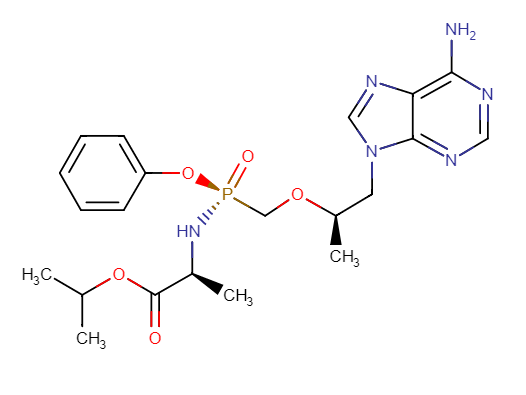
Drug name
Last update: Oct 2026Tenofovir alafenamide (TAF)
Developer(s)
Drug information
Tenofovir alafenamide
Biktarvy, Descovy, Genvoya, Odefsey, Vemlidy, Symtuza
Small molecule
NRTI (Nucleoside/Nucleotide Reverse Transcriptase Inhibitor) — NRTI
Approved / Marketed — Also in development in association with LA platforms
Tenofovir alafenamide (TAF), also known as GS-7340, is a tenofovir prodrug used for HIV-1 treatment and pre-exposure prophylaxis, in addition to chronic hepatitis B treatment. TAF is an alanine ester of tenofovir that provides high levels of intracellular drug concentration with low overall systemic exposure. TAF provides significant advantages over previous generation tenofovir prodrugs such as tenofovir disoproxil fumarate, including a superior pharmacokinetic profile, a higher resistance barrier, enhanced intracellular distribution and an improved safety profile. TAF is available in multiple formulations, including short-acting oral medication (Vemlidy) and combination tablets (Genvoya, Odefsey, Descovy, Biktarvy). Long-acting formulations of TAF are currently in development.
Unknown
WHO guidelines July 2025: Preferred NRTI backbones for initial and subsequent regimens: * Tenofovir (tenofovir disoproxil fumarate or tenofovir alafenamide fumarate (TAF)) +lamivudine (3TC) (or emtricitabine (FTC)) is the preferred NRTI backbone for initial and subsequent ART for adults, adolescents and children weighing more than 30 kg. This includes individuals previously treated with or exposed to tenofovir or zidovudine (ZDV). * Abacavir + 3TC or TAF + 3TC (or FTC) is the suggested NRTI backbone for subsequent ART for children weighing less than 30 kg. This includes children previously treated with ABC or ZDV.
Therapeutic area(s)
- HIV
- Pre-Exposure Prophylaxis (PrEP)
Administration route
Oral, Subcutaneous
Associated long-acting platforms
Polymeric implant, Titanium implant
Use of drug
- Administered by a nurse
- Administered by a specialty health worker
Not provided
Dosage
Not provided
Not provided
Not provided
Not provided
Not provided
Additional information
Developer(s)

Gilead
Gilead Sciences, Inc. is a multinational biopharmaceutical company that develops and manufactures innovative medicines for life-threatening diseases, including anti-viral therapeutics for HIV/AIDS, Hepatitis B, Hepatitis C and Covid-19. Headquartered in Foster City, California, Gilead was originally founded in 1987 and is currently listed on both the S&P 500 and the NASDAQ Biotechnology Index.
Drug structure
Scale-up and manufacturing prospects
Not provided
Not provided
Not provided
Thermal stability characterization via thermogravimetric analysis and differential scanning calorimetry to the implantable, dissolving and/or pure drug formulations. Drug crystallinity can be tested using a powder diffractometer (e.g. Miniflex X-ray from Rigaku Coporation). Drug stability and quantification are determined using HPLC (e.g. SphereClone™ C18 ODS (length, 150 mm; particle size, 5 μm; pore size, 80 Å; internal diameter, 4.6 mm). In vitro drug release studied via dialysis membrane bags (e.g. Spectra-Por®, 12,000–14,000 MWCO, Spectrum Medical Industries, Los Angeles, CA, USA).
Excipients & delivery device(s)
Not provided
Not provided
Not provided
Several pre-clinical implant devices are currently in development for Tenofovir Alafenamide HIV PrEP. These include but are not limited to; [1] OCIS-001 consisting of a permeable polyurethane membrane developed by Northwestern University currently in Phase I/II trials, [2] Titanium reservoir containing nanochannels housed in a silicon membrane created by the Houston Methodist Research Institute, [3] Non-permeable silicone reservoir implant from the Oak Crest Institute of Science, and [4] a biodegradable poly(ε-caprolactone) reservoir implant developed by RTI International.
Safety, Efficacy and Evidence Summary
Not provided
Not provided
Not provided
Not provided