Technology name
Last update: Oct 2026Long-acting Direct-acting Antiviral system
Developer(s)
Sponsor(s)
Not specified
Type of technology
gastric-retentive biosensor coil delivered through a nasogastric tube and designed for prolonged residence in the stomach
Administration route
Oral
Development state and regulatory approval
sofosbuvir (SOF)
Pre-clinical
Not provided
Description
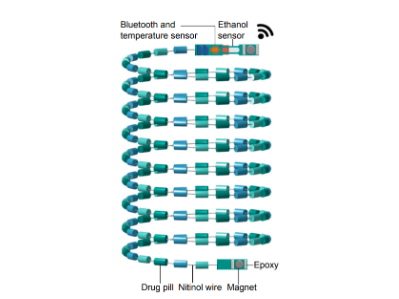
An investigational long-acting direct-acting antiviral delivery system for hepatitis C virus (HCV) treatment, comprising drug-loaded polymeric pills (polycaprolactone or silicone) attached to a superelastic nitinol wire. Following oral administration, the device coils and remains in the stomach, enabling sustained release of antiviral agents, including sofosbuvir, daclatasvir, ledipasvir and ribavirin. The system is designed for prolonged gastric drug delivery and can be retrieved using a nasogastric tube. Integrated sensors monitor device conditions and support wireless data transmission.
Developer(s)

Massachusetts Institute of Technology
MIT was chartered in 1861 by William Barton Rogers to bolster industrial America. From these pragmatic origins, its physical infrastructure evolved to anchor the Kendall Square biotech hub. Through the Whitehead Institute and partnerships like the Novartis-MIT Center for Continuous Manufacturing, MIT modernized pharmaceutical production pipelines from traditional batch processing to scalable.
Technology highlight
1) Gastric-retentive delivery: An expandable, wire-based device designed to remain in the stomach for prolonged drug delivery. 2) Sustained antiviral release: Polycaprolactone (PCL) and silicone polymer matrices enable controlled release of HCV direct-acting antivirals. 3) Multiple drug compatibility: Demonstrated formulation compatibility with sofosbuvir, daclatasvir, ledipasvir and ribavirin. 4) Prolonged drug exposure: In swine, the system maintained detectable GS-331007 (sofosbuvir's major circulating metabolite) for at least 28 days. 5) Retrievable design: The device can be retrieved using a nasogastric tube, with magnetic components facilitating retrieval. 6) Integrated monitoring: Temperature and ethanol sensors, coupled with Bluetooth connectivity, enable monitoring of the device.
Illustration(s)
Technology main components
1. Antiviral drug-loaded polymeric pills: sofosbuvir, daclatasvir, ledipasvir and ribavirin. 2. Polymer matrices: Polycaprolactone (PCL) and silicone 3. Superelastic nitinol wire 4. Central pill channel 5. Magnetic components 6. Epoxy components 7. Integrated sensors 8. Wireless communication system 9. Nasogastric administration and retrieval mechanism
Not provided
Safety, Efficacy and Evidence Summary
In a 30-day preclinical evaluation in Yorkshire swine shows no observed weight loss, gastrointestinal obstruction, restriction of food or liquid passage, gastric mucosal injury, erosions or ulceration.
In vivo antiviral efficacy against HCV was not demonstrated in infected animals or humans
In a 30-day preclinical evaluation in Yorkshire swine (n=3), the gastric-retentive device was reportedly well tolerated, with no observed weight loss, gastrointestinal obstruction, restriction of food or liquid passage, gastric mucosal injury, erosions or ulceration. Animals underwent twice-daily clinical monitoring, with radiography every 3–4 days and endoscopic assessment. Human safety, long-term tolerability and risks associated with device migration or retrieval failure have not been established. Yet, there is no evidence on the efficacy of long-acting direct-acting antiviral systems (LA-DAAS).
APIs compatibility profile
The LA-DAAS is specifically designed to deliver direct-acting antivirals (DAAs) such as sofosbuvir, daclatasvir, ledipasvir, and ribavirin. These are all standard small-molecule drugs
Soluble in water and acetronitrile
Not provided
50-75 wt%
4 different APIs : Not provided
Min: -2.3 Max: 7.4
Scale-up and manufacturing prospects
Not provided
Not provided
Not provided
Not provided
Excipients & delivery device(s)
Not provided
Existing excipients: The formulation uses polycaprolactone (PCL), silicone, poloxamer 407 (P407) and polyethylene glycol (PEG)
Not provided
Not provided
Additional features
- Drug-eluting
- At least 1 year shelf life
- Needs insertion kit
Preclinical pharmacokinetic and drug-release findings: - An initial burst release was observed within the first 3 hours following administration. - Approximately 15–50% of the initial sofosbuvir load remained in the retrieved pills, indicating incomplete drug release over the study observation period. - The higher-load LA-DAAS formulation (22.4 g) maintained substantial drug release through day 30. - Immediate-release sofosbuvir (400 mg) demonstrated an exposure (AUC) of 698 ± 186 ng/mL × day.
Not an injectable
In vivo stability: All four antiviral agents incorporated into the direct-acting antiviral (DAA) system retained their stability following exposure to 100°C for 3 hours, as reported in the preclinical study.
Not provided
Therapeutic area(s)
- HCV
- HBV
- Treatment
Potential associated API(s)
- sofosbuvir (SOF)
- daclatasvir (DAC)
- ledipasvir (LDV)
- ribavirin (RBV)
Use of technology
- Administered by a community health worker
- Administered by a nurse
- Administered by a specialty health worker
Monthly, Every 2 weeks, Every 6 weeks
Targeted user groups
- Adults
- Older Adults
- All
Unspecified
Unspecified
Unspecified
Not provided
sofosbuvir (SOF)
Antivirals for treatment of HCV infections
Pre-clinical
Not provided
Hepatitis C virus (HCV) infections
Not provided
Once monthly
Not provided
daclatasvir (DAC)
Antivirals for treatment of HCV infections
Pre-clinical
Not provided
Hepatitis C virus (HCV) infections
Not provided
Once monthly
Once monthly
ledipasvir (LDV)
Antivirals for treatment of HCV infections
Pre-clinical
Not provided
Hepatitis C virus (HCV) infections
Not provided
Once monthly
Once monthly
ribavirin (RBV)
Antivirals for treatment of HCV infections
Pre-clinical
Not provided
Hepatitis C virus (HCV) infections
Not provided
Once monthly
Not provided
There are either no relevant patents or these were not yet submitted to LAPaL


All sponsors
No sponsor indicated