
|
Developed by 

|
Supported by 


|
Long-acting Direct-acting Antiviral system
Developer(s)

|
Massachusetts Institute of Technology Originator
https://www.mit.edu/
United States of America MIT was chartered in 1861 by William Barton Rogers to bolster industrial America. From these pragmatic origins, its physical infrastructure evolved to anchor the Kendall Square biotech hub. Through the Whitehead Institute and partnerships like the Novartis-MIT Center for Continuous Manufacturing, MIT modernized pharmaceutical production pipelines from traditional batch processing to scalable. |
Sponsor(s)
|
No sponsor indicated |
Partnerships

|
Harvard Medical School https://hms.harvard.edu/ |

|
Johns Hopkins University School of Medicine https://www.hopkinsmedicine.org/som |
Technology information
Type of technology
gastric-retentive biosensor coil delivered through a nasogastric tube and designed for prolonged residence in the stomach
Administration route
Oral
Development state and regulatory approval
sofosbuvir (SOF)
Pre-clinical
Not provided
Description
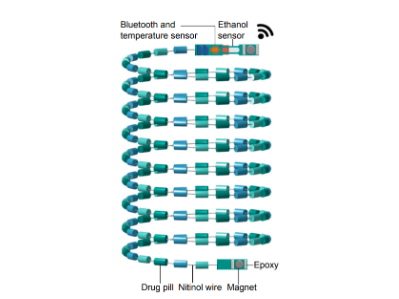
An investigational long-acting direct-acting antiviral delivery system for hepatitis C virus (HCV) treatment, comprising drug-loaded polymeric pills (polycaprolactone or silicone) attached to a superelastic nitinol wire. Following oral administration, the device coils and remains in the stomach, enabling sustained release of antiviral agents, including sofosbuvir, daclatasvir, ledipasvir and ribavirin. The system is designed for prolonged gastric drug delivery and can be retrieved using a nasogastric tube. Integrated sensors monitor device conditions and support wireless data transmission.
Technology highlight
1) Gastric-retentive delivery: An expandable, wire-based device designed to remain in the stomach for prolonged drug delivery. 2) Sustained antiviral release: Polycaprolactone (PCL) and silicone polymer matrices enable controlled release of HCV direct-acting antivirals. 3) Multiple drug compatibility: Demonstrated formulation compatibility with sofosbuvir, daclatasvir, ledipasvir and ribavirin. 4) Prolonged drug exposure: In swine, the system maintained detectable GS-331007 (sofosbuvir's major circulating metabolite) for at least 28 days. 5) Retrievable design: The device can be retrieved using a nasogastric tube, with magnetic components facilitating retrieval. 6) Integrated monitoring: Temperature and ethanol sensors, coupled with Bluetooth connectivity, enable monitoring of the device.
Technology main components
1. Antiviral drug-loaded polymeric pills: sofosbuvir, daclatasvir, ledipasvir and ribavirin. 2. Polymer matrices: Polycaprolactone (PCL) and silicone 3. Superelastic nitinol wire 4. Central pill channel 5. Magnetic components 6. Epoxy components 7. Integrated sensors 8. Wireless communication system 9. Nasogastric administration and retrieval mechanism
Information on the raw materials sourcing, availability and anticipated price
Not provided
Delivery device(s)
Not provided
APIs compatibility profile
API desired features
Water-soluble molecules
Water-insoluble molecules
Small molecules
The LA-DAAS is specifically designed to deliver direct-acting antivirals (DAAs) such as sofosbuvir, daclatasvir, ledipasvir, and ribavirin. These are all standard small-molecule drugs
Additional solubility data
Soluble in water and acetronitrile
Additional stability data
Not provided
API loading: Maximum drug quantity to be loaded
50-75 wt%
API co-administration
4 different APIs : Not provided
LogP
Min: -2.3 Max: 7.4
Scale-up and manufacturing prospects
Scale-up prospects
Not provided
Tentative equipment list for manufacturing
Not provided
Manufacturing
Not provided
Specific analytical instrument required for characterization of formulation
Not provided
Clinical trials
Not providedExcipients
Proprietary excipients used
Not provided
Novel excipients or existing excipients at a concentration above Inactive Ingredients Database (IID) for the specified route of administration
Existing excipients: The formulation uses polycaprolactone (PCL), silicone, poloxamer 407 (P407) and polyethylene glycol (PEG)
Residual solvents used
Not provided
Additional features
Other features of the technology
- Drug-eluting
- At least 1 year shelf life
- Needs insertion kit
Release properties
Preclinical pharmacokinetic and drug-release findings: - An initial burst release was observed within the first 3 hours following administration. - Approximately 15–50% of the initial sofosbuvir load remained in the retrieved pills, indicating incomplete drug release over the study observation period. - The higher-load LA-DAAS formulation (22.4 g) maintained substantial drug release through day 30. - Immediate-release sofosbuvir (400 mg) demonstrated an exposure (AUC) of 698 ± 186 ng/mL × day.
Injectability
Not an injectable
Stability
In vivo stability: All four antiviral agents incorporated into the direct-acting antiviral (DAA) system retained their stability following exposure to 100°C for 3 hours, as reported in the preclinical study.
Storage conditions and cold-chain related features
Not provided
Safety, Efficacy and Evidence Summary
Safety
In a 30-day preclinical evaluation in Yorkshire swine shows no observed weight loss, gastrointestinal obstruction, restriction of food or liquid passage, gastric mucosal injury, erosions or ulceration.
Efficacy
In vivo antiviral efficacy against HCV was not demonstrated in infected animals or humans
Evidence Summary
In a 30-day preclinical evaluation in Yorkshire swine (n=3), the gastric-retentive device was reportedly well tolerated, with no observed weight loss, gastrointestinal obstruction, restriction of food or liquid passage, gastric mucosal injury, erosions or ulceration. Animals underwent twice-daily clinical monitoring, with radiography every 3–4 days and endoscopic assessment. Human safety, long-term tolerability and risks associated with device migration or retrieval failure have not been established. Yet, there is no evidence on the efficacy of long-acting direct-acting antiviral systems (LA-DAAS).
Potential application(s)
Therapeutic area(s)
Use case(s)
Use of technology
Ease of administration
- Administered by a community health worker
- Administered by a nurse
- Administered by a specialty health worker
Frequency of administration
Monthly, Every 2 weeks, Every 6 weeks
User acceptance
Targeted user groups
Age Cohort- Adults
- Older Adults
- All
Pregnant individuals
Unspecified
Lactating individuals
Unspecified
Healthy individuals
Unspecified
Comment
Not provided
Potential associated API(s)
sofosbuvir (SOF)
Class(es)
Antivirals for treatment of HCV infections
Development stage
Pre-clinical
Clinical trial(s)
Not provided
Foreseen/approved indication(s)
Hepatitis C virus (HCV) infections
Foreseen user group
Not provided
Foreseen duration between application(s)
Once monthly
Applications to Stringent Regulatory Authorities (SRA) / regulatory approvals
Not provided
daclatasvir (DAC)
Class(es)
Antivirals for treatment of HCV infections
Development stage
Pre-clinical
Clinical trial(s)
Not provided
Foreseen/approved indication(s)
Hepatitis C virus (HCV) infections
Foreseen user group
Not provided
Foreseen duration between application(s)
Once monthly
Applications to Stringent Regulatory Authorities (SRA) / regulatory approvals
Once monthly
ledipasvir (LDV)
Class(es)
Antivirals for treatment of HCV infections
Development stage
Pre-clinical
Clinical trial(s)
Not provided
Foreseen/approved indication(s)
Hepatitis C virus (HCV) infections
Foreseen user group
Not provided
Foreseen duration between application(s)
Once monthly
Applications to Stringent Regulatory Authorities (SRA) / regulatory approvals
Once monthly
ribavirin (RBV)
Class(es)
Antivirals for treatment of HCV infections
Development stage
Pre-clinical
Clinical trial(s)
Not provided
Foreseen/approved indication(s)
Hepatitis C virus (HCV) infections
Foreseen user group
Not provided
Foreseen duration between application(s)
Once monthly
Applications to Stringent Regulatory Authorities (SRA) / regulatory approvals
Not provided
Patent info
There are either no relevant patents or these were not yet submitted to LAPaL
Supporting material
Publications
<p>Verma M, Chu JN, Salama JAF, et al. Development of a long-acting direct-acting antiviral system for hepatitis C virus treatment in swine. <em>Proc Natl Acad Sci U S A</em>. 2020;117(22):11987-11994. doi:10.1073/pnas.2004746117</p>
Malvika Verma — Proceedings of the National Academy of Sciences of the United States of America — 2020-05-18
Summary: Direct-acting antiviral (DAA) therapy is highly effective against hepatitis C virus (HCV). Despite this, the burden of chronic HCV remains high, particularly in populations for whom daily medications can be challenging. The generation of long-acting modes of DAA delivery could thus expand HCV treatment. We have developed a long-acting DAA system (LA-DAAS) that can support multigram-level drug depots of HCV DAAs and provide controlled release of those drugs over the course of weeks. We demonstrate initial safety and efficacy of the LA-DAAS in a swine model. Expanding the range of delivery options of DAAs to patients and healthcare providers will further efforts toward global elimination of HCV infection.
Chronic hepatitis C virus (HCV) infection is a leading cause of cirrhosis worldwide and kills more Americans than 59 other infections, including HIV and tuberculosis, combined. While direct-acting antiviral (DAA) treatments are effective, limited uptake of therapy, particularly in high-risk groups, remains a substantial barrier to eliminating HCV. We developed a long-acting DAA system (LA-DAAS) capable of prolonged dosing and explored its cost-effectiveness. We designed a retrievable coil-shaped LA-DAAS compatible with nasogastric tube administration and the capacity to encapsulate and release gram levels of drugs while resident in the stomach. We formulated DAAs in drug–polymer pills and studied the release kinetics for 1 mo in vitro and in vivo in a swine model. The LA-DAAS was equipped with ethanol and temperature sensors linked via Bluetooth to a phone application to provide patient engagement. We then performed a cost-effectiveness analysis comparing LA-DAAS to DAA alone in various patient groups, including people who inject drugs. Tunable release kinetics of DAAs was enabled for 1 mo with drug–polymer pills in vitro, and the LA-DAAS safely and successfully provided at least month-long release of sofosbuvir in vivo. Temperature and alcohol sensors could interface with external sources for at least 1 mo. The LA-DAAS was cost-effective compared to DAA therapy alone in all groups considered (base case incremental cost-effectiveness ratio $39,800). We believe that the LA-DAA system can provide a cost-effective and patient-centric method for HCV treatment, including in high-risk populations who are currently undertreated.
Additional documents
No documents were uploaded
Useful links
There are no additional links
Additional information
Illustrations
The LA-DAAS consists of a series of drug pills on a coiled superelastic nitinol wire with end protected with epoxy and a magnet for retrieval. One end of the LA-DAAS is equipped with a Bluetooth
Verma M, Chu JN, Salama JAF, et al. Development of a long-acting direct-acting antiviral system for hepatitis C virus treatment in swine. Proc Natl Acad Sci U S A. 2020;117(22):11987-11994. doi:10.1073/pnas.2004746117
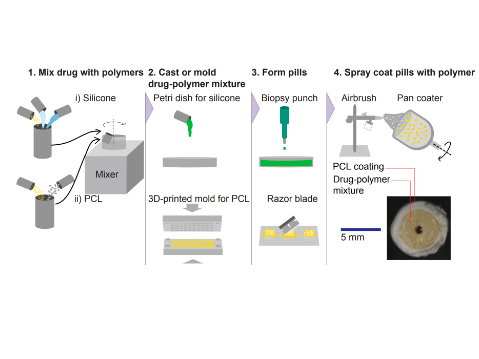
Drug–polymer pills are made by mixing drug with either silicone or PCL and then casting into a Petri dish or a three-dimensional (3D) printed mold.
Verma M, Chu JN, Salama JAF, et al. Development of a long-acting direct-acting antiviral system for hepatitis C virus treatment in swine. Proc Natl Acad Sci U S A. 2020;117(22):11987-11994. doi:10.107