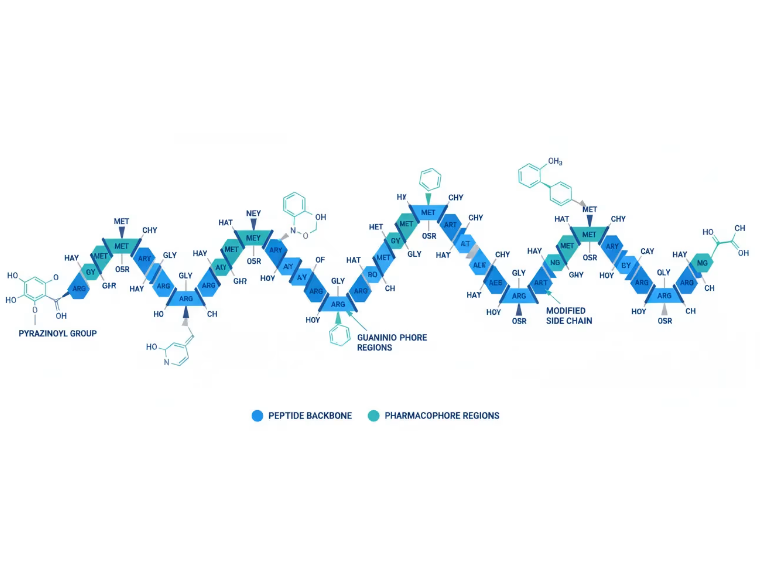
Type of technology
peptide lipidation technology
Administration route
Subcutaneous, Oral
Development state and regulatory approval
Glucagon-like peptide-1 (GLP-1) analogues and associated (GLP-1)
Phase III
Not provided
Description
The HALO (Half-life Augmented Ligand Oligomer) is a peptide lipidation–based drug delivery technology designed to extend the PK of peptide therapeutics, particularly glucagon-like peptide‑1 (GLP‑1) analogues. This approach involves the covalent conjugation of lipid moieties to peptide backbones, a process commonly referred to as peptide lipidation. The resulting modified peptides exhibit prolonged systemic exposure due to reduced clearance and enhanced stability, enabling extended dosing intervals. In addition, the sustained pharmacokinetic profile minimizes peak-to-trough fluctuations.
Developer(s)
Metsera
Metsera is a recent (2022) biotechnology startup that rapidly grew due to its innovative obesity drug pipeline. Within just a few years, it progressed from early development to IPO and major acquisition by Pfizer, highlighting the high strategic importance of obesity therapeutics in the pharmaceutical industry. In October 2025, merging of Metsera with Pfizer was completed.
Pfizer
Pfizer is a global biopharmaceutical company headquartered in New York, USA, and is one of the world’s leading developers of innovative medicines and vaccines. Founded in 1849, Pfizer focuses on key therapeutic areas such as oncology, vaccines, internal medicine, and inflammation, with the goal of improving health and extending life worldwide.
Technology highlight
1. Enhances plasma protein binding, particularly to albumin, thereby increasing systemic retention. 2. Reduces renal clearance, contributing to prolonged circulation time. 3. Improves resistance to enzymatic degradation, including proteolytic cleavage. 4. Enables the development of ultra‑long‑acting peptide therapeutics with extended pharmacokinetic and pharmacodynamic profiles. 5. HALO utilizes proprietary oligonucleotide sequence which reduces renal clearance.
Illustration(s)
Technology main components
1) Proprietary Oligonucelotide carrier 2) GLP-1 peptide 2) Proprietary Linker (spacer region) 3) Lipid moiety (fatty acid chain) 4) Stabilizing amino acids
Not provided
Safety, Efficacy and Evidence Summary
No AE-related discontinuations occurred. Common GI AEs (nausea/vomiting) were mostly mild and within the first few weeks of dosing. By day 36 post-treatment, MET097 caused dose-dependent clinically meaningful weight loss, which was maintained through day 85, 8 wks after the last dose.
Not provided
Not provided
Not provided
APIs compatibility profile
GLP-1 peptide analogues, NuSH (Nutrient-Stimulated Hormone) analog peptides and other analogues used in the treatment of Overweight and obesity are the targeted molecules for HALO peptide lipidated complex.
Not provided
Not provided
75-90 wt%
1 single API :
Not provided
Scale-up and manufacturing prospects
MET-097 (PF-08653944) is planned to be scaled and manufactured by Pfizer, Inc at their Andover, Massachusetts (mammalian cell platform) and Kalamazoo, Michigan (sterile injectables) sites in the United States of America.
Not provided
Not provided
Not provided
Excipients & delivery device(s)
No proprietary excipient used
No novel excipient or existing excipient used
No residual solvent used
No delivery device
Additional features
Not provided
Based on preclinical studies, pharmacokinetic analysis revealed that MET-097 has a mean time to peak concentration of approximately 18 days, with predictable, dose-proportional plasma levels and minimal variability. The accumulation ratio after five weekly doses was approximately three, and a two-fold dose increase resulted in a predictable rise in drug exposure.
HALO™ technology–based therapeutics are administered via subcutaneous injection using a 23‑ to 25‑gauge needle, consistent with standard clinical practice for injectable peptide therapeutics.
Not provided
Not provided
Therapeutic area(s)
- Diabetes : "T2DM"
- Other(s) : "Cardiovascular diseases, Inflammation, Metabolic disorders"
- Obesity / Weight Management
- Treatment
Potential associated API(s)
- Glucagon-like peptide-1 (GLP-1) analogues and associated (GLP-1)
- Glucagon-like peptide-1 (GLP-1) analogues and associated (GLP-1)
- Glucagon-like peptide-1 (GLP-1) analogues and associated (GLP-1)
- MET-233i
Use of technology
- Administered by a community health worker
- Administered by a nurse
- Administered by a specialty health worker
- Self-administered
Weekly, Monthly
Targeted user groups
- Adults
- Older Adults
- All
Unspecified
Unspecified
Unspecified
Not provided
Glucagon-like peptide-1 (GLP-1) analogues and associated (GLP-1)
Anti-obesity agent
Phase III
Obesity and over-weight management
Male or female adults, aged ≥18 years with BMI ≥27.0 kg/m2
Once monthly; Once weekly
Not provided
Glucagon-like peptide-1 (GLP-1) analogues and associated (GLP-1)
Anti-Obesity Agent
Phase I
Not provided
Not provided
Not provided
Not provided
Not provided
Glucagon-like peptide-1 (GLP-1) analogues and associated (GLP-1)
Anti-Obesity Agent
Pre-clinical
Not provided
Not provided
Not provided
Not provided
Not provided
MET-233i
Amylin Analog - Ultra-Long-Acting Amylin Receptor Agonist
Phase I
Not provided
Obesity or Overweight
Not provided
Once monthly
Not approved yet
There are either no relevant patents or these were not yet submitted to LAPaL
Partnerships
No partner indicated
All sponsors
No sponsor indicated