Technology name
Last update: Sep 2026Drug Combination Nanoparticles (DcNP)
Developer(s)
Sponsor(s)

Type of technology
Based on other organic particles, Aqueous drug particle suspension
Administration route
Subcutaneous
Development state and regulatory approval
Lamivudine (3TC), Dolutegravir (DTG), Tenofovir (TFV)
Phase I
Not provided
Description
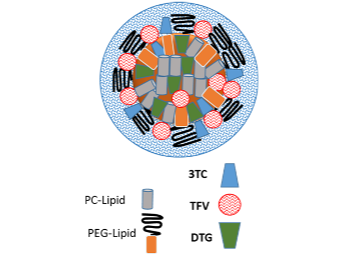
A targeted and long-acting Drug combination Nano-Particle (DcNP) platform that enables transformations of existing and new drug entities from short-acting daily doses to a long-acting drug combination for a maximum therapeutic effect through sustained viral suppression. Developed by Targeted & Long-acting drug Combination (TLC) Program at University of Washington.
Developer(s)

University of Washington
The purpose of the Targeted Long-acting Combination AntiRetroviral Therapy (TLC-ART) program is to develop one or more safe, stable, scalable and tolerable long acting antiretroviral combinations for treatment of HIV infection.
Technology highlight
TLC's enabling DcNP technology has been validated to work with a number of current HIV drug combinations using clinics in both pediatric and adult populations. A number of these formulations have been evaluated in non-human primate models to provide both plasma and cell drug levels that persist for weeks after a single subcutaneous injection. This technology has been shown to bring together water soluble (such as tenofovir and lamivudine) and insoluble (such as lopinavir, ritonavir, atezenovir, and dolutegravir) drugs into an all-in-one long-acting injectable product. At least 4 formulations have been tested in NHP to have long-acting plasmakinetics for all drugs and are targeted to enhanced drug levels above plasma drug combinations in HIV host cells-PBMCs.
Illustration(s)
Technology main components
Drug API and common lipid excipients used in pharmaceutical formulations.
The existing HIV drug APIs can be sourced through WHO pre-qualified raw material suppliers.
Safety, Efficacy and Evidence Summary
Not provided
Not provided
Not provided
Not provided
APIs compatibility profile
Tenofovir, Lamivudine, Dolutegravir, Lopinavir, Ritonavir, Atazanavir, Efavirenz
Not provided
Not provided
10-30 wt%
4 different APIs : 2 to 4 different drugs in a single injection are being investigated
Not provided
Scale-up and manufacturing prospects
Good
Spray-dryer; homogenization; size-reduction
Injectable cGMP facilties
Not provided
Excipients & delivery device(s)
No proprietary excipient used
No novel excipient or existing excipient used
No residual solvent used
No delivery device
Additional features
- Biodegradable
- Non-removable
- Room temperature storage
- At least 1 year shelf life
Intracellular uptake and accessible by cellular enzymes to transform into active metabolites such as TFV-DP and 3TC-TP.
Not provided
Not provided
No cold-chain needed
Therapeutic area(s)
- HIV
- Treatment
Potential associated API(s)
- Lamivudine (3TC) , Dolutegravir (DTG) , Tenofovir (TFV)
- Lopinavir and ritonavir (LPV/r) , Tenofovir (TFV)
- Tenofovir-Lamivudine-Dolutegravir (TLD) - long-acting injectable (LAI) (TLD LAI)
Use of technology
- Administered by a community health worker
- Administered by a nurse
- Administered by a specialty health worker
- Self-administered
Monthly
Targeted user groups
- Adults
- Male
- Female
- Cisgender female
- Cisgender male
- Transgender female
- Transgender male
- Intersex
- Gender non-binary
- All
Unspecified
Unspecified
No
Not provided
Lamivudine (3TC) , Dolutegravir (DTG) , Tenofovir (TFV)
Antiviral
Phase I
Not provided
Treatment for people living with HIV
People living with HIV
1 month
Not provided
Lopinavir and ritonavir (LPV/r) , Tenofovir (TFV)
antiviral
Pre-clinical
Not provided
Treatment for people living with HIV to provide sustained viral suppression
People living with HIV
1 month
Not provided
Not provided
Pre-clinical
Not provided
HIV treatment
Adults living with HIV
1 month
Not provided