Drug name
Last update: Oct 2026Cabotegravir + Rilpivirine
Developer(s)
Drug information
Cabotegravir + Rilpivirine
Cabenuva (Cabotegravir and Rilpivirine co-packaged medication) and Vocabria (Cabotegravir) co-administered with Rekambys (Rilpivirine)
Small molecule
INSTI (Integrase Strand Transfer Inhibitor), NNRTI (Non-Nucleoside Reverse Transcriptase Inhibitor) — INSTI+NNRTI
Approved / Marketed
Long-acting injectable Cabotegravir and Rilpivirine (CAB/RPV-LA) is a complete treatment regimen for HIV-1 infection consisting of two components: (1) Cabotegravir a HIV-1 integrase strand transfer inhibitor (INSTI) developed by ViiV Healthcare and (2) Rilpivirine a second-generation non-nucleoside reverse transcriptase inhibitor (NNRTI) manufactured by Janssen. CAB/RPV-LA is designated for the treatment of HIV-1 infection.
Cabotegravir and Rilpivirine extended-release injectable suspensions co-packaged as CABENUVA is approved by several Stringent Regulatory Authorities. Individually packaged extended-release Cabotegravir (VOCABRIA) and extended-release Rilpivirine (REKAMBYS) are approved for co-administration by various regulatory authorities for the treatment of HIV-1 infection. Oral and injectable versions are available.
CAB + RPV combination for HIv treatment is approved by several SRAs. At the moment, this combination is specifically indicated for virologically suppressed adults with HIV-1 infection (HIV-1 RNA <50 copies per millilitre [c/ml]), weighing at least 35 kg. Eligible patients must have previously maintained stability on a treatment regimen without experiencing treatment failure or showing signs of resistance to Rilpivirine/Cabotegravir. There are several studies investigating its use in adults who are not virally suppressed, as well as in children and in adolescents.
Therapeutic area(s)
- HIV
- Treatment
Administration route
Oral, Intramuscular
Associated long-acting platforms
Aqueous drug particle suspension, Oral solid form
Use of drug
- Administered by a nurse
- Administered by a specialty health worker
- Self-administered
- Administered by a community health worker
- Monthly
- Every 2 months
Dosage
Not provided
Not provided
Not provided
Not provided
Not provided
Not provided
Related entries
Cabotegravir (CAB)
Rilpivirine (RPV)
CAB 6 times a year (CAB-LA; Cabotegravir 2-monthly)
Cabotegravir + Lenacapavir
Cabotegravir + Rilpivirine 3 times a year (CAB4M + RPV4M)
Cabotegravir 3 times a year (CAB 4M)
cabotegravir PH20
Rilpivirine 2-monthly
Rilpivirine Prodrug Nanoformulation (NM3RPV)
Additional information
Cabotegravir for PrEP is included in WHO guidelines. CAB+RPV LA injectable for treatment, is also recommended by WHO to be used as an alternative switching option for adults and adolescents with undetectable HIV viral load on oral ART and without active hepatitis B infection : https://www.who.int/teams/global-hiv-hepatitis-and-stis-programmes/guidelines
ViiV Healthcare and Medicines Patent Pool have signed a voluntary licensing agreement to enable access to long-acting injectable cabotegravir for HIV PrEP and HIV treatment https://tinyurl.com/VL-CAB-MPP
Developer(s)

ViiV Healthcare
ViiV Healthcare is a pharmaceutical company that specializes in the development of therapies for HIV infection. The company is headquartered in Brentford in the United Kingdom and was initially formed in November 2009 as a part of a joint venture between GlaxoSmithKline and Pfizer.

Johnson & Johnson
Janssen Pharmaceuticals is a subsidiary company of Johnson & Johnson headquartered in Beerse, Belgium. They manufacture and develop pharmaceutical products for use in areas such as, Immunology, Infectious Diseases & Vaccines, Pulmonary Hypertension, Cardiovascular & Metabolism, Oncology, and Neuroscience.
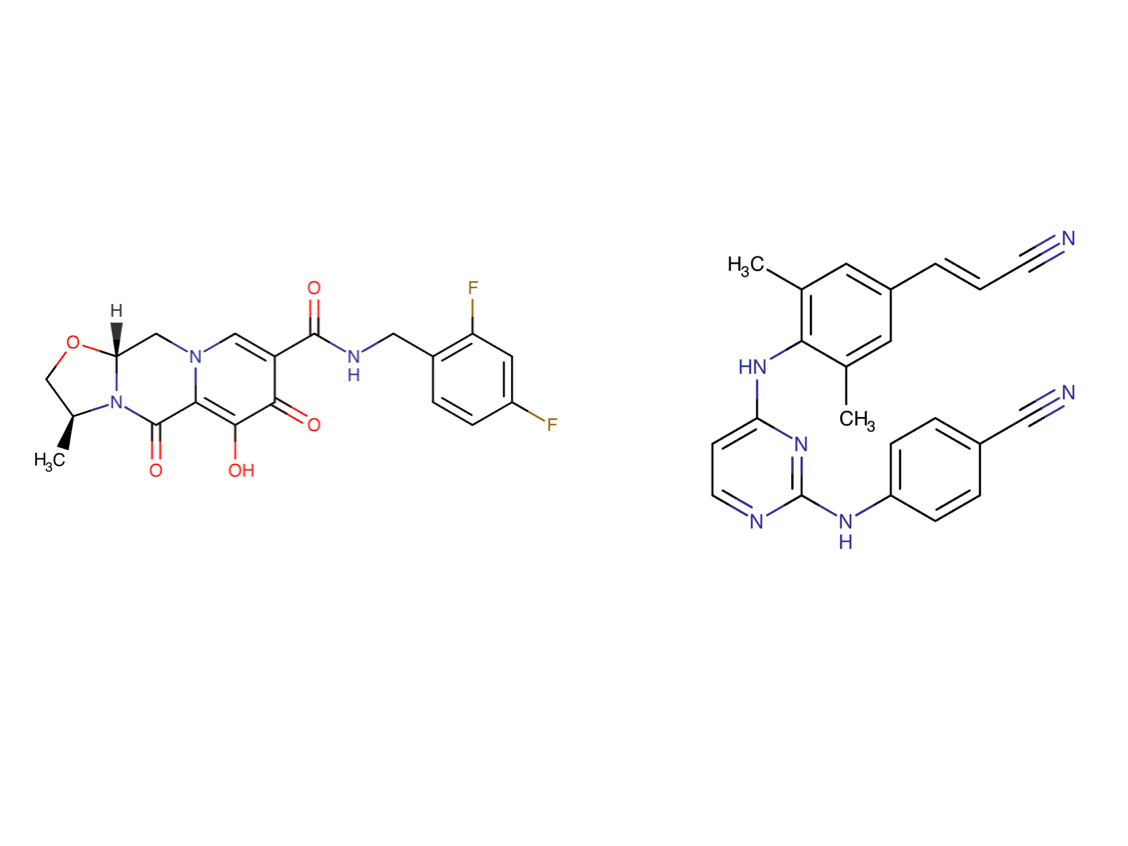
Drug structure
Scale-up and manufacturing prospects
Compounds are commercially manufactured.
Conventional wet-bead milling apparatus (e.g. Netzsch ball mill), depyrogenated glass vials, high pressure homogenizer.
Cabotegravir and Rilpivirine are formulated into a wet-mill suspension of approximately 200mg/ml and 300mg/ml respectively, due to their low aqueous solubility. This formulation results in the creation of nanocrystal drug particles which are amenable for intramuscular gluteal depot injection. The manufacturing process for RPV is considered to be non-standard due to the inclusion of an aseptic processing step. RPV is light-sensitive, and exposure to light can induce conversion into a Z-isomer form which can affect pharmacokinetic data and activity.
PANalytical X’Pert PRO diffractometer equipped with a theta/theta coupled goniometer (or equivalent x-ray powder diffractor), Mettler TGA/DSC 1 instrument for thermal analysis, Laser diffractor (determine particle size), FT-IR UHPLC (chemical identification), UHPLC (chromatographic purity), paddle apparatus & UPLC/UV (determine in-vitro drug release for QC / dissolution testing).
Excipients & delivery device(s)
No proprietary excipient used
The novel excipient poloxamer 338 (P338) is used in the final G001 Rilpivirine clinical formulation. Following both an in-vitro mammalian chromosome aberration and an Ames test, it was considered to be non-genotoxic with no evidence for mutagenicity. Further P338 fertility, genotoxicity and development studies have been conducted with no negative effects, in addition to a 6-week and 9- month minipig repeat-dose toxicity study. No adverse local or systemic toxicity was reported in the minipigs at 100mg/month (Margin of Exposure:19).
No residual solvent used
No delivery device
Safety, Efficacy and Evidence Summary
Not provided
Not provided
Not provided
Not provided