Drug name
Last update: Oct 2026survodutide
Developer(s)
Drug information
Not provided
survodutide ; BI 456906
Not provided
Biotherapeutic
Glucagon receptor / GLP-1 receptor dual agonist (incretin-based peptide)
Active / In Development (Phase 1/2/3) — Highest reported development stage: Phase III. Obesity/overweight (SYNCHRONIZE programme): Phase III, with SYNCHRONIZE-1, -2 and -MASLD reported and SYNCHRONIZE-CVOT completed (results expected late 2026); type 2 diabetes (glycaemic control): Phase III started August 2026; MASH with F2-F3 fibrosis (LIVERAGE) and compensated MASH cirrhosis (LIVERAGE-Cirrhosis): Phase III, recruiting; CKD with albuminuria (ARTIST-CKD): Phase II, not yet recruiting. Not approved in any jurisdiction as of 9 October 2026.
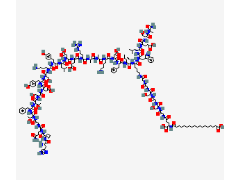
Survodutide (BI 456906) is an investigational, once-weekly, subcutaneous dual agonist of the glucagon receptor (GCGR) and the GLP-1 receptor (GLP-1R), developed and commercialised globally by Boehringer Ingelheim under licence from Zealand Pharma. It is a 29-amino-acid glucagon-based synthetic peptide (C192H289N47O61; MW 4231.7 Da) containing 1-aminocyclobutane-1-carboxylic acid (Ac4c) at position 2 and a C-terminal amide; a lysine side chain carries a C18 fatty diacid (17-carboxyheptadecanoyl) attached through a gamma-glutamic acid / Gly-Ser-Gly-Ser-Gly-Gly linker. Acylation with the C18 fatty acid extends the half-life to support once-weekly dosing. In vitro, it is a potent agonist at both receptors (EC50 0.33 nM at GLP-1R and 0.52 nM at GCGR, cAMP assays in CHO-K1 cells). GLP-1R agonism reduces food intake and improves glycaemia, while GCGR agonism increases energy expenditure and acts directly on the liver to increase fatty-acid oxidation and reduce liver fat. It is being developed for obesity (with and without type 2 diabetes), MASLD/MASH including compensated cirrhosis, cardiovascular risk reduction and chronic kidney disease.
Not approved by any regulatory authority; investigational and available only through clinical trials. Boehringer Ingelheim has not publicly announced a regulatory submission timeline for obesity, type 2 diabetes or MASH as of 9 October 2026. Expedited designations (all for MASH with fibrosis): US FDA Fast Track (May 2021) and Breakthrough Therapy (September 2024) for non-cirrhotic MASH with F2-F3 fibrosis; EMA PRIME (November 2023); China NMPA Breakthrough Therapy (June 2024); Taiwan FDA Breakthrough designation (September 2024).
No submissions announced. Expedited designations: US FDA (Fast Track, Breakthrough Therapy), EMA (PRIME), China NMPA (Breakthrough Therapy), Taiwan FDA (Breakthrough). No WHO Prequalification, WHO EML listing or WHO guideline recommendation (investigational product).
Therapeutic area(s)
- Diabetes : "T2D"
- Cardiovascular
- Obesity / Weight Management : "Weight management"
- Metabolic Dysfunction-Associated Steatohepatitis (MASH/NASH) : "MASH and compensated MASH cirrhosis"
- Kidney Disease
- Treatment
Administration route
Subcutaneous
Associated long-acting platforms
Albumin-binding peptide conjugate, Peptide lipidation (C18 fatty diacid acylation enabling reversible albumin binding)
Use of drug
- Self-administered
- Weekly
- Other/Variable/Unknown : twice weekly
Dosage
0.3 mg, 0.6 mg, 1.2 mg, 2.4 mg, 3.6 mg, 4.8 mg, 6 mg. Maintenance doses in Phase III: 3.6 mg and 6.0 mg once weekly. Phase II tested 0.3 to 6.0 mg once weekly (and 1.2 and 1.8 mg twice weekly in
6.0 mg
Once weekly (QW) subcutaneous injection (investigational), escalated to a maintenance dose of 3.6 mg or 6.0 mg.
Phase III (SYNCHRONIZE-1 and -2) uptitrated participants to 3.6 mg or 6.0 mg with limited dose flexibility permitted; SYNCHRONIZE-MASLD and LIVERAGE use up to 6.0 mg. Phase II showed most GI events and discontinuations occurred during rapid dose escalation, and the authors suggested slower escalation could reduce them. Boehringer is testing more flexible titration in SYNCHRONIZE-START. The full Phase III escalation schedule (starting dose and step intervals) is described in the trial design papers and should be confirmed there. The labelled regimen will be determined at regulatory review.
Not provided
Related entries
Not provided
Additional information
Developer(s)

Boehringer Ingelheim
Drug structure
Scale-up and manufacturing prospects
As a 29-residue lipidated peptide with one non-proteinogenic amino acid (Ac4c) and a long linker, survodutide requires specialised peptide API synthesis and purification capacity.
Not provided
Synthetic acylated peptide. Manufacturing process, formulation composition and container closure have not been publicly disclosed.
Not provided
Excipients & delivery device(s)
Not provided
Not provided
Not provided
Pre-filled syringe/pen-like injector to be confirmed.
Safety, Efficacy and Evidence Summary
Safety profile consistent with GLP-1 receptor agonist-based therapies; gastrointestinal adverse events are dominant, dose-dependent and concentrated in the dose-escalation phase. GI-related discontinuation is relatively high in some clinical trials. BI attributed the high discontinuation partly to a rigid titration protocol; newer trials allow more flexible titration. Data gaps: long-term safety, cardiovascular outcomes (glucagon receptor agonism may raise heart rate and affect amino-acid metabolism - ongoing CT assessing this), pregnancy and lactation, paediatric/adolescent use, and populations in LMIC settings.
Boehringer reports MASH improvement, liver-fat reduction, weight loss and glycemic targets improvements. Pending: cardiovascular outcomes, histological and clinical liver outcomes, kidney outcomes. No head-to-head Phase III trial against approved incretin therapies has been registered.
Survodutide gives weight reduction broadly comparable to semaglutide 2.4 mg (indirect comparison). Its differentiating feature is the liver: histology and imaging data show strong effects on MASH resolution and liver fat, supported by FDA Breakthrough Therapy and EMA PRIME designations. Tolerability with the current titration scheme led to GI-related discontinuation rates (about 18%).
Not provided
There are either no relevant patents or these were not yet submitted to LAPaL