Drug name
Last update: Oct 2026retatrutide
Developer(s)
Drug information
retatrutide ; LY-3437943; RETA; GLP-3;GLP3
investigational
Biotherapeutic
incretin-based peptide: GIP receptor / GLP-1 receptor / glucagon receptor triple agonist; GGG Tri-Agonist; Multi-target incretin/metabolic hormone pathway agent
Active / In Development (Phase 1/2/3) — Highest reported development stage: Phase III (T2DM: Phase III; Obesity: Phase III; CKD: Phase II). It is being developed for obesity and its complications (knee osteoarthritis pain, obstructive sleep apnoea, chronic low back pain, cardiovascular and renal outcomes)
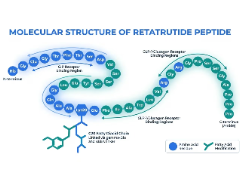
Retatrutide is an investigational, once-weekly, subcutaneous single-molecule agonist of the glucose-dependent insulinotropic polypeptide (GIP), glucagon-like peptide-1 (GLP-1) and glucagon receptors, discovered and developed by Eli Lilly. It is a 39-amino-acid synthetic peptide (C221H342N46O68; MW 4731.3 Da) containing three non-coded amino acids (2-aminoisobutyric acid at positions 2 and 20, alpha-methyl-leucine at position 13) and a C-terminal amide; lysine 17 carries a C20 fatty diacid attached through a gamma-glutamic acid / AEEA linker. The lipid moiety binds reversibly to serum albumin, giving a half-life of approximately 6 days that supports once-weekly dosing. In vitro (cAMP, HEK293 cells) retatrutide is most potent at the GIP receptor (EC50 0.064 nM), followed by the GLP-1 receptor (0.775 nM) and the glucagon receptor (5.79 nM). Glucagon receptor agonism is thought to add increased energy expenditure and hepatic fat reduction to the appetite-suppressing and glycaemic effects of GIP/GLP-1 agonism.
Investigational, not approved by any regulatory authority. On 23 July 2026 Lilly announced it is completing the Chemistry, Manufacturing and Controls (CMC) package and plans to submit a Biologics License Application (BLA) to the US FDA in Q1 2027, stating the clinical data package supports global submissions for obesity, knee osteoarthritis pain and obstructive sleep apnoea. Earlier in 2026 Lilly had listed retatrutide among possible submissions by end-2026; the delay was attributed to gathering additional manufacturing and quality-control data.
No regulatory authority has received a submission to date. Planned first submission: US FDA (BLA, Q1 2027). No submissions to other national regulatory authorities have been announced. No WHO Prequalification, WHO EML listing or WHO guideline recommendation (investigational product).
Therapeutic area(s)
- Diabetes : "Type 2 Diabetes (investigational)"
- Obesity / Weight Management : "Obesity (investigational)"
- Metabolic Dysfunction-Associated Steatohepatitis (MASH/NASH) : "MASH (investigational)"
- Pain management (incl. joints, lower back, knee)
- Obstructive sleep apnea
- Cardiovascular : "MACE"
- Ostheoarthritis
- Kidney Disease
- Treatment
Administration route
Subcutaneous
Associated long-acting platforms
Fusion protein or PEGylated conjugate
Use of drug
- Self-administered
- Weekly
Dosage
2 mg, 4 mg, 6 mg, 9 mg, 12 mg
12 mg
Once weekly (QW) subcutaneous
Not provided
Not provided
Related entries
Not provided
Additional information
Developer(s)

Eli Lilly
Drug structure
Scale-up and manufacturing prospects
Not provided
Not provided
Not provided
Not provided
Excipients & delivery device(s)
Not provided
Not provided
Not provided
injector
Safety, Efficacy and Evidence Summary
-Safety profile broadly consistent with GLP-1 receptor agonist-based therapies, with dose-dependent adverse events occurring mainly during dose escalation (nausea, diarrhoea, constipation, vomiting) -No severe hypoglycaemia in type 2 diabetes trials -Discontinuations due to AEs including discontinuations for perceived excessive weight loss -Data gaps: long-term safety, pregnancy and lactation, paediatric/adolescent use, and populations in LMIC settings. -Adverse events of special interest for retatrutide: -- Dysaesthesia (abnormal skin sensation) --Urinary tract infections modestly increased --Hypotension: dose-dependent, more frequent in participants taking antihypertensives. --Heart rate: dose-dependent increase peaking then declining; cardiac arrhythmias --Pancreatitis: one case
-Weight reduction (obesity without diabetes): TRIUMPH-1: 45.3% of 12 mg participants lost >=30% of body weight; up to -30.3% at 104 weeks in the BMI >=35 extension. - Glycemic control (obesity with type 2 diabetes): TRIUMPH-2: HbA1c -1.5% vs -0.2% (baseline 7.7%). -Comorbidities: --TRIUMPH-4 (68 weeks, knee osteoarthritis): WOMAC pain -75.8% / -74.3% vs -40.3% placebo --TRIUMPH-1 OSA basket: apnoea-hypopnoea index reduced by 22.9-34.3 events/hour vs 9.9 with placebo. -Liver: MASLD substudy : relative liver-fat reduction up to 86% at 48 weeks (12 mg); steatosis resolved in >85% of participants (8 and 12 mg). -Pending: head-to-head trials vs tirzepatide (TRIUMPH-5) and semaglutide (TRANSCEND-T2D-2), and cardiovascular/renal (TRIUMPH-OUTCOMES) and liver outcomes (SYNERGY-Outcomes)
Retatrutide produces the largest mean weight reductions reported to date for a pharmacological agent in Phase III (about 28% at 80 weeks at 12 mg), approaching bariatric-surgery outcomes, with clinically meaningful improvements in glycaemia, knee osteoarthritis pain, obstructive sleep apnoea and cardiometabolic risk factors. Limitations: cardiovascular, renal and liver outcome data are pending; comparative efficacy vs tirzepatide is not yet reported; tolerability at higher doses (GI events, dysaesthesia, discontinuations in lower-BMI participants) may restrict use to selected populations; all trials are sponsor-funded and conducted predominantly in high- and upper-middle-income countries.
Not provided
There are either no relevant patents or these were not yet submitted to LAPaL