Drug name
Last update: Aug 2026Fluphenazine
Developer(s)
Drug information
Fluphenazine decanoate
Prolixin
Small molecule
Not provided
Not provided
1) Prolixin is a trifluoromethyl phenothiazine derivative which blocks postsynaptic mesolimbic D1, D2 Dopaminergic receptors, 5HT 2A, 2C, and calmodulin receptors in the brain. 2) Prolixin decanoate intramuscular is used for the treatment of chorea, depression, psychotic disorders, and Tourette syndrome. 3) Half-life (t1/2) is 6.8 to 9.6 days. 4) The onset of action generally appears between 24 and 72 hours after injection. 5) Dose interval of 2 to 5 weeks. 6) Not recommended for children, and safety for the use of this drug during pregnancy has not been established yet. 7) Excipients include: Benzyl alcohol, Sesame oil etc.
Due to a shortage of raw materials, Fluphenazine is only available in United States of America, Canada, United Kingdom, Nigeria, and Australia & New Zealand
Fluphenazine decanoate USP 25mg/mL and 100mg/mL is approved by United States Food Drug Administration, Health Canada, Therapeutic Goods Administration, Medicines and Healthcare Products Regulatory Agency, MedSafe, and the National Agency for Food and Drug Administration and Control
Therapeutic area(s)
- Mental Health Disorders (incl. schizophrenia, bipolar disorders, Schiz. Aff. Dis.)
- Treatment
Administration route
Intramuscular, Subcutaneous
Associated long-acting platforms
Oil depot
Use of drug
- Administered by a community health worker
- Administered by a nurse
- Administered by a specialty health worker
- Other/Variable/Unknown : Q2W; Q3W; Q4W; Q6W
Dosage
Fluphenazine decanoate USP 25mg/mL (5 mL multidose vial); 100mg/mL (2 mL multidose vial)
100 mg
• Fluphenazine decanoate 12.5 to 25 mg (0.5 to 1 mL) IM may be given to initiate therapy. • Subsequent injections and the dosage interval are determined in accordance with the patient’s response. When administered as maintenance therapy, a single injection may be effective in controlling schizophrenic symptoms for up to four weeks or longer.
Not provided
Related entries
Not provided
Additional information
Developer(s)

Bristol Myers Squibb
Bristol Myers Squibb (BMS) is a large, multinational biopharmaceutical company. It was founded in 1887. They focus on discovering, developing, and delivering innovative medicines for patients with serious diseases, particularly in areas like oncology, hematology, cardiology, immunology, and fibrosis. BMS is known for its strong commitment to patients and its dedication to scientific innovation
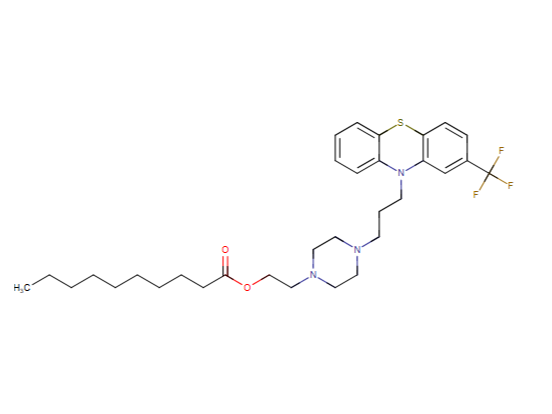
Drug structure
Scale-up and manufacturing prospects
Prolixin is commercially manufactured by Bristol-Myers Squibb at 125-199.64 USD per 5 mL vial.
• Jacketed stirred tank reactors • Pipeline/feed pumps • Circulation pump • Gas-liquid separators • Distillation • Mixing vessels and filtration system
Compliant with aseptic conditions of GMP: • Active Ester synthesis using decanoic acid and dehydrating agents • Scale up in controlled reaction conditions • Depot formulation preparation—oil-based injectable depot prepared using sesame oil and benzyl alcohol, PEG 300/400, solubilizers, and poloxamer surfactants (poloxamer 407/188).
• High-Performance Liquid Chromatography (HPLC UV/DAD/PDA) • Liquid Chromatography–Mass Spectrometry (LC–MS/MS) • Gas Chromatography–Mass Spectrometry (GC–MS) • Differential Scanning Calorimetry (DSC)
Excipients & delivery device(s)
No proprietary excipient used
Benzyl alcohol and poloxamer 407/188
No residual solvent used
No delivery device
Safety, Efficacy and Evidence Summary
Not provided
Not provided
Not provided
Not provided
Fluphenazine compound
This invention relates to new 10-(piperazinylalkyl) perfluoroalkylphenothiazine derivatives The novel compounds of this invention are of value as therapeutic agents. More specifically, the compounds of this invention have utility as antiemetics, tranquilizers, antihistaminics, spasmolytics, antishock agents and potentiators of various drugs such as analgetics and anesthetics When used as tranquilizers, these compounds have the ability to abate mental disturbances such as anxiety, confusion or excitation without physical incapacitation In addition, these compounds have chemotherapeutic or antimicrobial activity, such as antibacterial and fungicidal activity Further, the novel compounds of this invention have a surprisingly low degree of toxicity.
US3058979
Compound
SMITH KLINE FRENCH LAB
Not provided
May 13, 1977
Expired (US, GB)