
|
Developed by 

|
Supported by 


|
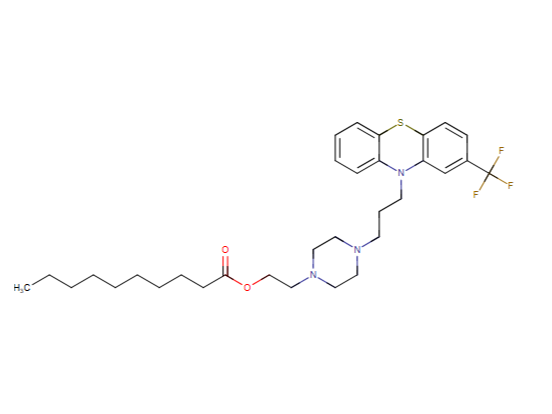
Fluphenazine
Developer(s)

|
Bristol Myers Squibb Originator
https://www.bms.com/gb
United States of America Bristol Myers Squibb (BMS) is a large, multinational biopharmaceutical company. It was founded in 1887. They focus on discovering, developing, and delivering innovative medicines for patients with serious diseases, particularly in areas like oncology, hematology, cardiology, immunology, and fibrosis. BMS is known for its strong commitment to patients and its dedication to scientific innovation |
Drug structure
2-(4-{3-[2-(trifluoromethyl)-10H-phenothiazin-10-yl]propyl}piperazin-1-yl)ethyl decanoate
https://go.drugbank.com/salts/DBSALT000776
Drug information
Associated long-acting platforms
Oil depot
Administration route
Intramuscular, Subcutaneous
Therapeutic area(s)
Use case(s)
Use of drug
Ease of administration
Frequency of administration
User acceptance
Dosage
Available dose and strength
Fluphenazine decanoate USP 25mg/mL (5 mL multidose vial); 100mg/mL (2 mL multidose vial)
Maximum dose
100 mg
Recommended dosing regimen
• Fluphenazine decanoate 12.5 to 25 mg (0.5 to 1 mL) IM may be given to initiate therapy. • Subsequent injections and the dosage interval are determined in accordance with the patient’s response. When administered as maintenance therapy, a single injection may be effective in controlling schizophrenic symptoms for up to four weeks or longer.
Additional comments
Not provided
Drug information
Drug's link(s)
Generic name
Brand name
Compound type
Drug class/category
Lifecycle status
Summary
Approval status
Regulatory authorities
Safety
Efficacy
Evidence Summary
Delivery device(s)
No delivery device
Scale-up and manufacturing prospects
Scale-up prospects
Prolixin is commercially manufactured by Bristol-Myers Squibb at 125-199.64 USD per 5 mL vial.
Tentative equipment list for manufacturing
• Jacketed stirred tank reactors • Pipeline/feed pumps • Circulation pump • Gas-liquid separators • Distillation • Mixing vessels and filtration system
Manufacturing
Compliant with aseptic conditions of GMP: • Active Ester synthesis using decanoic acid and dehydrating agents • Scale up in controlled reaction conditions • Depot formulation preparation—oil-based injectable depot prepared using sesame oil and benzyl alcohol, PEG 300/400, solubilizers, and poloxamer surfactants (poloxamer 407/188).
Specific analytical instrument required for characterization of formulation
• High-Performance Liquid Chromatography (HPLC UV/DAD/PDA) • Liquid Chromatography–Mass Spectrometry (LC–MS/MS) • Gas Chromatography–Mass Spectrometry (GC–MS) • Differential Scanning Calorimetry (DSC)
Clinical trials
FP-CL1
Identifier
NCT00356200
Link
https://clinicaltrials.gov/study/NCT00356200
Phase
Phase II
Status
Terminated
Sponsor
Tufts Medical Center
More details
We are doing this research study to evaluate the effectiveness and safety of fluphenazine decanoate when injected with a needle into psoriasis lesions in adults. Fluphenazine decanoate is FDA (U.S. Food and Drug Administration) approved for use in people who have schizophrenia and psychotic symptoms. Fluphenazine decanoate is not approved by the FDA for use in psoriasis. Fluphenazine decanoate slows T cell growth in cells in laboratory test tubes. Its usefulness and safety in people with psoriasis will be investigated in this study.
Purpose
Fluphenazine Decanoate for Psoriasis
Interventions
Intervention 1
Intervention 2
Countries
Sites / Institutions
Not provided
Trials dates
Anticipated Start Date
Not provided
Actual Start Date
2006-07-01
Anticipated Date of Last Follow-up
2010-12-20
Estimated Primary Completion Date
Not provided
Estimated Completion Date
Not provided
Actual Primary Completion Date
2007-12-01
Actual Completion Date
2008-09-01
Studied populations
Age Cohort
- Adults
- Older Adults
Genders
- All
Accepts pregnant individuals
Unspecified
Accepts lactating individuals
Unspecified
Accepts healthy individuals
No
Comments about the studied populations
Inclusion Criteria: * Adults 18 to 65 years of age with psoriasis, in general good health * Must have symmetric target lesions approximately 2-4 cm in diameter on each side of the body (e.g., thighs) with baseline target lesion score of 6 or higher (scale of 0-12) for each target * Women of childbearing potential must agree to use two forms of contraception for the duration of the study Exclusion Criteria: * Infliximab (Remicade) or alefacept (Amevive) within the past 6 months (24 weeks) * Etanercept (Enbrel), efalizumab (Raptiva), adalimumab (Humira), or other tumor necrosis factor- (TNF)-alpha inhibitor within the past 3 months (12 weeks) * Other systemic psoriasis therapies (e.g., methotrexate, cyclosporine, acitretin) or PUVA (psoralen plus ultraviolet A) within the past 4 weeks * U
Health status
Not provided
Study type
Interventional (clinical trial)
Enrollment
10
Allocation
Randomized
Intervention model
Parallel Assignment
Intervention model description
Not provided
Masking
Double-blind masking
Masking description
Not provided
Frequency of administration
Studied LA-formulation(s)
Studied route(s) of administration
Use case
Treatment
Indication(s)
Mental Health Disorders (incl. schizophrenia, bipolar disorders, Schiz. Aff. Dis.)
Key resources
GAP
Identifier
NCT02374567
Link
https://clinicaltrials.gov/study/NCT02374567
Phase
Phase III
Status
Terminated
Sponsor
Hannover Medical School
More details
The purpose of this multicenter-study is to investigate safety of psychopharmacological treatment and rates of adverse drug reactions in gerontopsychiatric inpatients. Elderly people are at higher risk for developing side effects under pharmacological treatment due to an altered metabolic situation, higher comorbidity rates and often polypharmacy. Furthermore gerontopsychiatric patients can often not articulate their symptoms clearly, for example due to pronounced cognitive impairment. The aim of the study is to gain valid data of possible adverse drug reaction rates, their potential risk factors and outcome, as well as medical prescription practises. To assess these outcomes an intensive pharmacovigilance-monitoring will be conducted at the five participating study sites. At Baseline d
Purpose
Pharmacovigilance in Gerontopsychiatric Patients
Interventions
Intervention 1
Intervention 2
Intervention 3
Intervention 4
Intervention 5
Countries
Sites / Institutions
Not provided
Trials dates
Anticipated Start Date
Not provided
Actual Start Date
2015-01-01
Anticipated Date of Last Follow-up
2018-02-27
Estimated Primary Completion Date
Not provided
Estimated Completion Date
Not provided
Actual Primary Completion Date
2017-06-28
Actual Completion Date
2017-06-28
Studied populations
Age Cohort
- Older Adults
Genders
- All
Accepts pregnant individuals
Unspecified
Accepts lactating individuals
Unspecified
Accepts healthy individuals
No
Comments about the studied populations
Inclusion Criteria: * Age 65+ years old * Inpatients treated at one of the geriatric psychiatry study sites. * Signed consent form ( Patient and/or legally authorized custodian) Exclusion Criteria: * Patients that are incapable to give their informed consent and are not under legally authorized custodianship. * Parallel participation in another clinical trial.
Health status
Not provided
Study type
Interventional (clinical trial)
Enrollment
407
Allocation
Not provided
Intervention model
Single group assignment
Intervention model description
Not provided
Masking
Open label
Masking description
Not provided
Frequency of administration
Not provided
Studied LA-formulation(s)
Studied route(s) of administration
Not provided
Use case
Treatment
Indication(s)
Mental Health Disorders (incl. schizophrenia, bipolar disorders, Schiz. Aff. Dis.)
Key resources
N01 MH090001-06
Identifier
NCT00014001
Link
https://clinicaltrials.gov/study/NCT00014001
Phase
Marketed
Status
Completed
Sponsor
National Institute of Mental Health (NIMH)
More details
Not provided
Purpose
CATIE- Schizophrenia Trial
Interventions
Intervention 1
Intervention 2
Intervention 3
Intervention 4
Intervention 5
Countries
Sites / Institutions
Not provided
Trials dates
Anticipated Start Date
Not provided
Actual Start Date
2000-12-01
Anticipated Date of Last Follow-up
Not provided
Estimated Primary Completion Date
Not provided
Estimated Completion Date
Not provided
Actual Primary Completion Date
Not provided
Actual Completion Date
Not provided
Studied populations
Age Cohort
- Adults
- Older Adults
Genders
- All
Accepts pregnant individuals
Unspecified
Accepts lactating individuals
Unspecified
Accepts healthy individuals
Unspecified
Comments about the studied populations
Not provided
Health status
Not provided
Study type
Interventional (clinical trial)
Enrollment
1600
Allocation
Randomized
Intervention model
Cross-over assignment
Intervention model description
Not provided
Masking
Double-blind masking
Masking description
Not provided
Frequency of administration
Not provided
Studied LA-formulation(s)
Studied route(s) of administration
Not provided
Use case
Treatment
Indication(s)
Mental Health Disorders (incl. schizophrenia, bipolar disorders, Schiz. Aff. Dis.)
Key resources
LAMP
Identifier
NCT05766007
Link
https://clinicaltrials.gov/study/NCT05766007
Phase
Marketed
Status
Completed
Sponsor
University of Liverpool
More details
The goal of this observational study is to learn about how long-acting injectable antipsychotic (LAIA) medications are affected by the changes that take place in the body during pregnancy, and how much an unborn baby is exposed to. The investigators are also interested in the amount of these drugs that enters into breastmilk and taken by babies during breastfeeding. In addition to their regular clinic visits to receive long-acting mental health medicine injection, participants will be invited for up to four study visits between day 2 and 14 after the injection. This will happen only once during pregnancy, and once during the breastfeeding period to collect a few drops of blood on special filter paper card from the finger using safety lancet. A few drops of breastmilk will also be collecte
Purpose
Long-acting Injectable Antipsychotics for Mental Ill-Health in Pregnancy and Postpartum
Interventions
Intervention 1
Intervention 2
Intervention 3
Intervention 4
Intervention 5
Countries
Sites / Institutions
Not provided
Trials dates
Anticipated Start Date
Not provided
Actual Start Date
2023-08-01
Anticipated Date of Last Follow-up
2026-04-01
Estimated Primary Completion Date
2025-12-31
Estimated Completion Date
2026-06-30
Actual Primary Completion Date
2025-11-21
Actual Completion Date
2025-11-21
Studied populations
Age Cohort
- Adults
- Older Adults
Genders
- Female
- Cisgender female
- Transgender female
Accepts pregnant individuals
Yes
Accepts lactating individuals
Yes
Accepts healthy individuals
Yes
Comments about the studied populations
Not provided
Health status
Not provided
Study type
Not provided
Enrollment
168
Allocation
Not provided
Intervention model
Not provided
Intervention model description
Not provided
Masking
Not provided
Masking description
Not provided
Frequency of administration
Studied LA-formulation(s)
Studied route(s) of administration
Not provided
Use case
Treatment
Indication(s)
Mental Health Disorders (incl. schizophrenia, bipolar disorders, Schiz. Aff. Dis.)
Key resources
FP-CL2
Identifier
NCT00929578
Link
https://clinicaltrials.gov/study/NCT00929578
Phase
Phase II
Status
Completed
Sponsor
Tufts Medical Center
More details
The objective of this study is to assess the safety and biologic activity of intralesional injection of fluphenazine in adult subjects with psoriasis.
Purpose
Fluphenazine Hydrochloride for Psoriasis
Interventions
Intervention 1
Intervention 2
Countries
Sites / Institutions
Not provided
Trials dates
Anticipated Start Date
Not provided
Actual Start Date
2008-11-01
Anticipated Date of Last Follow-up
2017-03-02
Estimated Primary Completion Date
Not provided
Estimated Completion Date
Not provided
Actual Primary Completion Date
2010-11-01
Actual Completion Date
2011-01-01
Studied populations
Age Cohort
- Adults
- Older Adults
Genders
- All
Accepts pregnant individuals
Unspecified
Accepts lactating individuals
Unspecified
Accepts healthy individuals
No
Comments about the studied populations
Inclusion Criteria: * Adults 18 to 65 years of age with psoriasis, in general good health as determined by the Principal Investigator based upon the results of medical history, laboratory profile, and physical examination * Must have symmetric target lesions 2-4 cm in diameter on each side of the body (e.g., thighs) with baseline Target Lesion Score (TLS) of 6 or higher (scale of 0-12) for each target * Women are eligible to participate in the study if they meet one of the following criteria: * Women who are postmenopausal (for at least one year), sterile, or hysterectomized * Women of childbearing potential must undergo monthly pregnancy testing during the study and agree to use two of the following methods of contraception throughout the study and for 60 days after the last dose of
Health status
Not provided
Study type
Interventional (clinical trial)
Enrollment
15
Allocation
Randomized
Intervention model
Parallel Assignment
Intervention model description
Not provided
Masking
Triple-blind masking
Masking description
Not provided
Frequency of administration
Studied LA-formulation(s)
Studied route(s) of administration
Use case
Treatment
Indication(s)
Mental Health Disorders (incl. schizophrenia, bipolar disorders, Schiz. Aff. Dis.)
Key resources
Excipients
Proprietary excipients used
No proprietary excipient used
Novel excipients or existing excipients at a concentration above Inactive Ingredients Database (IID) for the specified route of administration
Benzyl alcohol and poloxamer 407/188
Residual solvents used
No residual solvent used
Patent info
Description
Fluphenazine compound
Brief description
This invention relates to new 10-(piperazinylalkyl) perfluoroalkylphenothiazine derivatives The novel compounds of this invention are of value as therapeutic agents. More specifically, the compounds of this invention have utility as antiemetics, tranquilizers, antihistaminics, spasmolytics, antishock agents and potentiators of various drugs such as analgetics and anesthetics When used as tranquilizers, these compounds have the ability to abate mental disturbances such as anxiety, confusion or excitation without physical incapacitation In addition, these compounds have chemotherapeutic or antimicrobial activity, such as antibacterial and fungicidal activity Further, the novel compounds of this invention have a surprisingly low degree of toxicity.
Representative patent
US3058979
Category
Compound
Patent holder
SMITH KLINE FRENCH LAB
Exclusivity
Not provided
Expiration date
May 13, 1977
Status
Expired (US, GB)
Supporting material
Publications
Fluphenazine decanoate (depot) and enanthate for schizophrenia.
Maayan N — Cochrane Database Systematic Review — 2015-02-05
Link: https://pubmed.ncbi.nlm.nih.gov/25654768/
Summary: There are more data for fluphenazine decanoate than for the enanthate ester. Both are effective antipsychotic preparations. Fluphenazine decanoate produced fewer movement disorder effects than other oral antipsychotics but data were of low quality, and overall, adverse effect data were equivocal. In the context of trials, there is little advantage of these depots over oral medications in terms of compliance but this is unlikely to be applicable to everyday clinical practice.
Background: Intramuscular injections (depot preparations) offer an advantage over oral medication for treating schizophrenia by reducing poor compliance. The benefits gained by long-acting preparations, however, may be offset by a higher incidence of adverse effects.
Objectives: To assess the effects of fluphenazine decanoate and enanthate versus oral anti-psychotics and other depot neuroleptic preparations for individuals with schizophrenia in terms of clinical, social and economic outcomes.
Search methods: We searched the Cochrane Schizophrenia Group's Trials Register (February 2011 and October 16, 2013), which is based on regular searches of CINAHL, BIOSIS, AMED, EMBASE, PubMed, MEDLINE, PsycINFO, and registries of clinical trials.
Selection criteria: We considered all relevant randomised controlled trials (RCTs) focusing on people with schizophrenia comparing fluphenazine decanoate or enanthate with placebo or oral anti-psychotics or other depot preparations.
Data collection and analysis: We reliably selected, assessed the quality, and extracted data of the included studies. For dichotomous data, we estimated risk ratio (RR) with 95% confidence intervals (CI). Analysis was by intention-to-treat. We used the mean difference (MD) for normal continuous data. We excluded continuous data if loss to follow-up was greater than 50%. Tests of heterogeneity and for publication bias were undertaken. We used a fixed-effect model for all analyses unless there was high heterogeneity. For this update. we assessed risk of bias of included studies and used the GRADE (Grading of Recommendations Assessment, Development and Evaluation) approach to create a 'Summary of findings' table.
Main results: This review now includes 73 randomised studies, with 4870 participants. Overall, the quality of the evidence is low to very low.Compared with placebo, use of fluphenazine decanoate does not result in any significant differences in death, nor does it reduce relapse over six months to one year, but one longer-term study found that relapse was significantly reduced in the fluphenazine arm (n = 54, 1 RCT, RR 0.35, CI 0.19 to 0.64, very low quality evidence). A very similar number of people left the medium-term studies (six months to one year) early in the fluphenazine decanoate (24%) and placebo (19%) groups, however, a two-year study significantly favoured fluphenazine decanoate (n = 54, 1 RCT, RR 0.47, CI 0.23 to 0.96, very low quality evidence). No significant differences were found in mental state measured on the Brief Psychiatric Rating Scale (BPRS) or in extrapyramidal adverse effects, although these outcomes were only reported in one small study each. No study comparing fluphenazine decanoate with placebo reported clinically significant changes in global state or hospital admissions.Fluphenazine decanoate does not reduce relapse more than oral neuroleptics in the medium term (n = 419, 6 RCTs, RR 1.46 CI 0.75 to 2.83, very low quality evidence). A small study found no difference in clinically significant changes in global state. No difference in the number of participants leaving the study early was found between fluphenazine decanoate (17%) and oral neuroleptics (18%), and no significant differences were found in mental state measured on the BPRS. Extrapyramidal adverse effects were significantly less for people receiving fluphenazine decanoate compared with oral neuroleptics (n = 259, 3 RCTs, RR 0.47 CI 0.24 to 0.91, very low quality evidence). No study comparing fluphenazine decanoate with oral neuroleptics reported death or hospital admissions.No significant difference in relapse rates in the medium term between fluphenazine decanoate and fluphenazine enanthate was found (n = 49, 1 RCT, RR 2.43, CI 0.71 to 8.32, very low quality evidence), immediate- and short-term studies were also equivocal. One small study reported the number of participants leaving the study early (29% versus 12%) and mental state measured on the BPRS and found no significant difference for either outcome. No significant difference was found in extrapyramidal adverse effects between fluphenazine decanoate and fluphenazine enanthate. No study comparing fluphenazine decanoate with fluphenazine enanthate reported death, clinically significant changes in global state or hospital admissions.
Authors' conclusions: There are more data for fluphenazine decanoate than for the enanthate ester. Both are effective antipsychotic preparations. Fluphenazine decanoate produced fewer movement disorder effects than other oral antipsychotics but data were of low quality, and overall, adverse effect data were equivocal. In the context of trials, there is little advantage of these depots over oral medications in terms of compliance but this is unlikely to be applicable to everyday clinical practice.
Inderbitzin, L. B. — The American journal of psychiatry — 1994-01-01
Link: https://psychiatryonline.org/doi/10.1176/ajp.151.12.1753
Objective: This study evaluated the feasibility and impact of gradually reducing relatively high doses of fluphenazine decanoate by one-half for chronically impaired, poor inner-city patients with schizophrenia.
Method: Forty-three patients currently receiving an average of 23 mg (0.3 mg/kg) of fluphenazine decanoate every 2 weeks were divided alternately into a group to remain at current doses (control group) and a group to undergo stepwise 50% dose reduction over 5 months under double-blind conditions. Clinical status and side effects were assessed quarterly for a year. Relapse was determined clinically and by changes in psychopathology ratings.
Results: Eighty-six percent (N = 37) of the patients (control group, N = 17; reduced-dose group, N = 20) completed the study. The groups did not differ at baseline in demographic or clinical variables or neuroleptic dose. In the reduced-dose group, doses were lowered to an average of 11.5 mg every 2 weeks. The two groups did not differ throughout the year in number of relapses, and hospitalization rates fell similarly in both (overall, by about 67%). Clinical measures changed little. Extrapyramidal symptoms worsened in the control group but improved slightly in the reduced-dose group. Tardive dyskinesia worsened in both groups, but less in the reduced-dose group.
Conclusions: Maintenance neuroleptic doses much lower than the conventional ones can be achieved safely in schizophrenic patients by gradual reduction, without clinical worsening and perhaps with fewer extrapyramidal symptoms and less tardive dyskinesia. The two-thirds lower hospitalization rate, with substantial financial savings, apparently was due to nonspecific effects of research intervention.
Additional documents
No documents were uploaded
Useful links
There are no additional links