Drug name
Last update: Jul 2026Benzathine benzylpenicillin
Developer(s)
Drug information
Benzathine benzylpenicillin, Penicillin G benzathine anhydrous, Benzathine benzylpenicillin anhydrous,
BICILLIN® L-A; EXTENCILLINE; BICILLIN-5; BICILLIN-3
Small molecule
First Generation Penicillin - Bacterial Cell Wall Synthesis Inhibitor (narrow spectrum)
Penicillin G inhibits the final stage of bacterial cell wall synthesis by binding to select penicillin‑binding proteins (PBPs) located within the bacterial cell wall. It demonstrates in‑vitro activity against a range of aerobic and anaerobic, gram‑positive and gram‑negative organisms. Following intramuscular administration of benzathine penicillin G (BPG), penicillin G is absorbed slowly, with a median time to maximum concentration (t_max) of 48 hours. After reaching maximum concentration, plasma levels decline in a monophasic manner, with a mean apparent terminal half‑life of 189 hours. The geometric mean values for AUC_inf and C_max were 50,770 ng·h/mL and 259 ng/mL, respectively. The median duration during which concentrations exceeded the established therapeutic threshold for syphilis.
Benzathine benzylpenicillin LAI is approved in 55 countries including United States, Asian countries, European countries, Australia and New Zealand, Africa, and Latin America as branded and generic versions. In the US, some alternative brands are authorised only for temporary import or shortage mitigation rather than full approval. It has received approval for syphilis, congential syphilis and upper-respiratory tract infections.
Benzathine benzylpenicillin 0.6 M IU; 1.2 M IU; 2.4 M IU has received approval from US FDA, TGA, RFDA, ARCSA, EDA, DNM, FDA, DoH HK, CDSCO, BADAN POM, EMA/BASG, EMA/FAHMP, EMA/MoH, EMA/CBG, PMDA, MOHW, MFDS, LMHRA, NPRA, NMRC, Medsafe, NAFDAC, Minzdrav, CCMPA, NMPA, SSSHCS, AMMDC, SFDA, HSA, MOHHS, NHRA, NMRA, COFEPRIS, Swissmedic, TFDA, Thailand FDA, ZAMRA, ADPI, EMA/AEMPS, EMA/JAZMP, EMA/ANMDMR, EMA/INFARMED, EMA/URPL, EMA/AIFA, MHRA, RCETH, DCGA, BoMRA, ANVISA, HC, INVIMA, and DDF. EXNTENCILLIN and LENTOCILLIN has been made available temporarily in USA by USFDA due to shortage of BICILLIN.
Therapeutic area(s)
- Other(s) : "Syphilis and Congential Syphilis; upper-respiratory tract due to susceptible streptococci; yaws, bejel, pinta and rheumatic fever"
- Syphilis
- Treatment
- Prevention
Administration route
Intramuscular
Associated long-acting platforms
Aqueous drug particle suspension
Use of drug
- Administered by a community health worker
- Administered by a nurse
- Administered by a specialty health worker
- Weekly
- Monthly
- Every 2 weeks
Dosage
600000 units/1mL; 1,200,000 units/2 mL; 240000 units/4 mL prefilled syringes
240000 units/4 mL
1) Upper Respiratory Infections (for example, pharyngitis): Adults—1,200,000 units bolus; older pediatric patients—900,000 units bolus; infants and pediatric patients (under 27 kg)—300,000 to 600,000 units. 2) Syphilis (Primary, secondary, and latent)—2,400,000 units bolus. (i) Late (tertiary and neurosyphilis)— 2,400,000 units weekly for three weeks. (ii) Congenital (<2 years of age)— 50,000 units/kg/body weight; ages 2 to 12 years: adjust dosage based on adult dosage schedule. 3) Treatment of Yaws, Bejel, and Pinta—1,200,000 units bolus 4) Prophylaxis for rheumatic fever and glomerulonephritis. Following an acute attack, penicillin G benzathine 1,200,000 units Q1M (or) 600,000 units Q2W.
Not provided
Related entries
Not provided
Additional information
(2) Safety - Common side effects include: hypersensitivity, Jarisch-Herxheimer reaction, and injection-site pain. No TEAE; Mild AE in the phase 1 study, which was nasopharyngitis reported in 12% of participants
Developer(s)
Pfizer
Pfizer Inc. is an American multinational pharmaceutical and biotechnology company headquartered in Manhattan, New York City. Established in 1849 by two German entrepreneurs, the company has contributed to the development of several widely used medicines, including sildenafil (Viagra), sertraline (Zoloft), and atorvastatin (Lipitor). The organization has played a notable role in advancing treatment
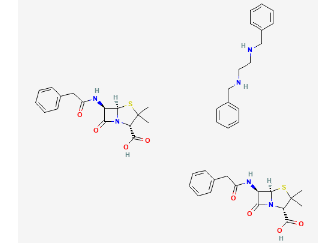
Drug structure
Scale-up and manufacturing prospects
The cost of Bicillin L- A is USD $80–$150 per vial. There is a shortage of benzathine benzylpenicillin which has been extended until 30 November 2026.
1) Round bottom flask - Multi-neck; Ca-Cl₂ drying tube fitted 2) Dropping funnel (500 mL capacity) 3) Hydrogenation apparatus - H2 absorbed at 45 min; 175 mm Hg 4) Vaccum fractionator (Distils 160–175°C / 0.5 mm Hg; n=1.5621) 5) Crystallination vessel ( 95% ethanol; recryst. hot alcohol; M.P. 110–112°C) 6) Suction filter (Vacuum applied; white needle crystals collected) 7) Jacketed mixing vessel 8) Mechanical stirrer 9) Suction filter 10) Spread-layer dryer
1) ISO Class 5 (Grade A) for aseptic filling, ISO Class 7 (Grade B) as background for aseptic processing, and ISO Class 8 (Grade C/D) for pharmaceutical manufacturing support areas 2) Manufacturing process includes: Step 1 — Prepare the Diamine salt (DBED Diacetate) in 95% EtOH Step 2 — React with sodium penicillin G in cold water (0-4 celsius) Step 3 — Filter, wash, and dry Step 4 — Add excipeints and formulate pre-filled syringe
1) Refractometer 2) FTIR spectrometer 3) H-NMR spectrometer 4) RP-HPLC system 5) Laser diffraction 6) Light microscope 7) SEM 8) DSC 9) X-ray diffratometer 10) Viscometer 11) Karl Fischer titrator
Excipients & delivery device(s)
Not provided
1) Methyl hydroxybenzoate 2) Propyl hydroxybenzoate. 3) Lecithin 4) Polysorbate 80 5) Carmellose sodium 6) Sodium citrate, anhydrous 7) Povidone
Not provided
Not provided
Safety, Efficacy and Evidence Summary
Not provided
Not provided
Not provided
Not provided
There are either no relevant patents or these were not yet submitted to LAPaL