access-principles-1access-principles-2access-principles-3backcarrierdevelopmentease_of_administrationexportimplantableinjectablenon-implantablenon_carriernon_injectableother_featuresprintroute_of_administrationtherapeutic_areatype_of_tech

Drug information

Drug's link(s)
Generic name

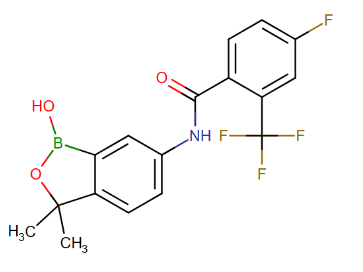
Acoziborole; SCYX-7158; 4‑fluoro‑N‑(1‑hydroxy‑3,3‑dimethyl‑2,1‑benzoxaborol‑6‑yl)‑2‑(trifluoromethyl) benzamide

Brand names

Acoziborole Winthrop

Compound type

Small molecule

Drug class/category

CPSF3 inhibitor

Summary

Acoziborole is a novel benzoxaborole derivative that inhibits the cleavage and polyadenylation specificity factor 3 (CPSF3) enzyme in Trypanosoma brucei parasites. Acoribozole is a long-acting oral therapy with an intrinsic ADME properties that results in a prolonged half life ~272–400 hours. In plasma, 95% of circulating drug is unchanged acoziborole and only small fractions (<3%) are oxidized metabolites. Acoziborole is predominantly released from the body via slow biliary-fecal route. By 60 days, ~87% of total radioactivity has been excreted, mostly in feces (~74%). The drug appeared rapidly in plasma (at 1 h), reached tmax between 24 and 72 h, and remained stable for up to 96 h, after which a slow decrease was quantifiable until 14 weeks after dosing.

Approval status

Acoziborole Winthrop 960 mg has received positive opinion from European Union including all 27 member states and 3 member states of the European Free Trade Association (EFTA).

Regulatory authorities

Acoziborole Winthrop 960 mg single dose therapy has received positive opinion from European Medicines Agency for treatment of African trypanosomiasis through accelerated assessment programme.

Therapeutic area(s)

  • Sleeping sickness
Use case(s)
  • Treatment

Administration route

Oral

Associated long-acting platforms

Oral solid form

Use of drug

Ease of administration
  • Self-administered
Frequency of administration
  • Once
User acceptance

Acoziborole had mostly mild–moderate TEAEs; 14% drug‑related, mainly pyrexia and asthenia. Most TEAEs occurred within days 1–5, were self‑limiting, and 93% were mild–moderate; no serious drug‑related events were reported. Serious TEAEs 10%, with four non‑drug‑related deaths. Severe events were uncommon (7%); procedural pain and headache were frequent, not the drug. Psychiatric events (3%) occurred only in late‑stage HAT; none were drug‑related, and symptoms generally improved during follow‑up.

Dosage

Available dose and strength

320 mg tablet

Maximum dose

1200 mg

Recommended dosing regimen

Acoziborole Winthrop 960 mg (320 mg*3 as single dose) is indicated for use in adults and adolescents > 12 years of age weighing at least 40 kg to treat first-stage and second-stage (including severe second-stage) human African trypanosomiasis (sleeping sickness).

Additional comments

The listed dosage information is based on the documents submitted to EMA’s human medicines committee (CHMP) and published literature.

Dosage link(s)

Associated technologies

Not provided

Comment & Information

Not provided

Developer(s)

Sanofi S.A.
Originator
France

Sanofi S.A.

Sanofi was established in February 15, 1973 in France as a subsidiary of the oil company Elf Aquitaine,. It has merged with Synthélabo in 1999, then acquired Aventis in 2004, and later Genzyme in 2011. Sanofi Winthrop Industrie is a major pharmaceutical manufacturing subsidiary of the global French biopharmaceutical company Sanofi. It produces a wide range of medications, including small molecules

Drugs for Neglected Diseases Initiative
Originator
Switzerland

Drugs for Neglected Diseases Initiative

The Drugs for Neglected Diseases initiative (DNDi) is an international, not‑for‑profit research and development organization. It was established in 2003 through a partnership involving the Indian Council of Medical Research, the Oswaldo Cruz Foundation, KEMRI, the Malaysian Ministry of Health, and Institut Pasteur of France, together with the participation of WHO/TDR and Médecins Sans Frontières.

Drug structure

Scale-up and manufacturing prospects

Scale-up prospects

Not provided

Tentative equipment list for manufacturing

Round-bottom flasks / reaction flasks, 20 mL scintillation vials, Magnetic stirrers / stir bars, Oil bath for heated reactions, Ice bath / cooling setup, Nitrogen / inert atmosphere setup, Sealed reaction vessels with rubber septa / Teflon screw caps, Büchi rotary evaporator for solvent removal under vacuum, Vacuum source / vacuum concentration setup, Drying / concentration setup.

Manufacturing

Acoziborole and related compounds can be manufactured in ISO Class 8 (equivalent to EU GMP Grade D “at rest”) by Sanofi Winthrop Industrie. Manufacturing process includes:- 1) Preparation the aryl-amine precursor 2) Install the boron functionality (boronylation) under Pd catalysis at controlled temperature 3) Aldehyde reduction and cyclize to the oxaborole ring 4) Debenzylate / deprotect to obtain the 6-amino oxaborole intermediate 5) Form the final amide (key finishing step for acoziborole-type molecules)

Specific analytical instrument required for characterization of formulation

1) HPLC, LCMS, NMR, Silica gel chromatography, 2) Flash chromatography using Teledyne ISCO CombiFlash / Companion systems, 3) Reverse-phase chromatography / Biotage C18 cartridges, 4) Prep-HPLC / Waters Prep LC systems, and 5) Crystallization / isolation after solvent remova

Excipients

Proprietary excipients used

Not provided

Novel excipients or existing excipients at a concentration above Inactive Ingredient Database (IID) for the specified route of administration

Not provided

Residual solvents used

No residual solvent used

Delivery device(s)

No delivery device

Description

Boron-containing small molecules as anti-protozoal agents

Brief description

This invention provides, among other things, novel compounds useful for treating protozoal infections, pharmaceutical compositions containing such compounds, as well as combinations of these compounds with at least one additional therapeutically effective agent.

Representative patent

WO2010045503A1

Category

Not provided

Patent holder

Anacor Pharmaceuticals LLC

Exclusivity

Not provided

Expiration date

April 15, 2011

Status

Ceased

Publications

Betu Kumeso, V. K., Kalonji, W. M., Rembry, S., Valverde Mordt, O., Ngolo Tete, D., Prêtre, A., Delhomme, S., Ilunga Wa Kyhi, M., Camara, M., Catusse, J., Schneitter, S., Nusbaumer, M., Mwamba Miaka, E., Mahenzi Mbembo, H., Makaya Mayawula, J., Layba Camara, M., Akwaso Massa, F., Kaninda Badibabi, L., Kasongo Bonama, A., Kavunga Lukula, P., … Tarral, A. (2023). Efficacy and safety of acoziborole in patients with human African trypanosomiasis caused by Trypanosoma brucei gambiense: a multicentre, open-label, single-arm, phase 2/3 trial. The Lancet. Infectious diseases, 23(4), 463–470. https://doi.org/10.1016/S1473-3099(22)00660-0

Background

Human African trypanosomiasis caused by Trypanosoma brucei gambiense (gambiense HAT) in patients with late-stage disease requires hospital admission to receive nifurtimox–eflornithine combination therapy (NECT). Fexinidazole, the latest treatment that has been recommended by WHO, also requires systematic admission to hospital, which is problematic in areas with few health-care resources. We aim to assess the safety and efficacy of acoziborole in adult and adolescent patients with gambiense HAT.

Methods

This multicentre, prospective, open-label, single-arm, phase 2/3 study recruited patients aged 15 years or older with confirmed gambiense HAT infection from ten hospitals in the Democratic Republic of the Congo and Guinea. Inclusion criteria included a Karnofsky score greater than 50, ability to swallow tablets, a permanent address or traceability, ability to comply with follow-up visits and study requirements, and agreement to hospital admission during treatment. Oral acoziborole was administered as a single 960 mg dose (3 × 320 mg tablets) to fasted patients. Patients were observed in hospital until day 15 after treatment administration then for 18 months as outpatients with visits at 3, 6, 12, and 18 months. The primary efficacy endpoint was the success rate of acoziborole treatment at 18 months in patients with late-stage gambiense HAT (modified intention-to-treat [mITT] population), based on modified WHO criteria. A complementary post-hoc analysis comparing the 18-month success rates for acoziborole and NECT (using historical data) was performed. This study is registered at ClinicalTrials.gov, NCT03087955.

Findings

Between Oct 11, 2016, and March 25, 2019, 260 patients were screened, of whom 52 were ineligible and 208 were enrolled (167 with late-stage and 41 with early-stage or intermediate-stage gambiense HAT; primary efficacy analysis set). All 41 (100%) patients with early-stage or intermediate-stage and 160 (96%) of 167 with late-stage disease completed the last 18-month follow-up visit. The mean age of participants was 34·0 years (SD 12·4), including 117 (56%) men and 91 (44%) women. Treatment success rate at 18 months was 95·2% (95% CI 91·2–97·7) reached in 159 of 167 patients with late-stage gambiense HAT (mITT population) and 98·1% (95·1–99·5) reached in 159 of 162 patients (evaluable population). Overall, 155 (75%) of 208 patients had 600 treatment-emergent adverse events. A total of 38 drug-related treatment-emergent adverse events occurred in 29 (14%) patients; all were mild or moderate and most common were pyrexia and asthenia. Four deaths occurred during the study; none were considered treatment related. The post-hoc analysis showed similar results to the estimated historical success rate for NECT of 94%.

Interpretation

Given the high efficacy and favourable safety profile, acoziborole holds promise in the efforts to reach the WHO goal of interrupting HAT transmission by 2030.

Funding

Bill & Melinda Gates Foundation, UK Aid, Federal Minis

Tarral, A., Hovsepian, L., Duvauchelle, T., Donazzolo, Y., Latreille, M., Felices, M., Gualano, V., Delhomme, S., Valverde Mordt, O., Blesson, S., Voiriot, P., & Strub-Wourgaft, N. (2023). Determination of the Optimal Single Dose Treatment for Acoziborole, a Novel Drug for the Treatment of Human African Trypanosomiasis: First-in-Human Study. Clinical pharmacokinetics, 62(3), 481–491. https://doi.org/10.1007/s40262-023-01216-8

Background and Objectives

Acoziborole is a novel boron-containing candidate developed as an oral drug for the treatment of human African trypanosomiasis (HAT). Results from preclinical studies allowed progression to Phase 1 trials. We aimed to determine the best dose regimen for all stages of HAT.

Methods

Acoziborole was assessed in 128 healthy adult males of sub-Saharan African origin living in France. The study included a single oral administration of a 20- to 1200-mg dose in a randomised double-blind study in cohorts of 8 (6 active, 2 placebo) to assess safety, tolerability, and pharmacokinetics. In three additional open cohorts of 6 participants, the effect of activated charcoal was evaluated, bioequivalence of capsules versus tablets was assessed, and safety in the 960-mg tablet cohorts was monitored.

Results

Acoziborole was well tolerated at all doses tested; no dose-related adverse events were observed. The drug appeared rapidly in plasma (at 1 h), reached tmax between 24 and 72 h, and remained stable for up to 96 h, after which a slow decrease was quantifiable until 14 weeks after dosing. Charcoal had little impact on the enterohepatic recirculation effect, except for the 20-mg dose. Bioequivalence between capsule and tablet formulations was demonstrated. The therapeutic single dose for administration under fasted conditions was fixed to 960 mg. The maximum administered dose was 1200 mg.

Conclusions

This study showed that acoziborole could be safely assessed in patients as a potential single-dose oral cure for both stages of gambiense HAT.

Trial Registration

The study was registered with ClinicalTrials.gov: NCT01533961

Additional documents

No documents were uploaded

Collaborate for development

Consider on a case by case basis, collaborating on developing long acting products with potential significant public health impact, especially for low- and middle-income countries (LMICs), utilising the referred to long-acting technology

Share technical information for match-making assessment

Provide necessary technical information to a potential partner, under confidentiality agreement, to enable preliminary assessment of whether specific medicines of public health importance in LMICs might be compatible with the referred to long-acting technology to achieve a public health benefit

Work with MPP to expand access in LMICs

In the event that a product using the referred to long-acting technology is successfully developed, the technology IP holder(s) will work with the Medicines Patent Pool towards putting in place the most appropriate strategy for timely and affordable access in low and middle-income countries, including through licensing