Drug name
Last update: Oct 202610E8.4/iMab
Developer(s)
Drug information
Not provided
10E8.4/iMab bispecific broadly neutralising antibody; derived from 10E8V2.0/iMab (CrossMAb format)
Not applicable (investigational; no brand name assigned)
Biotherapeutic
mAb (Monoclonal antibody) — Bispecific broadly neutralising antibody (gp41 MPER bNAb arm plus anti-CD4 post-attachment inhibitor arm);; derived from 10E8V2.0/iMab
Active / In Development (Phase 1/2/3)
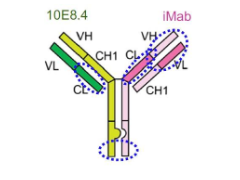
10E8.4/iMab is a bispecific antibody developed at the Aaron Diamond AIDS Research Center, Columbia University. One arm is 10E8.4, which binds the membrane-proximal external region (MPER) of HIV-1 gp41, a highly conserved fusion-critical epitope. The other arm is ibalizumab (iMab), a humanised anti-CD4 antibody that blocks HIV entry post-attachment. The two arms are joined in a knob-into-hole CrossMab architecture, and the molecule is engineered for extended in vivo half-life and reduced Fc-effector function to limit IgG-mediated toxicity. Linking the arms produces marked synergy: the parent construct 10E8V2.0/iMab neutralised a 118-virus tier-2 pseudovirus panel with a mean IC50 of 0.002 microgram/mL and 99% of a 200-isolate clade C panel. PK PD simulaiton https://pk10e8imab.fredhutch.org
Not approved in any jurisdiction as of September 2026. Investigational; phase 1. The first-in-human study (NCT03875209) is complete and published; a phase 1b single-dose study alone and with VRC07-523LS is under way in Tanzania (RV584, NCT05890963).
No marketing authorisation application identified. Developed under a US FDA IND held by Columbia University Irving Medical Center.
Therapeutic area(s)
- HIV
- Pre-Exposure Prophylaxis (PrEP)
- Treatment
Administration route
Intravenous, Route of administration is being determined in the clinical program, Subcutaneous
Associated long-acting platforms
Monoclonal antibodies and antibody drug conjugates
Use of drug
- Administered by a nurse
- Administered by a specialty health worker
- Other/Variable/Unknown : single dose studied to date; dosing interval not established
Dosage
Not provided
Not provided
Not provided
bispecific monoclonal antibody, potentially to be used alone or in combination with VRC07-523LS. It is tested for prevention (IV) as well as for treatment of HIV
Not provided
Related entries
Not provided
Additional information
Developer(s)

Columbia University
Drug structure
Scale-up and manufacturing prospects
Not reported. Clinical supply was manufactured to GMP and shipped to sites from a designated GMP storage facility. Bispecific CrossMab formats add chain-pairing and purification complexity relative to conventional IgG.
Not reported for this product. Standard mAb train assumed, with additional analytics for correct heavy-heavy and heavy-light chain pairing in the bispecific format.
Recombinant bispecific IgG produced in mammalian cell culture. Knob-into-hole substitutions in the heavy chains drive heterodimerisation; CL/CH1 domain crossover in one arm ensures correct heavy-light pairing. Process details not published.
Reported bioanalytical methods: ELISA for unbound antibody concentration; electrochemiluminescence bridging assay (MSD) for anti-drug antibodies with epitope mapping by competition; modified TZM.bl neutralisation assay for functional ADA inhibition; quantitative flow cytometry for CD4 receptor occupancy.
Excipients & delivery device(s)
Not provided
Not provided
Not provided
No delivery device
Safety, Efficacy and Evidence Summary
Not provided
Not provided
Not provided
Not provided
CrossMAb bispecific antibody capable of neutralizing HIV, covering 10E8.4/iMab specifically
Not provided
WO2019135921
Not provided
AARON DIAMOND AIDS RESEARCH CENTER
Not provided
December 20, 2038
Granted: JP Not in force: AU, CA, CN, EP, US
CrossMAb bispecific antibody capable of neutralizing HIV, covering 10E8.4/iMab and analogues broadly
In various embodiments, the present invention relates generally to using bispecific antibodies in the prevention and treatment of HIV.
WO2015084859
Compound
AARON DIAMOND AIDS RESEARCH CENTER
Not provided
December 2, 2034
Not in force: AU, CA, CN, EP, JP, US To be confirmed: ZA