Technology name
Last update: Sep 2026Polymeric Nanobiotics
Developer(s)
Sponsor(s)
Not specified
Type of technology
Polymer-based particles
Administration route
Intramuscular, Intravenous
Development state and regulatory approval
Isoniazid
Pre-clinical
Not provided
Description
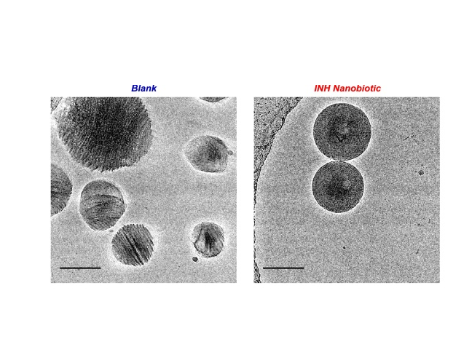
Polymeric nanobiotics are a novel nanoparticle drug-delivery system designed to treat Mycobacterium tuberculosis. They are created by covalently bonding antibiotics, like isoniazid, directly to a biodegradable polymer chain. In acidic environments—such as inside infected macrophages and granulomas—the polymer undergoes hydrolysis to trigger a sustained, targeted release of the active drug. Furthermore, these nanoparticles can encapsulate a second hydrophobic drug, like clofazimine, enabling synchronized multi-drug therapy that maximizes bacterial killing while minimizing systemic toxicity.
Developer(s)

University of Cambridge
It is one of the prestigous univerisities in the UK. The University of Cambridge's drug and formulation development evolved from its 1946 Department of Pharmacology into an open-innovation ecosystem. Its infrastructure centers on the Cambridge Biomedical Campus, anchoring the Milner Therapeutics Institute and CATS. This network pairs AI-driven target discovery with advanced engineering to translat
Technology highlight
1) Core Design: Polymeric nanobiotics are nanoparticles formed by covalently bonding antibiotics (e.g., isoniazid) directly to biodegradable polymer chains. 2) Triggered Release: α-keto polyester undergo hydrolysis in acidic environments—like inside Mtb-infected macrophages and granulomas—triggering targeted, sustained drug release. 3) Multi-Drug Therapy: They can encapsulate a second hydrophobic drug (like clofazimine) for synchronized combination chemotherapy. 4) High Payload: Direct conjugation achieves a massive drug payload (up to 25% by weight) with excellent long-term structural stability. 5) Targeted Uptake: They are avidly engulfed by macrophages, delivering drugs directly to intracellular bacteria and extracellular granulomas.
Illustration(s)
Technology main components
1. α keto polyester 2. Conjugated API (eg: isoniazid (INH)) 3. Conjugated API (eg: clofazimine (CFZ)) 4. Stabilizer (eg: poly(vinyl alcohol) (PVA)
Not provided
Safety, Efficacy and Evidence Summary
Safety studies were not conducted yet.
Preclinical studies: (i) In vitro studies - indicate that Isoniazid (INH) Polymer nanobiotic showed equivalent potency to free INH against intracellular M. tuberculosis (100 μM free INH versus 100 μM INH delivered as nanodrug) for 48 hours. This was demonstrated in both THP-1 cells and primary human macrophages. Intracellular bacterial burden was assessed using relative luminescence units normalised to untreated cells. (ii) In vivo studies - In an M. marinum-infected zebrafish model, treatment with INH nanobiotics +/- clofazimine. The nanobiotics effectively trigger sustained drug release via hydrolysis in acidic environments. Nanoparticles were taken up by >70% of infected macrophages. Both Nano-INH and Nano-INH + CFZ significantly reduced bacterial burden (0.6 and 0.45-0.5).
Preclinical studies show that the Nano-INH retained INH activity intracellularly and demonstrated superior in-vivo effects versus equivalent free drug in the M. marinum zebrafish model. Further safety studies of polymer nanobiotics is required.
Not provided
APIs compatibility profile
Anti-tubercular drugs are targeted for polymer nanobiotics such as Isoniazid and clofazimine
Not provided
Not provided
10-30 wt%
2 different APIs : Two small molecules (hydrophilic and hydrophobic)
Min: -0.7
Max: 7.5
Polymer Nanobiotics has the capacity to encapsulate both hydrophilc and hydrophobic drugs
Scale-up and manufacturing prospects
Not provided
Not provided
Not provided
Not provided
Excipients & delivery device(s)
Not provided
Poly(vinyl alcohol) (PVA)
No residual solvent used
No delivery device
Additional features
- Biodegradable
- Monolithic
The nanobiotics exhibit greater and more rapid drug release in acidic environments (pH 5.0 and 6.0) bu the release is significantly slower at physiological pH (7.4), which represents systemic circulation. Invitro studies demonstrates that the drug release has a sustained release upto 30 days
Polymer nanobiotics are intended to be adminstered through Intravenous and Intramuscular injections.
Polymer nanobiotics are stable in solution for at least 9 months at room temperature.
Not provided
Therapeutic area(s)
- TB
- Treatment
Potential associated API(s)
- Isoniazid
- Drugs for treatment of tuberculosis
Use of technology
- Administered by a community health worker
- Administered by a nurse
- Administered by a specialty health worker
Unknown
Targeted user groups
- Adults
- Older Adults
- All
Unspecified
Unspecified
Unspecified
Not provided
Isoniazid
Anti-tubercular antibiotics
Pre-clinical
Not provided
Mycobacterium tuberculosis (Mtb) infections
Not provided
Not provided
Not provided
Drugs for treatment of tuberculosis
Anti-tubercular Antibiotic
Pre-clinical
Not provided
Mycobacterial Infections
Not provided
Not provided
Not provided
There are either no relevant patents or these were not yet submitted to LAPaL


All sponsors
No sponsor indicated