Technology name
Last update: Mar 2026Multi-Arm Polymer Conjugated Immmunotherapies
Developer(s)
Sponsor(s)
Not specified
Type of technology
Polymer-based particles
Administration route
Intratumoral, Intravenous
Development state and regulatory approval
Antineoplastic and immunomodulating agents
Phase II
Not approved yet
Description
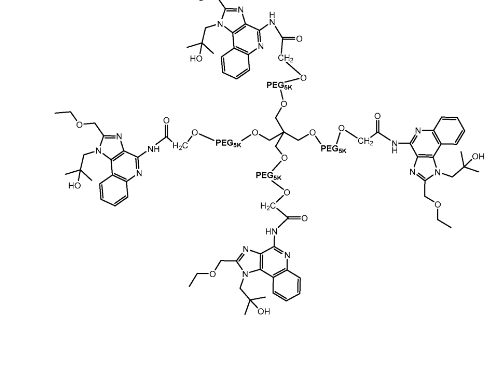
This technology uses multi‑arm polymer conjugates of TLR7/8 agonists to activate local antitumor immunity while minimizing systemic toxicity. Delivered intratumorally, these conjugates stay in the tumor, enhance antigen presentation, and boost CD8⁺ T‑cell responses. The release of the TLR7/8 agonist from the polymer conjugate depends on the linkage‑containing spacer (Xₐ) connecting the polymer (POLY) to the drug. When combined with a long‑acting IL‑2Rβ‑biased agonist, they produce synergistic, systemic antitumor effects and strong abscopal responses.
Developer(s)

Nektar Therapeutics
Nektar Therapeutics (Nasdaq: NKTR) is a clinical-stage biopharmaceutical company headquartered in San Francisco, California. Founded in 1990, the company specializes in immunotherapy, utilizing proprietary PEGylation and polymer conjugate technology platforms to develop drug candidates for autoimmune disorders, chronic inflammation, and oncology.
Technology highlight
1. Core Scaffold (R) – Polyol / Polythiol / Polyamine Backbone (Eg: pentaerythritol, glycerol, trimethylolpropane, polyglycerols) 2. Linker Atom (Oxygen (O), Sulfur (S), Nitrogen (–NH–)) 3. Polymer Arms (Polyethylene glycol 2,000–150,000 Da) 4. Linkage‑Containing Spacer (Xᵣ) 5. API
Illustration(s)
Technology main components
The conjugated complex has 1. Core Scaffold (R) – Polyol / Polythiol / Polyamine Backbone (Eg: pentaerythritol, glycerol, trimethylolpropane, polyglycerols) 2. Linker Atom (Oxygen (O), Sulfur (S), Nitrogen (–NH–)) 3. Polymer Arms (Polyethylene glycol 2,000–150,000 Da) 4. Linkage‑Containing Spacer (Xᵣ) 5. API
Not provided
Safety, Efficacy and Evidence Summary
Rezpegaldesleukin (NKTR-358; REZPEG) is a polyethylene glycol–conjugated recombinant human interleukin-2 (rhIL-2). Phase 2 results show Treatment-emergent adverse events (TEAEs) were reported in 66.0% of subjects receiving REZPEG compared with 48.7% of those receiving placebo, while treatment-related adverse events (TRAEs) occurred in 41.9% and 10.4% of subjects, respectively. Severe TEAEs were reported in 3.2% of subjects in the REZPEG group and 4.5% in the placebo group. The most frequently reported TRAE with REZPEG was injection-site reaction (ISR), occurring in 26.4% of subjects.
Not provided
Not provided
Not provided
APIs compatibility profile
Unit: mg/mL
(i) Antiviral agents (particularly HIV and chronic viral infections) Nucleos(t)ide reverse transcriptase inhibitors (NRTIs), Non-nucleoside reverse transcriptase inhibitors (NNRTIs) Integrase strand transfer inhibitors (INSTIs), Protease inhibitors; (ii) Antibacterial agents (including TB and chronic bacterial infections) Rifamycins, Macrolides, Fluoroquinolones; (iii) Antifungal agents; (iv) Antiparasitic agents; (v) Anti-inflammatory and immunomodulatory drugs; (vi) Anticancer agents and (vii) CNS-active drugs (viii) TLR 7/8 agonists N-[4-(4-amino-2- ethyl-1H-imidazo[4,5c]quinolin-1-yl)butyl
Rezpegaldesleukin and Bempegaldesleukin
Not provided
Not provided
75-90 wt%
1 single API :
Min: 1.5 Max: 6.5
Scale-up and manufacturing prospects
Not provided
1. Reaction Vessels/bioreactors 2. Magnetic stirrers 3. Heating plates / heating mantles 4. Cooling baths (20°C, 50°C, 60°C operations described) 5. Temperature controllers / thermometers 6. Hand‑swirling for dissolution 7. Nitrogen/argon inert atmosphere setups (implied by anhydrous conditions) 8. Filtration apparatus (frit funnels, Büchner funnels) 9. Vacuum filtration setups 10. High‑vacuum drying systems (overnight drying)
To manufacture multi-arm conjugated complex, we need ISO cleanroom (class not explicited mentioned). Step1: Derive polymer from Lactide, Glycolide, Caprolactone or Combinations thereof (copolymers) Step 2: Ring-opening polymerization - initiated by alcohol-based initiators, using metal-based catalysts (e.g., tin-based catalysts) Step 3: Polymer purification, Removal of unreacted monomer, Drying of the polymer prior to formulation use Step 4: API and Polymer complex formation using Melt or semi-solid processing or solvent based mixing.
1. 500 MHz Bruker ¹H NMR spectrometer Drug content & release: 2. HPLC or UPLC 3. UV–Vis spectroscopy Polymer–drug interaction: 4. DSC (thermal behavior) 5. FTIR (compatibility assessment) Physical characterization: 6. Particle size analyzers (if particulate) 7. Microscopy (optical / SEM implied) Stability & performance: 8. Dissolution or release testing apparatus 9. Accelerated stability chambers
Excipients & delivery device(s)
Not provided
1. Carbohydrates (Monosaccharides; Disaccharides; Polysaccharides; Sugar alcohols (Alditols)) 2. Inorganic Salts (NaCl; KCl; NaSO4; KNO3; Na2PO3/Na2PO4) 3. Antimicrobial Agents (Benzalkonium chloride, Benzethonium chloride, Benzyl alcohol) 4. Antioxidants (Butylated hydroxyanisole (BHA)) 5. Surfactants (Polysorbates, Pluronics) 6. Buffers (Phosphate buffers) 7. Acids (HCL. HPO3, Acetic acid and citric acid) 8. Bases (NaOH, KOH, NH3OH)
Not provided
No delivery device
Additional features
- Biodegradable
The release kinetics of the active pharmaceutical ingredient (API) are influenced by multiple factors, including the chemical stability of the linker (with ester < carbonate < carbamate < amide), local pH conditions, and the presence and activity of relevant enzymes (e.g., esterases and proteases). Additional determinants include PEG arm length and molecular architecture, as well as the degree of drug loading, defined by the number of conjugated arms.
This technology is adminstered as intratumoral injection. Intratumoral administration is conducted using a fine-gauge needle (approximately 22–25 gauge), with needle insertion angle and depth selected based on tumor size, location, and imaging guidance, where applicable.
- In situ stability: The stability of the conjugate in circulation is influenced by linker chemistry. Stable linkers (e.g., amides, thioethers) are resistant to hydrolytic cleavage under physiological conditions, whereas releasable linkers undergo gradual cleavage in biological environments. PEG chains (e.g., PEG 20 kDa) enhance aqueous solubility and reduce the risk of drug precipitation. -Formulation stability: Long-term stability studies are typically conducted under controlled conditions (25 °C ± 2 °C / 60% RH ± 5% RH). but no results were disclosed.
1. Refrigeration at 2–8 °C (most PEGylated cytokines) 2. Temperature‑controlled shipping
Therapeutic area(s)
- Diabetes
- Other(s) : "dermatological disorders like alopecia areata and acute dermatitis and scarring disorders"
- HIV
- Oncology : "Solid Tumors and Large B-Cell Lymphoma"
- Treatment
Potential associated API(s)
- Antineoplastic and immunomodulating agents
- Antineoplastic and immunomodulating agents
- Antineoplastic and immunomodulating agents
- Antineoplastic and immunomodulating agents
- Antineoplastic and immunomodulating agents
- Antineoplastic and immunomodulating agents
Use of technology
- Administered by a community health worker
- Administered by a nurse
- Administered by a specialty health worker
Monthly, Every 2 weeks, Every 3 weeks
Targeted user groups
- Adults
- Older Adults
- All
Unspecified
Unspecified
Unspecified
Not provided
Antineoplastic and immunomodulating agents
IL-2 receptor agonist
Phase II
Diabetes mellitus type 2 (T2DM), Acute dermatitis and Alopecia Areata
Not provided
Every 2 weeks
Not approved yet
Antineoplastic and immunomodulating agents
Tumor necrosis factor receptor 2 agonist (TNFR2)
Pre-clinical
Not provided
Ulcerative Colitis, Vitiligo, Multiple Sclerosis
Not provided
Not provided
Not approved yet
Antineoplastic and immunomodulating agents
Bispecific antibody incorporating TNFR agonist
Pre-clinical
Not provided
Autoimmune Diseases
Not provided
Not provided
Not approved yet
Antineoplastic and immunomodulating agents
Colony stimulating factor 1 (CSF-1)
Pre-clinical
Not provided
Fibrotic diseases
Not provided
Not provided
Not approved yet
Antineoplastic and immunomodulating agents
IL-15 receptor agonist
Phase II
Solid Tumors and Large B-Cell Lymphoma (Relapsed/Refractory Multiple Myeloma & Non-Hodgkin Lymphoma)
Not provided
Every 3 weeks, every 4 weeks IV infusion
Not approved yet
Antineoplastic and immunomodulating agents
IL-2 receptor agonist
Phase II
Locally Advanced or Metastatic Solid Tumors
Not provided
Every 3 weeks
Not approved yet
Multi-arm polymer conjugates of tlr agonist compounds and related immunotherapeutic treatment methods
Provided are multi-arm polymer conjugates of Toll-Like Receptor ("TLR") agonists such as TLR 7/8 agonists, as well as related compositions, and methods of making and using such conjugates. Exemplary conjugates are encompassed by Formula I: (I) or a pharmaceutically acceptable salt form thereof, where R, taken together with each Q, is a residue of a polyol, polythiol, or polyamine bearing from 3 to about 50 hydroxyl, thiol, or amino groups; each Q is a linker selected from oxygen, sulfur and -NH; each POLY is independently a water-soluble, non-peptidic polymer; each Xr is independently a linkage-containing spacer moiety; q is a positive integer from 3 to about 50; and each TLR 7/8 AG is a Toll-like receptor 7/8 agonist. Also provided is a method of administering to a patient having cancer.
WO2018132496A1
Not provided
Nektar Therapeutics
Not provided
October 17, 2019
Ceased







All sponsors
No sponsor indicated