Technology name
Last update: Dec 2024Mesoporous silica nanoparticles (MSNP)
Developer(s)
Sponsor(s)
Not specified
Type of technology
Silica based nanoparticles
Administration route
Oral, Subcutaneous, Intramuscular, Intravenous, intraarterial, intracerebral, intrathecal, intranasal
Development state and regulatory approval
irinotecan
Phase II
Not provided
Description
The Mesoporous Silica Nanoparticle Platform Technology (MSNP) is composed of silicasomes (lipid-coated porous silica nanoparticle) , proton gradients, and a phospholipid bilayer (LB) coating. These components collectively function as a nanocarrier, enabling the delivery of multiple APIs to targeted site of action. These nanocarriers prolong the drug's circulatory half-life and deliver high doses at the site of action with reduced systemic toxicity compared to the free drug.
Developer(s)

University of California
The University of California (UC), established in 1868, is a renowned public research institution comprising 10 campuses, governed by the Board of Regents, which oversees its strategic direction. With a legacy of academic excellence and innovation, UC has pioneered advancements across diverse fields, including mesoporous nanoparticle technology for precision drug delivery and targeted therapies.
Technology highlight
1) Biocompatible 2) Cellular-level delivery of hydrophobic drugs 3) Nanocarriers encapsulate, covalently attach, and/or adsorb therapeutic agents to overcome drug solubility problems 4) Large surface area and porous interior to accommodate multiple API
Illustration(s)
Technology main components
The Mesoporous Silica Nanoparticle (MSNP) system comprises 'n' nanocarriers, each characterized by the following components: (i) API; (ii) a silicasome structure featuring a defined surface with a network of multiple pores; (iii) a phospholipid bilayer coating the silicasome surface; and (iv) a cargo-trapping agent (e.g., trimethylammonium salts, alpha- cyclodextrin sulfate, trim ethylammonium, beta-cyclodextrin phosphate, trimethyl ammonium citrate, and trimethylammonium acetate) and a targeting peptide (optional). These structural components are organized at the submicron scale.
Not provided
Safety, Efficacy and Evidence Summary
A Phase I clinical trial of mesoporous silica nanoparticle-encapsulated irinotecan (MSNP-IRI) was conducted, starting at a dose of 120 mg/m² with incremental increases of 60 mg/m², up to a maximum dose of 150 mg/m². Dose-limiting toxicities (DLTs) observed included diarrhea, dehydration, and fatigue. Notably, MSNP-IRI did not exhibit any unexpected toxicities when administered intravenously.
Not provided
Not provided
Not provided
APIs compatibility profile
MSNP-based drug delivery systems include a range of antifungal agents such as amphotericin B, anidulafungin, caspofungin, fluconazole, flucytosine, isavuconazole, itraconazole, micafungin, posaconazole, nocodazole, and voriconazole. Additionally, antiviral agents such as tenofovir disoproxil fumarate, antibiotics including ciprofloxacin and levofloxacin, and hydrophobic anticancer agents such as iriotecan, paclitaxel, ellipticine, camptothecin, acyclovir diphosphate, dimyristoylglycerol, doxorubicin, and chlorambucil can be included in this portfolio.
Not provided
Not provided
75-90 wt%
More than 4 different APIs : Not provided
Min: -1
Max: 7.1
Suitable for low and highly hydrophobic drugs
Scale-up and manufacturing prospects
Not provided
Not provided
Manufacturing of the MSNP: 1. Synthesize mesoporous silica spheres using iron oxide nanocrystals or gold(III) chloride trihydrate and TEOS. 2. NPs are modified with a hydrophilic trihydroxylsilylpropyl methlphosphonate to prevent aggregation 3. Dissolve API in DMSO or an appropriate solvent. 4. Load the drug into mesoporous nanoparticles. 5. Redisperse drug-loaded nanoparticles in a hydrophobic solvent, or DMSO. 6. Sonicate, homogenize, and filter through a 0.44 µm syringe filter. 7. Mix with NaOH and H₂O; heat at 80 °C. For drugs with higher concentrations, reduce the heating temperature.
1. Pore characterization is performed using X-ray Diffraction (XRD) 2. Nitrogen Adsorption desorption experiment - Brunauer-Emmett-Teller
Excipients & delivery device(s)
No proprietary excipient used
No novel excipient or existing excipient used
No residual solvent used
No delivery device
Additional features
- Biodegradable
- Drug-eluting
- Non-removable
- Reservoir-type
- Requires stimuli from outside the body
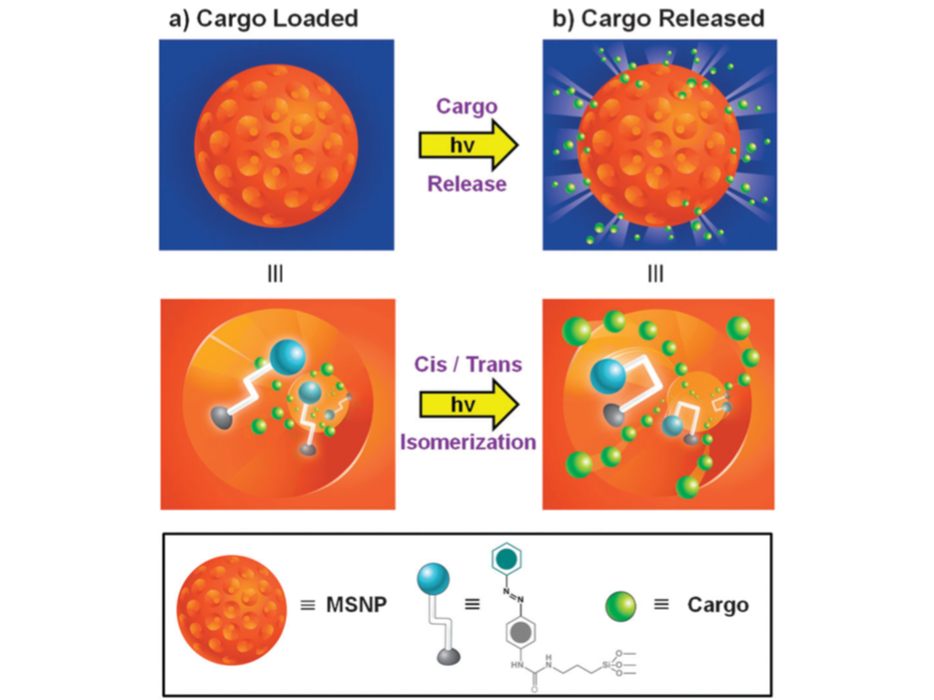
The release kinetics of MSNP are based on interactions between particles and cell membrane phospholipids during endocytosis, which can induce the release of encapsulated hydrophobic drugs. MSNP is designed to employ mechanical regulation of pore openings on the surface of NPs. Specifically, polymers, either adsorbed onto or covalently bonded to the MSNP surface, have been utilized as mechanized systems for controlled drug release.
MSNP preparations can be formulated for intravenous, subcutaneous, and intramuscular routes of administration.
In Situ Stability: The mesoporous silica nanoparticles (MSNPs) exhibit excellent colloidal and circulatory stability in physiological fluids at pH 7.4, maintaining a monodisperse state to facilitate systemic biodistribution. Product Stability: While chronic shelf-life studies are yet to be undertaken, preliminary analyses indicate that the formulation remains stable for up to six months under cold storage conditions.
At least 6 months is possible when stored at 4 ° C
Therapeutic area(s)
- Other(s) : "Bacterial Infections and Fungal Infections"
- HIV
- Oncology
- Treatment
Potential associated API(s)
- irinotecan
- camptothecin
- paclitaxel , taxanes
Use of technology
- Administered by a community health worker
- Administered by a nurse
- Administered by a specialty health worker
Every 3 weeks; Every 2 weeks
Targeted user groups
- Adults
- Older Adults
- All
Unspecified
Unspecified
Unspecified
Not provided
irinotecan
Topoisomerase 1 inhibitors
Phase II
Gliomas and solid tumors
Adults who are < 18 years old with recurrent glioma
Every 3 weeks
Not provided
camptothecin
Topoisomerase - 1 inhibitors
Pre-clinical
Not provided
Pancreatic ductal Adenocarcinoma (PDAC)
Not provided
Not provided
Not provided
paclitaxel , taxanes
Taxane
Pre-clinical
Not provided
Pancreatic Duct Adenocarcinoma (PDAC)
Not provided
Not provided
Not provided
Cationic polymer coated mesoporous silica nanoparticles and uses thereof
A submicron structure having a silica body defining a plurality of pores is described. The submicron body may be spherical or non-spherical, and may include a cationic polymer or co-polymer on the surface of said silica body. The submicron structure may further include an oligonucleotide and be used to deliver the oligonucleotide to a cell. The submicron structure may further include a therapeutic agent and be used to deliver the therapeutic agent to a cell. An oligonucleotide and therapeutic agent may be used together. For example, when the oligonucleotide is an siRNA, the composition may be used to decrease cellular resistance to the therapeutic agent by decreasing translation of a resistance gene.
US10343903B2
Formulation
The Regents of the University of California
Not provided
July 13, 2031
Active
MESOPOROUS SILICA NANOPARTICLES FOR BIOMEDICAL APPLICATIONS
A submicron structure includes a silica body defining a plurality of pores that are suitable to receive molecules therein , the silica body further defining an outer surface between pore openings of said plurality of pores ; and a plurality of anionic molecules attached to the outer surface of the silica body . The anionic molecules provide hydrophilicity to the submicron structure and are suitable to provide repulsion between other similar submicron structures, and the submicron structure has a maximum dimension less than one micron .
US10668024B2
Formulation
The Regents of the University of California
Not provided
December 8, 2028
Expired - Fee Expired




All sponsors
No sponsor indicated