access-principles-1access-principles-2access-principles-3backcarrierdevelopmentease_of_administrationexportimplantableinjectablenon-implantablenon_carriernon_injectableother_featuresprintroute_of_administrationtherapeutic_areatype_of_tech

Drug information

Drug's link(s)
Generic name

VRS07-523LS

Brand names

Not provided

Compound type

Biotherapeutic

Drug class/category

bNAb targeting gp120 on HIV-1 virus envelope

Summary

VRC07-523LS (VRC-HIVMAB075-00-AB) is a broadly neutralizing antibody (bNAb) engineered to target the CD4 binding site on HIV’s envelope protein gp120. It is a modified version of VRC01, with an LS mutation that extends its half-life, allowing less frequent dosing. Administered via IV, IM, SC, it has shown safety and tolerability in clinical trials. Furthermore, the estimated half life is 42 days.In combination with long-acting Cabotegravir, VRC07-523LS maintained HIV viral suppression in over 90% of participants over 48 weeks. It is being explored for both HIV prevention and treatment, potentially reducing the need for daily antiretroviral therapy. VRC07-523LS, was 5- to 8-fold more potent than VRC01 and considerably broader in vitro, with an IC50 <1 μg/mL against 92% of HIV-1 pseudovirus.

Approval status

Not yet approved

Regulatory authorities

Not yet approved

Therapeutic area(s)

  • HIV
Use case(s)
  • Treatment

Administration route

Intravenous, Subcutaneous, Intramuscular

Associated long-acting platforms

Solution

Use of drug

Ease of administration
  • Administered by a community health worker
  • Administered by a nurse
  • Administered by a specialty health worker
Frequency of administration
  • Every 3 months
User acceptance

To be determined

Dosage

Available dose and strength

5 mg/kg; 20mg/kg; 40mg/kg

Maximum dose

40 mg/kg

Recommended dosing regimen

VRC07-523LS 20 mg/kg IV Q12W- 3 doses VRC07-523LS 5 mg/kg SC Q12W- 3 doses

Additional comments

Not provided

Dosage link(s)

Not provided

Associated technologies

Not provided

Comment & Information

Not provided

Developer(s)

Vaccine Research Center, National Institute of Allergy and Infectious Diseases (NIAID)
Originator
United States of America

Vaccine Research Center, National Institute of Allergy and Infectious Diseases (NIAID)

The National Institute of Allergy and Infectious Diseases (NIAID) is a key institute within the National Institutes of Health (NIH) dedicated to advancing research on infectious, immunologic, and allergic diseases. Established over 60 years ago, NIAID conducts both basic and applied research aimed at improving understanding, diagnosis, treatment, and prevention of these diseases.

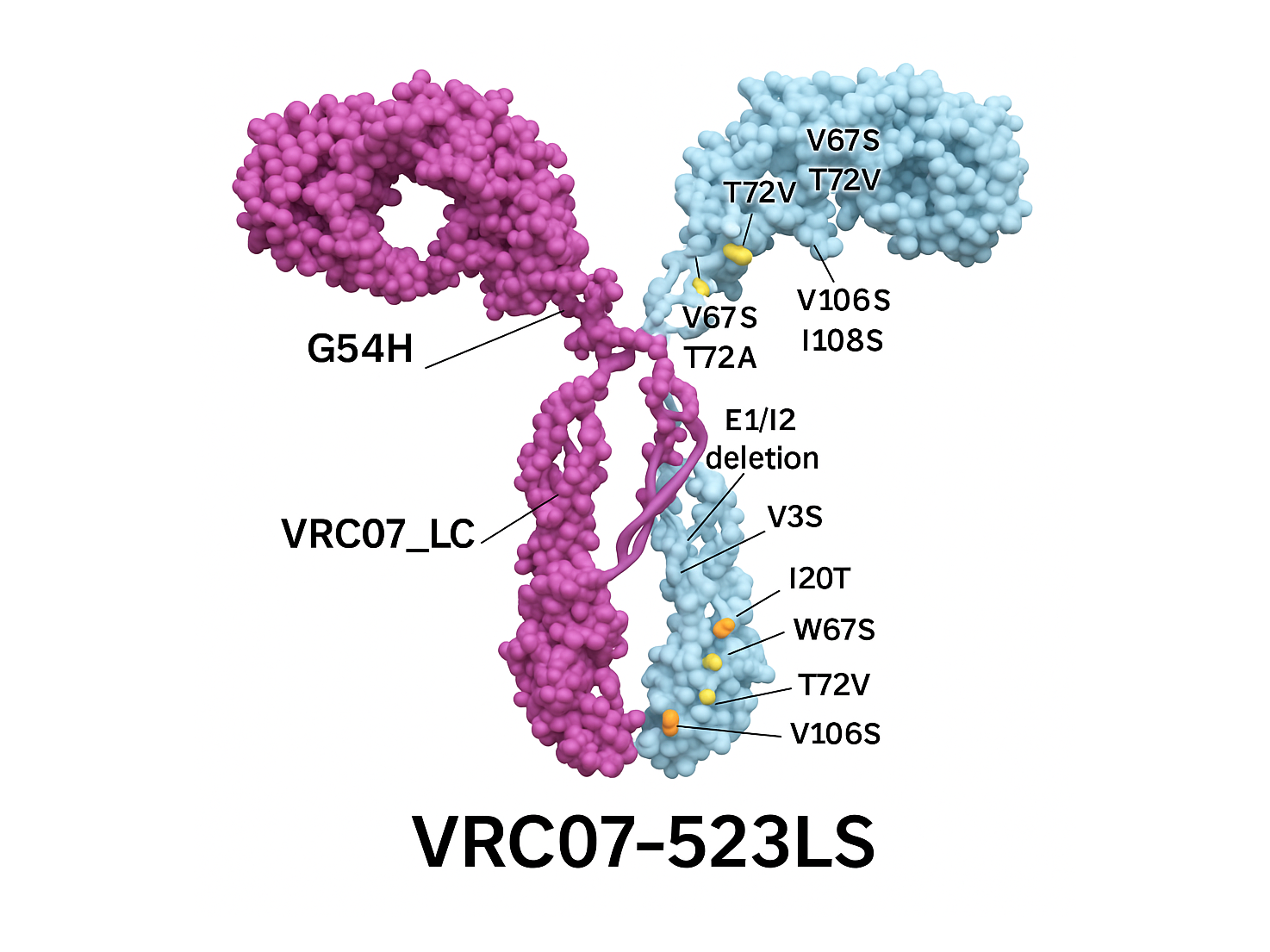
Drug structure

Scale-up and manufacturing prospects

Scale-up prospects

Not provided

Tentative equipment list for manufacturing

Bioreactors, incubators, filtration units, lyophilizers, and formulation vessels.

Manufacturing

VRC07-5LS is a monoclonal antibody, and its production involves several key steps: VRC07-523LS is produced in a Chinese Hamster Ovary (CHO) DG44 cell line. Further information is not disclosed yet.

Specific analytical instrument required for characterization of formulation

1. Bio-Plex Instrument (Bio-Rad) 2. Beckman Biomek Automation Platform 3. Surface-Plasmon-Resonance-(SPR)-Systeme 4. Dynamic Light Scattering, 5. Differential Scanning Calorimetry 6. Circular dichroism and isothermal chemical denaturation

Excipients

Proprietary excipients used

No proprietary excipient used

Novel excipients or existing excipients at a concentration above Inactive Ingredient Database (IID) for the specified route of administration

No novel excipient or existing excipient used

Residual solvents used

No residual solvent used

Delivery device(s)

No delivery device

Description

VRC07-523LS antibody

Brief description

Antibodies and antigen binding fragments that specifically bind to HIV-1 Env and neutralize HIV-1 are disclosed. Nucleic acids encoding these antibodies, vectors and host cells are also provided. Methods for detecting HIV-1 using these antibodies are disclosed. In addition, the use of these antibodies, antigen binding fragment, nucleic acids and vectors to prevent and/or treat an HIV-1 infection is disclosed.

Representative patent

WO2019165122

Category

Compound

Patent holder

The United States of America

Exclusivity

Not provided

Expiration date

February 21, 2039

Status

Granted: US Pending: AU, CA, CN, EP, IN

Publications

Mahomed, S., Garrett, N., Capparelli, E. V., Osman, F., Harkoo, I., Yende-Zuma, N., Gengiah, T. N., Archary, D., Samsunder, N., Baxter, C., Mkhize, N. N., Modise, T., Carlton, K., McDermott, A., Moore, P. L., Karim, Q. A., Barouch, D. H., Fast, P. E., Mascola, J. R., Ledgerwood, J. E., … Abdool Karim, S. S. (2022). Safety and Pharmacokinetics of Monoclonal Antibodies VRC07-523LS and PGT121 Administered Subcutaneously for Human Immunodeficiency Virus Prevention. The Journal of infectious diseases226(3), 510–520. https://doi.org/10.1093/infdis/jiac041

Abstract

Background: Effective, long-acting prevention approaches are needed to reduce human immunodeficiency virus (HIV) incidence. We evaluated the safety and pharmacokinetics of VRC07-523LS and PGT121 administered subcutaneously alone and in combination as passive immunization for young women in South Africa.

Methods: CAPRISA 012A was a randomized, double-blinded, placebo-controlled, dose-escalation phase 1 trial. We enrolled 45 HIV-negative women into 9 groups and assessed safety, tolerability, pharmacokinetics, neutralization activity, and antidrug antibody levels. Pharmacokinetic modeling was conducted to predict steady-state concentrations for 12- and 24-weekly dosing intervals.

Results: VRC07-523LS and PGT121, administered subcutaneously, were safe and well tolerated. Most common reactogenicity events were injection site tenderness and headaches. Nine product-related adverse events were mild and transient. Median VRC07-523LS concentrations after 20 mg/kg doses were 9.65 μg/mL and 3.86 μg/mL at 16 and 24 weeks. The median week 8 concentration after the 10 mg/kg PGT121 dose was 8.26 μg/mL. Modeling of PGT121 at 20 mg/kg showed median concentrations of 1.37 μg/mL and 0.22 μg/mL at 16 and 24 weeks. Half-lives of VRC07-523LS and PGT121 were 29 and 20 days. Both antibodies retained neutralizing activity postadministration and no antidrug antibodies were detected.

Conclusions: Subcutaneous administration of VRC07-523LS in combination with optimized versions of PGT121 or other antibodies should be further assessed for HIV prevention.


Gaudinski, M. R., Houser, K. V., Doria-Rose, N. A., Chen, G. L., Rothwell, R. S. S., Berkowitz, N., Costner, P., Holman, L. A., Gordon, I. J., Hendel, C. S., Kaltovich, F., Conan-Cibotti, M., Gomez Lorenzo, M., Carter, C., Sitar, S., Carlton, K., Gall, J., Laurencot, C., Lin, B. C., Bailer, R. T., … VRC 605 study team (2019). Safety and pharmacokinetics of broadly neutralising human monoclonal antibody VRC07-523LS in healthy adults: a phase 1 dose-escalation clinical trial. The lancet. HIV6(10), e667–e679. https://doi.org/10.1016/S2352-3018(19)30181-X

Abstract


Background:


Human monoclonal antibodies that potently and broadly neutralize HIV-1 (bnMAbs) are under development to prevent and treat HIV-1 infection. We performed a phase 1 clinical trial to determine the safety, tolerability, and pharmacokinetic profile of the bnMAb VRC07–523LS, an engineered variant of VRC01 that targets the CD4 binding-site of the HIV-1 Env protein.

Methods:


This phase 1, open-label, dose-escalation clinical trial was done at the National Institutes of Health Clinical Center in Bethesda, MD, USA. Individuals were recruited from the greater Washington, DC, area by IRB-approved written and electronic media. We enrolled healthy, HIV-1-negative adults aged 18–50 years. Inclusion criteria were good general health, measured through clinical laboratory tests, medical history, and physical examination. Participants self-selected into one of seven open groups during enrollment without randomization. Four groups received a single intravenous dose of 1, 5, 20, or 40 mg/kg of VRC07–523LS, and one group received a single 5 mg/kg subcutaneous dose. Two groups received three doses of either 20 mg/kg intravenous VRC07–523LS, or 5 mg/kg subcutaneous VRC07–523LS at 12-week intervals. The primary outcome was the safety and tolerability of VRC07–523LS, assessed by dose, route, and number of administrations. This study is registered with ClinicalTrials.govNCT03015181.

Findings:


Between Feb 21, 2017, and September 13, 2017, we enrolled 26 participants, including 11 (42%) men and 15 (58%) women. Two (8%) participants withdrew from the study early: one participant in group 1 enrolled in the study but never received VRC07–523LS, and one participant in group 6 chose to withdraw after a single administration. One (4%) participant in group 7 received only one of the three scheduled administrations. 17 participants received intravenous administrations and 8 participants received subcutaneous administrations. Local and systemic reactogenicity were mild to moderate when reported. The most commonly reported symptoms following IV administration included malaise or myalgia in three participants (18%) and headache or chills in two participants (12%). Following SC administration, the most commonly reported symptoms included pain and tenderness in four participants (50%) and malaise or headache in three participants (38%). No serious adverse events or dose-limiting toxicities occurred.

Interpretations:


We found VRC07–523LS to be safe and well tolerated. These qualities make VRC07–523LS a strong and practical candidate for inclusion in HIV-1 prevention and therapeutic strategies. The results from this trial also indicate that an HIV-1 bnMAb engineered to improve pharmacokinetic properties and neutralization activity can be safe for clinical use.

Additional documents

No documents were uploaded

Useful links

There are no additional links

Collaborate for development

Consider on a case by case basis, collaborating on developing long acting products with potential significant public health impact, especially for low- and middle-income countries (LMICs), utilising the referred to long-acting technology

Share technical information for match-making assessment

Provide necessary technical information to a potential partner, under confidentiality agreement, to enable preliminary assessment of whether specific medicines of public health importance in LMICs might be compatible with the referred to long-acting technology to achieve a public health benefit

Work with MPP to expand access in LMICs

In the event that a product using the referred to long-acting technology is successfully developed, the technology IP holder(s) will work with the Medicines Patent Pool towards putting in place the most appropriate strategy for timely and affordable access in low and middle-income countries, including through licensing