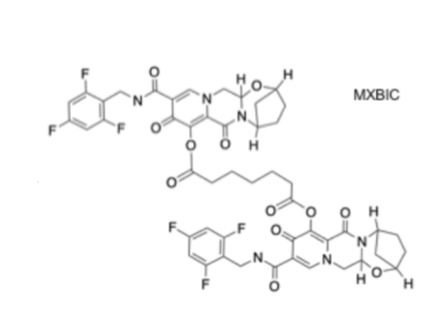
Drug name
Last update: Oct 2026Ultra-Long-Acting Dimeric Bictegravir Prodrug
Developer(s)
Drug information
Not provided
Bictegravir
Bictegravir
Small molecule
INSTI (Integrase Strand Transfer Inhibitor) — prodrug of bictegravir (integrase strand transfer inhibitor; INSTI)
Preclinical / IND
This ultra-long-acting bictegravir prodrug is a synthetic lipophilic ester of bictegravir. The homodimeric form of BIC is formulated into a single aqueous nanosuspension (NMXBIC) with Tween 20 and PEG3350 as excipients. The PK profile of NMXBIC—tail phase half-life (t½): 18–26 days; Cmax: 2,328 ng/mL within 24 hours post-injection and a low PK tail phasing duration (70 days). The mechanism of absorption involves a slow dissolution and hydrolysis of the prodrug at the injection site, forming a long-lasting depot. This hydrolysis releases the active BIC via enzymatic and chemical cleavage. Further, the NMXBIC likely undergoes two-step hydrolysis, releasing one BIC molecule at a time, compared to monomeric form (M2BIC), producing a 'controlled plateau.'
Not approved
Not approved
Therapeutic area(s)
- HIV
- Treatment
Administration route
Intramuscular
Associated long-acting platforms
Aqueous drug particle suspension
Use of drug
- Administered by a community health worker
- Administered by a nurse
- Administered by a specialty health worker
- Every 6 months
Dosage
NMXBIC 45 mg/kg and 90 mg/kg BIC equivalent dose (Preclinical dose - rat) and 30 mg (1mL) IM injection (Preclinical unit dosage - rabbit)
300 mg
Not provided
Not provided
Not provided
Not provided
Additional information
Developer(s)

University of Nebraska Medical Center
The University of Nebraska Medical Center (UNMC) is a public academic health-sciences center in Omaha, Nebraska, founded in 1869. UNMC houses six colleges, two degree-granting institutes, and graduate studies, with nearly 40 academic departments offering clinical, research, and graduate programs. They provide guidance and support to help advance early-stage drug discovery projects.
Drug structure
Scale-up and manufacturing prospects
Not provided
High-pressure homogenizer
The synthesized prodrug form is converted into surfactant-stabilized aqueous nanosuspensions through a scalable microfluidization process utilizing high-pressure homogenization. An optimal formulation was developed using polysorbate 20 (Tween 20) and polyethylene glycol 3350 (PEG 3350) as stabilizers. This advanced formulation significantly increased the drug concentration from 120 mg/mL to 300-330 mg/mL.
1. Nuclear magnetic resonance (NMR), 2. Fourier-transform infrared (FT-IR) spectroscopy, 3. Electrospray ionization mass spectrometry (ESI-MS)
Excipients & delivery device(s)
Not provided
1. Polysorbate 20 (Tween-20) 2. Polyethylene glycol 3350 (PEG-3350) 3. Poloxamer 407 (Pluronic F127) 4. PBS (vehicle)
No residual solvent used
No delivery device
Safety, Efficacy and Evidence Summary
Not provided
Not provided
Not provided
Not provided
Prodrug comprising dimer of integrase inhibitor (bictegravir) and nanoparticle comprising crystalline form of said prodrug
The present invention provides prodrugs and methods of use thereof.
WO2020112931
Compound
BOARD OF REGENTS OF THE UNIVERSITY OF NEBRASKA
Not provided
November 27, 2039
Granted: CN Pending: EPO, US