
|
Developed by
|
Supported by
|
|
University of Nebraska Medical Center Originator
https://www.unmc.edu/
United States of America The University of Nebraska Medical Center (UNMC) is a public academic health-sciences center in Omaha, Nebraska, founded in 1869. UNMC houses six colleges, two degree-granting institutes, and graduate studies, with nearly 40 academic departments offering clinical, research, and graduate programs. They provide guidance and support to help advance early-stage drug discovery projects. |

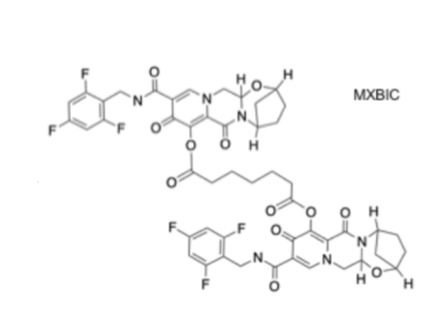
Chemical structure of Bictegravir Dimer Prodrug
Edagwa B, Nayan MU, Sillman B, et al. An Ultra-Long-Acting Dimeric Bictegravir Prodrug Defined by a Short Pharmacokinetic Tail. Preprint. Res Sq. 2025;rs.3.rs-5959131. doi:10.21203/rs.3.rs-5959131/v1
Aqueous drug particle suspension
Intramuscular
Not provided
NMXBIC 45 mg/kg and 90 mg/kg BIC equivalent dose (Preclinical dose - rat) and 30 mg (1mL) IM injection (Preclinical unit dosage - rabbit)
300 mg
Not provided
Not provided
Not provided
Not provided
No delivery device
Not provided
High-pressure homogenizer
The synthesized prodrug form is converted into surfactant-stabilized aqueous nanosuspensions through a scalable microfluidization process utilizing high-pressure homogenization. An optimal formulation was developed using polysorbate 20 (Tween 20) and polyethylene glycol 3350 (PEG 3350) as stabilizers. This advanced formulation significantly increased the drug concentration from 120 mg/mL to 300-330 mg/mL.
1. Nuclear magnetic resonance (NMR), 2. Fourier-transform infrared (FT-IR) spectroscopy, 3. Electrospray ionization mass spectrometry (ESI-MS)
Not provided
1. Polysorbate 20 (Tween-20) 2. Polyethylene glycol 3350 (PEG-3350) 3. Poloxamer 407 (Pluronic F127) 4. PBS (vehicle)
No residual solvent used
Prodrug comprising dimer of integrase inhibitor (bictegravir) and nanoparticle comprising crystalline form of said prodrug
The present invention provides prodrugs and methods of use thereof.
WO2020112931
Compound
BOARD OF REGENTS OF THE UNIVERSITY OF NEBRASKA
Not provided
November 27, 2039
Granted: CN Pending: EPO, US
Edagwa, B., Nayan, M. U., Sillman, B., Das, S., Hanson, B., Sultana, A., Le, N. T. H., Deodhar, S., Dash, A., Cohen, S., & Gendelman, H. (2025). An Ultra-Long-Acting Dimeric Bictegravir Prodrug Defined by a Short Pharmacokinetic Tail. Research square, rs.3.rs-5959131. https://doi.org/10.21203/rs.3.rs-5959131/v1
Ultra-long-acting (ULA) antiretroviral parenteral formulations, with low injection volumes, high resistance barriers, and short pharmacokinetic (PK) tails, can transform HIV-1 therapeutics. Here, we converted bictegravir (BIC), a potent daily oral antiretroviral drug, into monomeric and homodimeric ester prodrugs. The homodimeric prodrug nanosuspension, NMXBIC, shows sustained plasma BIC levels >16 times the protein-adjusted 95% inhibitory concentration (PA-IC95) for six months after a single injection in Sprague Dawley rats. The results paralleled a short PK tail with the potential for late dose forgiveness. The monomeric prodrug nanosuspension, NM2BIC, shows lower year-long plasma BIC concentrations above PA-IC95 after a single injection in Sprague Dawley rats. After repeated injections, NMXBIC and NM2BIC are well tolerated in New Zealand White rabbits. NMXBIC's physicochemical properties and high BIC loading/unit mass of the prodrug contribute to its unique ULA PK profile. These results support its development as a ULA formulation for HIV-1 treatment and prevention.
There are no additional links
|
|
Collaborate for developmentConsider on a case by case basis, collaborating on developing long acting products with potential significant public health impact, especially for low- and middle-income countries (LMICs), utilising the referred to long-acting technology Not provided |
|
|
Share technical information for match-making assessmentProvide necessary technical information to a potential partner, under confidentiality agreement, to enable preliminary assessment of whether specific medicines of public health importance in LMICs might be compatible with the referred to long-acting technology to achieve a public health benefit Not provided |
|
|
Work with MPP to expand access in LMICsIn the event that a product using the referred to long-acting technology is successfully developed, the technology IP holder(s) will work with the Medicines Patent Pool towards putting in place the most appropriate strategy for timely and affordable access in low and middle-income countries, including through licensing Not provided |
Not provided