access-principles-1access-principles-2access-principles-3backcarrierdevelopmentease_of_administrationexportimplantableinjectablenon-implantablenon_carriernon_injectableother_featuresprintroute_of_administrationtherapeutic_areatype_of_tech

Drug information

Drug's link(s)
Generic name

Rifapentine solid drug nanoparticle

Brand names

Not provided

Compound type

Small molecule

Drug class/category

Not provided

Summary

Intramuscular administration of rifapentine as a solid drug nanoparticle (SDN) suspension at weekly doses of 187.5 and 375 mg/kg produced a pharmacokinetic profile comparable to that observed with oral risperidone formulations. Preclinical evaluations demonstrated dose-dependent pharmacokinetics, with estimated release rate constants ranging from 0.0015 to 0.0025 h⁻¹. The AUC1-14d values were 6.629 and 13.071 µg·h/L for the 187.5 and 375 mg/kg doses, respectively. Physiologically based pharmacokinetic (PBPK) modeling further indicated a cumulative 11% increase in apparent clearance per dosing day following repeated administration of rifapentine SDN.

Approval status

Not approved yet.

Regulatory authorities

Not approved yet.

Therapeutic area(s)

  • TB
Use case(s)
  • Prevention

Administration route

Intramuscular

Associated long-acting platforms

Solid Drug Nanoparticle suspension

Use of drug

Ease of administration
  • Administered by a community health worker
  • Administered by a nurse
  • Administered by a specialty health worker
Frequency of administration
  • Every 2 weeks
  • Monthly
User acceptance

Not provided

Dosage

Available dose and strength

Animal dosage tested: 46.9 mg/kg; 93.75 mg/kg; 187.5 mg/kg; and 375 mg/kg IM

Maximum dose

Animal Maximum dose tested: 375 mg/kg IM

Recommended dosing regimen

Not provided

Additional comments

Not provided

Dosage link(s)

Associated technologies

Not provided

Comment & Information

Not provided

Developer(s)

Centre for Excellence of Long-acting Therapeutics
Originator
United Kingdom

Centre for Excellence of Long-acting Therapeutics

The Centre of Excellence for Long-acting Therapeutics (CELT) is a cross-faculty research initiative combining our world leading expertise in pharmacology and materials chemistry and working with international partners to disseminate research findings in long-acting medicine and change the global landscape of drug administration.

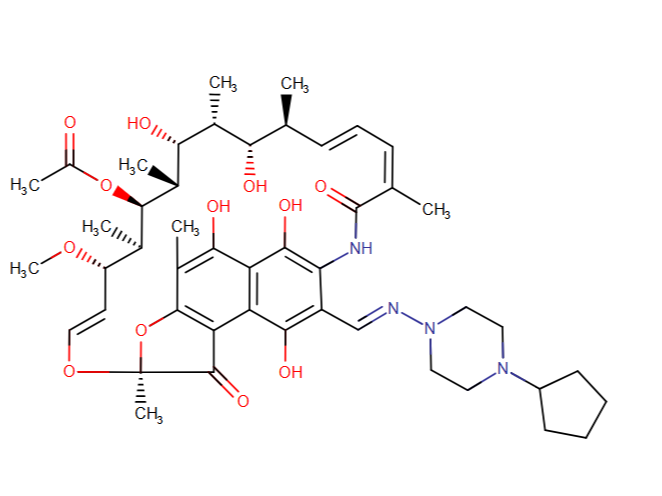
Drug structure

Scale-up and manufacturing prospects

Scale-up prospects

Not provided

Tentative equipment list for manufacturing

Not provided

Manufacturing

Not provided

Specific analytical instrument required for characterization of formulation

Not provided

Excipients

Proprietary excipients used

No proprietary excipient used

Novel excipients or existing excipients at a concentration above Inactive Ingredient Database (IID) for the specified route of administration

Not provided

Residual solvents used

Not provided

Delivery device(s)

No delivery device

Description

Solid compositions comprising nanoparticles of Rifapentine

Brief description

he present invention relates to solid compositions comprising nanoparticles of a Rifamycin, such a Rifapentine, dispersed within a matrix comprising a first excipient and a second excipient. The present invention also relates to microneedle arrays, implantable rods, aqueous dispersions, and pharmaceutical compositions derived from said solid compositions and uses for the same. In the method of the sixteenth aspect of the present invention, the concentration of the Rifamycin, such as Rifapentine, within the aqueous dispersion, the pharmaceutical composition, or the injectable formulation may be 100 to 1000 mg/mL, preferably 200 to 900 mg/mL, more preferably 300 to 800 mg/mL, and most preferably 500 to 700 mg/mL.

Representative patent

WO2024194655

Category

Formulation

Patent holder

THE UNIVERSITY OF LIVERPOOL

Exclusivity

Not provided

Expiration date

March 22, 2044

Status

Pending in EP and CN

Description

Rifapentine compound and preparation process

Brief description

ovel rifamycin SV derivatives of the general Formula I wherein R is cyclobutyl, cyclopentyl, cyclohexyl or cycloheptyl, each optionally substituted once or twice by methyl and/or ethyl, are prepared by contacting 3-formylrifamycin SV with 1-1.1 molar equivalents of an aminopiperazine of the general Formula II in the presence of an inert organic solvent at from ambient temperature to the reflux temperature of the reaction mixture. Pharmaceutical compositions having antibacterial activity comprise, as active ingredient, a rifamycin derivative of the general Formula a I, together with a pharmaceutically acceptable carrier.

Representative patent

US4002752

Category

Compound

Patent holder

LEPETIT SPA

Exclusivity

Not provided

Expiration date

March 5, 1995

Status

Expired

Publications

Chang, Y. S., Li, S. Y., Pertinez, H., Betoudji, F., Lee, J., Rannard, S. P., Owen, A., Nuermberger, E. L., & Ammerman, N. C. (2023). Using dynamic oral dosing of rifapentine and rifabutin to simulate exposure profiles of long-acting formulations in a mouse model of tuberculosis preventive therapy. bioRxiv : the preprint server for biology, 2023.04.12.536604. https://doi.org/10.1101/2023.04.12.536604

Administration of tuberculosis preventive therapy (TPT) to individuals with latent tuberculosis infection is an important facet of global tuberculosis control. The use of long-acting injectable (LAI) drug formulations may simplify and shorten regimens for this indication. Rifapentine and rifabutin have anti-tuberculosis activity and physiochemical properties suitable for LAI formulation, but there are limited data available for determining the target exposure profiles required for efficacy in TPT regimens. The objective of this study was to determine exposure-activity profiles of rifapentine and rifabutin to inform development of LAI formulations for TPT. We utilized a validated paucibacillary mouse model of TPT in combination with dynamic oral dosing of both drugs to simulate and understand exposure-activity relationships to inform posology for future LAI formulations. This work identified several LAI-like exposure profiles of rifapentine and rifabutin that, if achieved by LAI formulations, could be efficacious as TPT regimens and thus can serve as experimentally-determined targets for novel LAI formulations of these drugs. We present novel methodology to understand the exposure-response relationship and inform the value proposition for investment in development of LAI formulations that has utility beyond latent tuberculosis infection.

Additional documents

Useful links

There are no additional links

Collaborate for development

Consider on a case by case basis, collaborating on developing long acting products with potential significant public health impact, especially for low- and middle-income countries (LMICs), utilising the referred to long-acting technology

Share technical information for match-making assessment

Provide necessary technical information to a potential partner, under confidentiality agreement, to enable preliminary assessment of whether specific medicines of public health importance in LMICs might be compatible with the referred to long-acting technology to achieve a public health benefit

Work with MPP to expand access in LMICs

In the event that a product using the referred to long-acting technology is successfully developed, the technology IP holder(s) will work with the Medicines Patent Pool towards putting in place the most appropriate strategy for timely and affordable access in low and middle-income countries, including through licensing