Drug name
Last update: Aug 2026Pembrolizumab
Developer(s)
Drug information
Pembrolizumab
Keytruda
Biotherapeutic
PD-1 checkpoint inhibitor
Not provided
Pembrolizumab is a monoclonal antibody that targets the programmed death-1 (PD-1) receptor, thereby inhibiting the interaction between PD-1 and its ligands. It is approved for the treatment of multiple solid tumors, including melanoma, non-small cell lung cancer (NSCLC), small cell lung cancer (SCLC), head and neck squamous cell carcinoma (HNSCC), classical Hodgkin lymphoma (cHL), primary mediastinal large B-cell lymphoma, urothelial carcinoma, and various malignancies within the gastrointestinal tract. Pembrolizumab is administered every three weeks, supported by its pharmacokinetic profile, which includes a terminal half-life of approximately 26 days and a volume of distribution of 7.4 L. Clinical data have demonstrated that pembrolizumab provides improved tumor response.
Keytruda is approved by several SRAs, including FDA, fora wide range of cancers including: Melanoma, Non-small cell lung cancer (NSCLC), Head and neck squamous cell carcinoma (HNSCC), Classical Hodgkin lymphoma, Urothelial carcinoma, Colorectal cancer (MSI-H/dMMR), Gastric cancer, Cervical cancer, Esophageal cancer, Endometrial cancer, Hepatocellular carcinoma (HCC), Triple-negative breast cancer (TNBC), Tumor-agnostic approvals for MSI-H, TMB-H, and dMMR tumors. Keytruda is also approved by EMA for many of the same cancers as in the U.S., although specific indications and line-of-treatment approvals may differ slightly.
Keyruda received accelerated approval from US FDA and 55 other national regulatory bodies. all over the world.
Therapeutic area(s)
- Oncology : "Solid tumors such as Melanoma, NSCLC, SCLC, HNSCC, cHL, PMBCL, Urothelial Carcinoma, Microsatellite Instability-High or Mismatch Repair Deficient Colorectal Cancer"
- Treatment
Administration route
Intravenous, Subcutaneous
Associated long-acting platforms
Solution
Use of drug
- Administered by a community health worker
- Administered by a nurse
- Administered by a specialty health worker
- Every 3 weeks
Dosage
100mg/4mL (25mg/mL) [50 mg lyophilized powder/vial]
200mg
KEYTRUDA is given as 200 mg every 3 weeks / 400 mg every 6 weeks. This applies across multiple indications, including melanoma, NSCLC, SCLC, HNSCC, cHL/PMBCL, urothelial carcinoma, MSI-H/dMMR cancers, gastric, esophageal, cervical, HCC, MCC, RCC (with axitinib), endometrial carcinoma (with or without lenvatinib), TMB-H cancers, and cSCC. Pediatric dosing is typically 2 mg/kg (max 200 mg) every 3 weeks for cHL/PMBCL, MSI-H/dMMR, and MCC.
Not provided
Dosage of the medicine varies according to indication, setting, guidelines and clinical approach
Related entries
Not provided
Additional information
Developer(s)

Merck / MSD
Merck is a German multinational science and technology company headquartered in Darmstadt. It operates in three main sectors: healthcare, life sciences, and electronics. Merck is a leading company in pharmaceuticals, biotechnology, and chemicals, providing a wide range of products and services globally.

Biocad
BIOCAD is Russia's leading full-cycle biotechnology and pharmaceutical manufacturing company. Founded in 2001 by CEO Dmitry Morozov, it covers everything from initial drug discovery and molecular engineering to large-scale mass commercial production.
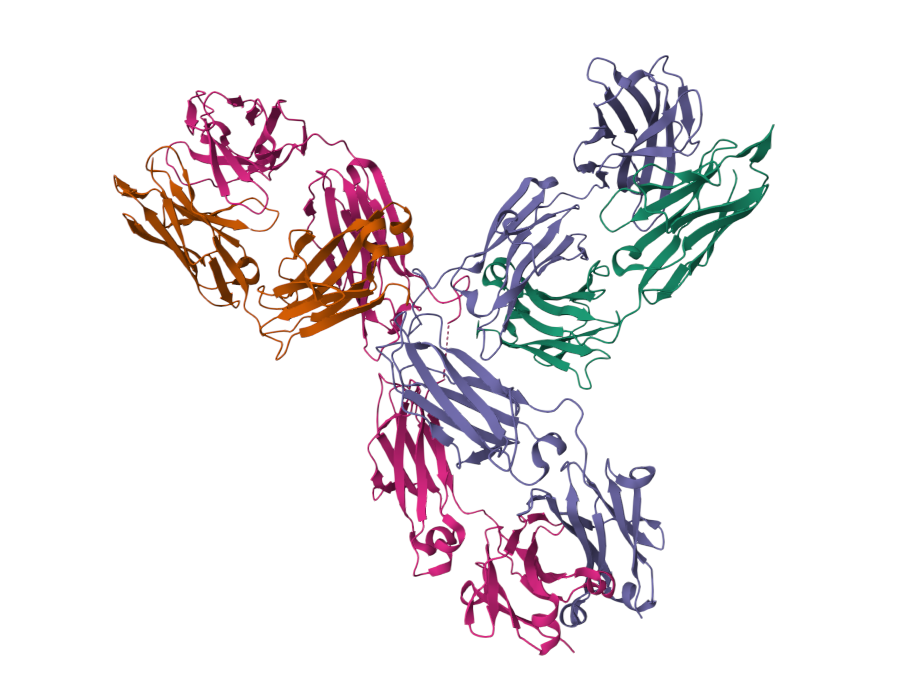
Drug structure
Scale-up and manufacturing prospects
The manufacturing process has been scaled up by transferring the process from a donor manufacturing site with a 12500 L bioreactor to two additional recipient sites with 12000 L and 22000 L bioreactors. This scaling up aims to increase the overall production capacity of the drug substance, which is a monoclonal antibody against PD-1. Keytruda generated approximately $29.5 billion in global sales in 2024
1. Helios Gene Gun 2. CELLine Bioreactors 3. 96-well flat-bottom culture plates. Other equipments are not disclosed.
The manufacturing process of pembrolizumab in aseptic conditions includes: 1. Immunization and antibody generation in CHO-K1 cells 2. B Cell isolation and hybridoma formation 3. Antibody expression and purification 4. Cloning and sequencing of immunoglobulin genes 5. Humanization of antibodies 6. Recombinant expression of humanized antibodies
FACS (Fluorescence-Activated Cell Sorting); ELISA (Enzyme-Linked Immunosorbent Assay) Reader; FMAT (Fluorometric Microvolume Assay Technology); Octet Bio-Layer Interferometry (BLI); Amicon Ultra Centrifugal Filters (Millipore); ABI 3730 DNA Analyzer; NanoDrop; Gel Electrophoresis.
Excipients & delivery device(s)
No proprietary excipient used
No novel excipient or existing excipient used
No residual solvent used
No delivery device
Safety, Efficacy and Evidence Summary
Not provided
Not provided
Not provided
Not provided