Drug name
Last update: Aug 2026Paliperidone Palmitate Once-Monthly (PP1M)
Developer(s)
Drug information
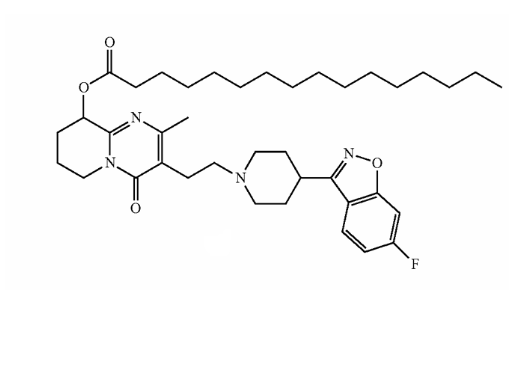
Paliperidone Palmitate Once-Monthly (PP1M)
INVEGA SUSTENNA®, XEPLION®, Niapelf
Small molecule
Central Dopamine (D2) type 2 and serotonin (5HT2A) type 2 Receptor Antagonist
Not provided
Paliperidone palmitate administered as a once monthly long-acting injectable (PP1M) is indicated for the maintenance treatment of schizophrenia and schizoaffective disorder. INVEGA SUSTENNA® and XEPLION® are manufactured by Janssen Pharmaceuticals and available in dosage strengths of 25mg, 50mg, 100mg, and 150mg. Prior to the initiation of treatment, oral-lead periods to establish tolerability are required for patients naïve to either oral paliperidone or oral or injectable risperidone. Due to its extremely low water solubility, PP1M dissolves slowly following intramuscular injection, prior to being hydrolysed to paliperidone and subsequent absorption. Release of the active paliperidone substance lasts up to 4 months, with maximum plasma concentrations achieved after 13 days (median Tmax).
PP1M has been approved under the trade name of INVEGA SUSTENNA® (Janssen-Cilag Ltd) by the US Food and Drug Administration for the treatment of schizophrenia (approved Aug 2009) & schizoaffective disorder (approved Nov 2015) as monotherapy and as an adjunct to mood stabilisers or antidepressants. The safety and effectiveness of INVEGA SUSTENNA® in patients < 18 years of age have not been established. PP1M is approved by the European Medicines Agency (EMA) under the trade name XEPLION® (Janssen-Cilag Ltd) for the maintenance treatment of schizophrenia in adults whose disease has already been stabilised on treatment with paliperidone or risperidone. The European Commission granted a marketing authorisation valid throughout the European Union for XEPLION® on 4 March 2011.
PP1M is authorised in 102 countries/territories worldwide as of December 6th 2022.
Therapeutic area(s)
- Mental Health Disorders (incl. schizophrenia, bipolar disorders, Schiz. Aff. Dis.) : "Schizophrenia (naive and previously treated) , Psychotic or manic symptoms of schizoaffective disorde"
- Treatment
Administration route
Intramuscular
Associated long-acting platforms
Aqueous drug particle suspension, Lipid Prodrug Depot - Nanocrystal technology
Use of drug
- Administered by a nurse
- Administered by a specialty health worker
- Administered by a community health worker
- Monthly
Dosage
39 mg, 78 mg, 156 mg, and 234 mg
234 mg
1. For both schizophrenia and schizoaffective disorder, the initiation regimen is the same: (i) Day 1: 234 mg (administered in the deltoid muscle) IM (ii) Day 8: 156 mg (administered in the deltoid muscle) IM 2. Maintenance: (i) Schizophrenia: 39 mg to 234 mg monthly - Recommended maintenance dose: 117 mg monthly (ii) Schizoaffective disorder: 78 mg to 234 mg monthly
Not provided
Contraindicated: Cerebrovascular ADRs, Neuroleptic malignant syndrome, QT Prolongation, Tardive dyskinesia, Metabolic changes, Orthostatic hypotension and syncope, Hyperprolactinemia, Cognitive impairment, and Seizures.
Related entries
Not provided
Additional information
Developer(s)

Johnson & Johnson
Janssen Pharmaceuticals is a subsidiary company of Johnson & Johnson headquartered in Beerse, Belgium. They focus on manufacturing and developing pharmaceutical products for use in areas such as, Immunology, Infectious Diseases & Vaccines, Pulmonary Hypertension, Cardiovascular & Metabolism, Oncology, and Neuroscience.
Neuraxpharm
Neruaxpharm is a European biopharmaceutical company headquartered in both Barcelona, Spain and Langenfeld, Germany. Neuraxpharm specialises in developing medicines and generics for diseases of the central nervous system (CNS). Their portfolio consists of more than 120 molecules for the treatment of Anxiety, Depression, Schizophrenia, Epilepsy, Alzheimer’s, Parkinson’s and other CNS disorders.
Drug structure
Scale-up and manufacturing prospects
PP1M is commercially manufactured.
NanoCrystal® Colloidal Dispersion Nanomill™ apparatus.
NanoCrystal technology enables intrinsically high loading of insoluble drugs as dosage forms consist mostly of pure API packed as a solid crystal, which is the most efficient form possible in relation to weight-to-volume. Paliperidone palmitate particles are dispersed in an aqueous suspension and transformed into smaller nanocrystals through particle-size reduction. These nanocrystals have a greater surface area than the larger original particles, resulting in increased water solubility. This medicinal product does not require any special storage conditions and has a shelf life of two years.
Digital microscope and scanning electron microscopy (SEM) to determine shape of the particles. Differential scanning calorimetric (DSC) and Fourier transforms infrared spectroscopy (FTIR) for quality control.
Excipients & delivery device(s)
No proprietary excipient used
No novel excipient or existing excipient used
No residual solvent used
No delivery device
Safety, Efficacy and Evidence Summary
Not provided
Not provided
Not provided
Not provided