Drug name
Last update: Aug 2026Delamanid Lipid-Based Nanoparticle Formulation
Developer(s)
Drug information
Delamanid
Delamanid
Small molecule
Bicyclic nitroimidazole
Not provided
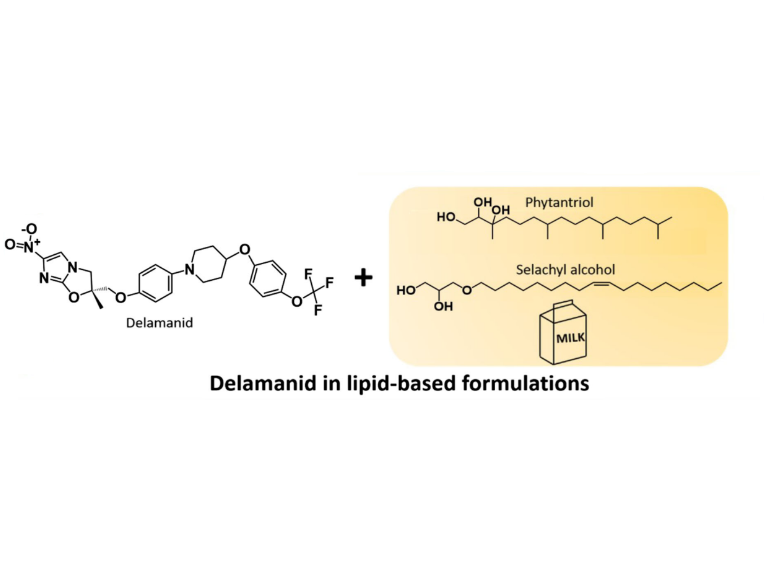
Delamanid sustained release lipid formulation (oral) based on Phytantriol (PHY) and Selachyl alcohol (SA) to achieve sustained oral absorption. In rats, a 10 mg/kg oral dose of delamanid formulated in PHY or SA significantly prolonged absorption, with Tmax values of 27 and 20 h, respectively, compared with 3.4 h for aqueous suspension and 6.5 h for milk. Relative bioavailability increased to 556% (PHY) and 645% (SA), indicating enhanced exposure and sustained drug release. The effect was attributed to prolonged gastric retention and persistent self-assembled lipid structures. No safety concerns were identified in this preclinical study, although comprehensive toxicological and clinical evaluations remain necessary before translation to human use.
Under preclinical investigation
Under preclinical investigation
Therapeutic area(s)
- TB
- Treatment
Administration route
Oral
Associated long-acting platforms
PHY and SA digestible lipid nanoparticles
Use of drug
- Self-administered
- Once
The published preclinical literature does not appear to specifically investigate safety endpoints for the PHY and SLY formulations of delamanid, limiting the available evidence for formulation-specific safety assessment.
Dosage
Strength: 10 mg/kg PO
10 mg/kg PO
Not provided
Not provided
Lipid dose incorporated in Delamanid formulations: 1) Phytantriol (PHY): 0.14 ± 0.01 mg/g lipid 2) Selachyl alcohol (SA/SLY): 0.41 ± 0.03 mg/g lipid
Related entries
Not provided
Additional information
Developer(s)

Monash University
Monash University is a public research university based in Melbourne, Australia which was established in 1958. It has grown into Australia's largest higher education institution. The Drug Delivery, Disposition and Dynamics (D4) is one of the core research themes within the world-renowned Monash Institute of Pharmaceutical Sciences (MIPS) at Monash University.
Drug structure
Scale-up and manufacturing prospects
Not provided
Analytical balance, vortex mixer, temperature-controlled incubator (37°C), and sample vials
The PHY and SLY (selachyl alcohol) formulations were prepared by dispersing delamanid in bulk lipid vehicles at a drug-to-lipid ratio of 1:10 (w/w), followed by equilibration at 37°C for 24 h before administration. Upon hydration in gastrointestinal fluids, phytantriol and selachyl alcohol self-assembled into inverse bicontinuous cubic and inverse hexagonal liquid-crystalline structures, respectively, enabling sustained drug release and prolonged absorption.
Small-angle X-ray scattering (SAXS), and HPLC with UV detection
Excipients & delivery device(s)
Not provided
1) Phytantriol (PHY), 3,7,11,15-tetramethylhexadecane-1,2,3-triol (lipid vehicle) 2) Selachyl alcohol (SA), 1-O-octadec-9-enyl glycerol (lipid vehicle)
Not provided
Not provided
Safety, Efficacy and Evidence Summary
The published preclinical literature does not appear to specifically investigate safety endpoints for the PHY and SLY formulations of delamanid, limiting the available evidence for formulation-specific safety assessment.
No published evidence on efficacy is currently available. However, a study by Ramirez et al. (2020) reported the pharmacokinetic profile of the PHY and SLY formulations. The median time to maximum plasma concentration (Tmax) was 27 hours for the PHY formulation and 20 hours for the SLY formulation. Compared with the reference formulation, delamanid exposure increased 5.56-fold and 6.45-fold with the PHY and SLY formulations, respectively.
Non-digestible lipid based formulations, particularly selachyl alcohol (SLY) and phytantriol (PHY), substantially increased delamanid exposure and prolonged drug absorption. These findings provide proof-of-concept evidence supporting the potential of sustained oral delivery systems to reduce dosing frequency and improve treatment adherence in patients with multidrug-resistant tuberculosis (MDR-TB).
Liquid crystal composition and method of use
The present invention provides a method, system and composition for controlled compound delivery, the composition comprising a liquid crystal carrier and a compound to be delivered. An external stimulus can be applied to control transition of the liquid crystal from a first phase having a first capacity for retention of the compound to a second phase having a second capacity for retention of the compound. The 'capacity for retention1 is the ability of the liquid crystalline matrix to reduce the apparent diffusion rate of the compound within the matrix to less than that in bulk solvent coexisting with the carrier, such as excess water, bodily fluid or other polar liquid. Thus, the transition from a first phase to a second phase can provide controlled release, on-demand delivery of the compound.
WO2011050388A1
Not provided
Monash University
Not provided
December 30, 2012
Ceased