Drug name
Last update: Sep 2026TBAJ-587 fumarate
Developer(s)
Drug information
Not provided
TBAJ-587 fumarate
Not provided
Small molecule
Diarylquinoline (DARQ) antimycobacterial agent
Not provided
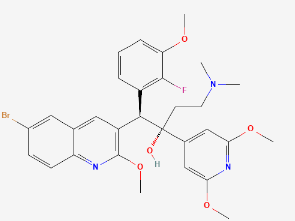
TBAJ-587 is a next-generation diarylquinoline that inhibits mycobacterial F1Fo ATP synthase and is being developed as a long-acting treatment for tuberculosis. The fumarate formulation has been investigated with excipients including polysorbate 20, polysorbate 80, poloxamer 188, poloxamer 338, poloxamer 407, and D-α-tocopheryl polyethylene glycol 1000 succinate. In preclinical studies, TBAJ-587 demonstrated potent activity against Mycobacterium tuberculosis H37Rv with a minimum inhibitory concentration (MIC) of 0.016 μg/mL. Pharmacokinetic studies of long-acting injectable formulations showed prolonged systemic exposure, with Cmax values of 110–218 ng/mL, Tmax values of 256–951 h, and AUC0–3 months of 69,112–107,535 ng·h/mL. Detectable plasma concentrations were maintained for > 90 days.
Not approved, under preclinical investigation
Not approved yet
Therapeutic area(s)
- TB
- Treatment
Administration route
Intramuscular
Associated long-acting platforms
Aqueous drug particle suspension
Use of drug
- Administered by a community health worker
- Administered by a nurse
- Administered by a specialty health worker
- Every 3 months
Dosage
280 mg/mL (Strength) × 0.1 mL (injection volume) = 28 mg TBAJ-587 (Preclinical dosage)
750 mg/mL TBAJ-587 fumarate (expressed as free-base equivalent)
0.1 ml of TBAJ-587 280 mg/mL (free-base equivalent) was administered via intramuscular (IM) injection to rats. Drug concentrations were monitored for up to three months.
Not provided
Not provided
Related entries
Not provided
Additional information
Developer(s)
TB Alliance
TB Alliance, formally known as the Global Alliance for TB Drug Development, is a not-for-profit product development partnership dedicated to the discovery, development, and delivery of faster-acting, safer, and affordable treatments for tuberculosis (TB). Since its establishment in 2000, the organization has played a pivotal role in advancing TB drug research and has built the largest pipeline.
Drug structure
Scale-up and manufacturing prospects
Not provided
1. Rotary evaporator 2. Filtration setup (filtration step described during free-base isolation). 3. Drying chamber/desiccator (used for drying isolated material). 4. DeltaVita 1 Dual Centrifuge (Netzsch) for wet media milling. 5. Yttrium-stabilized zirconium oxide milling beads. 6. Ultrapure Water Dispenser (18.2 MΩ, Merck Millipore). 7. Mastersizer 3000 laser diffraction analyzer with Hydro MV dispersion unit. 8. Gamma 2–16 LSCplus Freeze Dryer (CHRIST). 9. PANalytical X'Pert Pro X-ray diffractometer. 10. FEI Quanta 200 Scanning Electron Microscope. 11. Agilent 1100 HPLC system
Manufacturing is required to be conducted in Grade C/D cleanroom environments 1. Vehicle preparation 2. Wet media milling (critical step) 3. Particle-size characterization using yttrium-stabilized zirconium oxide beads and a dual centrifugation milling process 4. Bulk suspension holding 5. Sterile manufacture / aseptic processing 6. Fill-finish 7. Final product is lyophilized and reconstitution is required before use
1. Mastersizer 3000 laser diffraction analyzer 2. X-ray Powder Diffraction (XRPD) 3. Scanning Electron Microscopy (SEM) 4. High-Performance Liquid Chromatography (HPLC) 5. PANalytical X'Pert Pro X-ray diffractometer 6. FEI Quanta 200 Scanning Electron Microscope
Excipients & delivery device(s)
No proprietary excipient used
1) Polysorbate 20 2) Polysorbate 80 3) Poloxamer 188 4) Poloxamer 338 5) Poloxamer 407 6) D-α-tocopheryl polyethylene glycol 1000 succinate (TPGS)
No residual solvent used
No delivery device
Safety, Efficacy and Evidence Summary
Not provided
Not provided
Not provided
Not provided
TBAJ-587 and analogues
The present invention relates to compounds of formula (I) including any stereochemically isomeric form thereof, or pharmaceutically acceptable salts thereof, for the treatment of tuberculosis.
WO2017155909
Compound
THE GLOBAL ALLIANCE FOR TB DRUG DEVELOPMENT, INC.
Not provided
March 7, 2037
Granted: AU, BR, CA, CN, EA (AM, AZ, BY, KG, KZ, RU, TJ, TM), EP (CH, DE, ES, FR, GB, IT, LI), ID, IN, JP, KR, US