Drug name
Last update: Sep 2026Risperidone
Developer(s)
Drug information
Risperidone
RISPERDAL CONSTA®, PERSERIS®, RYKINDO®, UZEDY®
Small molecule
Not provided
Not provided
Risperidone LAI is an atypical antipsychotic indicated for schizophrenia and maintenance treatment of Bipolar I Disorder. It acts via dopamine D₂ and serotonin 5-HT₂ receptor antagonism. The apparent half-life for risperidone + hydroxyrisperidone is 3–6 days, and clearance is 13.7 L/h (in extensive metabolisers) and 3.3 L/h (in poor metabolisers). Following intramuscular injection, risperidone is released gradually, with therapeutic levels sustained for up to 6 weeks. It is metabolised hepatically via CYP2D6 to active 9-hydroxyrisperidone. Common adverse effects include extrapyramidal symptoms, weight gain, and hyperprolactinemia. Clinical trials demonstrate efficacy in reducing relapse rates in schizophrenia and bipolar disorder, with a favourable safety profile under monitored use.
Risperidone microsphere LAI formulation is approved in 54 countries including Canada, United States, European Union countries, UAE, Switzerland, Brazil, Chile, China, Russia, Hong Kong, Malaysia, India, New Zealand, Australia, Israel, Philippines, Saudi Arabia, South Africa, Taiwan, Thailand, the United Kingdom, South Korea, Turkey, Japan, United Arab Emirates, Argentina and Mexico.
Risperdal Consta (12.5 mg, 25 mg, 37.5 mg, and 50 mg) has received marketing authorization from multiple regulatory agencies, including Health Canada, the U.S. FDA, and authorities such as DOH, Swissmedic, ANVISA, ISP, NMPA, MINZDRAV, NPRA, CDSCO, MedSafe, TGA, MOH, FDA Philippines, SFDA, SAHPRA, TFDA, THAI FDA, MHRA, MFDS, TMMDA, PMDA, MOHAP, ANMAT, and COFEPRIS. In addition, approvals have been granted by European national agencies such as CBG, AGES, FAMHP, ANMDMR, SUKL (Czechia), SUKL (Slovakia), DMA, IMA, FIMEA, ANSM, BFARM, EOF, NNGYK, and HPRA. Other European authorities have also provided authorization. However, the European Medicines Agency (EMA) has issued only a positive opinion following a referral from BFARM (Germany), rather than granting centralized approval.
Therapeutic area(s)
- Mental Health Disorders (incl. schizophrenia, bipolar disorders, Schiz. Aff. Dis.) : "incl. schizophrenia"
- Treatment
Administration route
Oral, Subcutaneous, Intramuscular
Associated long-acting platforms
Polymer-based particles, Microspheres
Use of drug
- Administered by a nurse
- Administered by a specialty health worker
- Administered by a community health worker
- Every 2 weeks
Dosage
12.5 mg; 25 mg; 37.5 mg; 50 mg powder for injection
50 mg IM every 2 weeks
1. Initial Treatment Dose for Schizophrenia & Bipolar: • Administer 25 mg intramuscularly (IM) every 2 weeks. 2. Dose Adjustment for Non-Responders: • If inadequate response at 25 mg, consider increasing to 37.5 mg or 50 mg IM every 2 weeks. • Do not exceed 50 mg every 2 weeks. 3. Special Populations (Renal or Hepatic Impairment): • Initiate treatment at a reduced dose of 12.5 mg IM every 2 weeks. 4. Previously Treated Patients: • Previous antipsychotics should be continued for 3 weeks after the first injection of risperidone LAI to ensure that therapeutic concentrations are maintained until the main release phase of risperidone from the injection site has begun
Risperidone LAI must be reconstituted only in the diluent supplied in the dose pack and must be administered with only the appropriate needle supplied in the dose pack for gluteal (2-inch needle) or deltoid (1-inch needle) administration. All components are required for administration. Do not substitute any components of the dose pack. To ensure that the intended dose of risperidone is delivered, the full contents from the vial must be administered. Administration of partial contents may not deliver the intended dose of risperidone.
Additional information
Developer(s)

J&J / Janssen
Janssen Pharmaceuticals is a subsidiary company of Johnson & Johnson headquartered in Beerse, Belgium. They focus on manufacturing and developing pharmaceutical products for use in areas such as, Immunology, Infectious Diseases & Vaccines, Pulmonary Hypertension, Cardiovascular & Metabolism, Oncology, and Neuroscience.

Alkermes
Alkermes, Inc. is the U.S. R&D and manufacturing arm of Alkermes plc, a fully integrated, global biopharmaceutical company. The company focuses on developing innovative medicines for serious psychiatric and neurological disorders.
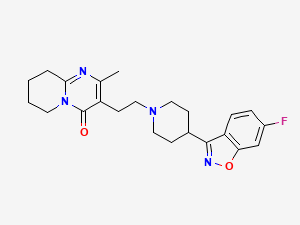
Drug structure
Scale-up and manufacturing prospects
Not provided
Static Mixer: Cole Parmer L04667-14. Gear Pumps: Cole Parmer L07149-04, L07002-16. Quench Tank: 55 L capacity. Sieves: 25 µm and 180 µm stainless steel mesh. Lyophilizer: Pilot-scale, ramped cycle (max 30°C, 50 h). Gamma Irradiator: Co-60 source.
Risperidone microspheres are synthesized by dissolving PLGA (75:25 lactide:glycolide) in ethyl acetate and benzyl alcohol, then adding risperidone base. This organic phase is emulsified with an aqueous phase containing 1% polyvinyl alcohol using a static mixer. The emulsion is quenched in chilled water with buffer, stirred for solvent removal, sieved (25–180 µm), washed, and dried. Optional steps include lyophilization and gamma sterilization for stability and sterility, ensuring controlled release for 14–60 days.
1. Laser Diffraction Analyzer 2. Scanning Electron Microscope (SEM) 3. High-Performance Liquid Chromatography (HPLC) 4. UV-Vis Spectrophotometer 5. Gas Chromatography (GC) 6. Differential Scanning Calorimetry (DSC) 7. Thermogravimetric Analysis (TGA)
Excipients & delivery device(s)
Not provided
The list of excipients used is: 1. Polysorbate 20 2. Sodium carboxymethyl cellulose 3. Disodium hydrogen phosphate dihydrate 4. Citric acid anhydrous 5. Sodium chloride 6. Sodium hydroxide 7. Water for injection
Not provided
No delivery device
Safety, Efficacy and Evidence Summary
(1) TEAEs were observed in ~70% of risperidone‑treated patients Vs ~60% placebo (2) Weight gain - ≥7% observed in ~18% of treated patients (3) SAEs reported in 3–5% across adult schizophrenia trials (4) Tardive Dyskinesia, Weight Gain, Somnolence, Hyperprolactinemia Common ADRs include: (1) Eye disorders: vision blurred (2) Gastrointestinal disorders such as constipation, nausea (3) Fatigue, edema, pain (4) Upper RTI, cough, congestion (5) Weight increase/loss (6) Headache, Parkinsonism, Sedation, syncope, Tremor (7) Acne, Dry skin
(1) 47% of schizophrenia patients treated with the recommended starting dose of 25 mg achieved clinical improvement (defined as a ≥20% reduction in PANSS total score), compared to only 17% of patients receiving a placebo. (2) 23.1% of bipolar I patients in the Risperdal Consta + TAU group experienced a relapse, compared to 45.8% of patients in the placebo + TAU group (3) 30% of bipolar patients treated with Risperdal Consta relapsed, compared to 56–60% of patients receiving a placebo (treatment peroid 90 days)
Risperidone LAI is associated with higher incidence of TEAE compared to placebo, with some common safety issues such as weight gain, drowsiness, hyperprolactinemia, and tradive dyskinesia. In efficacy evaluations, long-acting injectable risperidone demonstrated statistically significant improvements in schizophrenia symptom control compared with placebo, as evidenced by reductions in Positive and Negative Syndrome Scale (PANSS) scores, and was associated with a significantly lower risk of relapse in patients with bipolar disorder. Overall, these findings indicate highly significant efficacy with mild safety concerns.
Process for preparation of biodegradable microparticles
The invention provides a process for the preparation of biodegradable biocompatible microparticles, said process comprising: contacting microparticles comprising a biodegradable biocompatible polymer matrix containing an active (e.g. pharmaceutical or diagnostic) agent and an organic solvent with an aqueous solvent system whereby the content of said organic solvent in said particles is reduced to 2 % or less of the weight of said particles, said solvent system being such as to satisfy at least one of the conditions (a) that it is at an elevated temperature (e.g. from 25 to 40 °C) during at least part of the time that it is in contact with said particles, and (b) that it comprises water and water-miscible solvent for said organic solvent; and recovering said particles from said aqueous solv
WO1997041837A2
Process, Formulation
Alkermes Controlled Therapeutics Inc
Not provided
May 6, 2017
Expired
Risperidone encapsulated microparticles compositions
A pharmaceutical composition comprising biodegradable and biocompatible microparticle containing a 1,2-benzazole of the formula (I), or a pharmaceutically acceptable acid addition salt thereof, wherein R is hydrogen or C1-6alkyl; R1 and R2 independently are hydrogen, halo, hydroxy, C1-6alkyloxy and C1-6alkyl; X is O or S; Alk is C1-4alkanediyl; and R3 is hydrogen or C1-6alkyl; Z is -S-, -CH2, or -CR4=CR5-; where R4 and R5 independently are hydrogen or C1-6alkyl; A is a bivalent radical -CH2-CH2-, -CH2-CH2-CH2- or -CR6=CR7-; wherein R6 and R7 are hydrogen, halo, amino or C1-6alkyl; and R8 is hydrogen or hydroxyl; within a polymeric matrix.
WO1995013814
Formulation
Janssen Pharmaceutica N.V.
Not provided
November 11, 2014
Expired
Risperidone Compound
Novel 3-piperidinyl-1,2-benzisothiazoles and 3-piperidinyl-1,2-benzisoxazoles having the formula wherein X is O or S and Q is a radical of formula or a radical of formula the pharmaceutically acceptable acid addition salts and possible stereochemically isomeric forms thereof, which compounds have antipsychotic properties; pharmaceutical compositions containing such compounds as an active ingredient and methods of preparing said compounds and pharmaceutical compositions.
EP0196132
Compound
JANSSEN PHARMACEUTICA NV
Not provided
March 13, 2006
Expired