Drug name
Last update: Nov 2026Ultra-long-acting Tenofovir Phosphonate Prodrug
Developer(s)
Drug information
Nanoformulated Myristoylated Monophenyl Tenofovir Phosphonate Prodrug
Tenofover Phosphate
Small molecule
Protease Inhibitor (PI)
Preclinical / IND
NM5TFV (nanoformulated myristoylated monophenyl tenofovir ) is an ultra-long-acting intramuscular prodrug formulation designed to provide sustained delivery of tenofovir after a single administration. Following injection, nanocrystal depots formed at the injection site gradually release M5TFV into systemic circulation. The prodrug undergoes hydrolysis to tenofovir, which is subsequently phosphorylated intracellularly to the active metabolite, tenofovir diphosphate, responsible for antiviral activity. This approach aims to overcome adherence limitations associated with daily oral therapy by maintaining prolonged systemic drug exposure. Pharmacokinetic studies demonstrated slow and sustained release of tenofovir from the depot formulation. In rats, a single intramuscular dose maintained detectable plasma tenofovir concentrations for up to 365 days, with prolonged distribution to liver, spleen, lymph nodes, kidney and muscle tissues. The extended exposure was attributed to slow nanocrystal dissolution and gradual prodrug conversion. In HBV-transgenic mice, sustained drug levels following a single dose produced durable suppression of HBV DNA, HBsAg, HBeAg and intrahepatic viral markers
Under preclinical investigation
Under preclinical investigation
Therapeutic area(s)
- HIV
- HBV
- Pre-Exposure Prophylaxis (PrEP)
- Treatment
Administration route
Intramuscular
Associated long-acting platforms
phosphonate prodrug nanosuspension
Use of drug
- Administered by a community health worker
- Administered by a nurse
- Administered by a specialty health worker
- Other/Variable/Unknown : Frequency is unknown but the formulation sustained suppression of viral replication for >10 weeks
Dosage
Preclinical doses: 200 mg/kg & 400 mg/kg. Strength: 303 mg/ml via Intramuscular (IM) route
400 mg/kg
Not provided
Not provided
Not provided
Related entries
Not provided
Additional information
Developer(s)

University of Nebraska Medical Center
The University of Nebraska Medical Centre (UNMC) is a premier public academic health science centre located in Omaha, Nebraska. Established in 1869 as the Omaha Medical College, it became part of the University of Nebraska system in 1902 and operates as the state's only publicly supported health sciences centre.
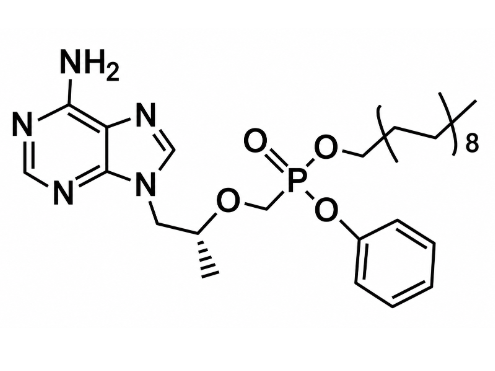
Drug structure
Scale-up and manufacturing prospects
Not provided
Not provided
1. Manufacturing formulation: Scalable-milling-compatible high-pressure homogenization process 2. Synthesis: Tenofovir monophenyl was chemically modified through esterification with octadecanol via a cleavable phosphoester bond to generate M5TFV, a lipophilic, amino acid-free crystalline phosphonate prodrug of tenofovir. The reaction requires: - PPh₃: Triphenylphosphine. - 2,2′-Dithiopyridine: Reaction-promoting reagent. - Et₃N: Triethylamine. - Pyridine: Reaction medium. - Temperature: 65°C.
1. Fourier transform infrared (FT-IR) spectroscopy, 2. Nuclear magnetic resonance (NMR) 3. Matrix-assisted laser desorption/ionization–time-of-flight (MALDI-TOF) mass spectrometry
Excipients & delivery device(s)
No proprietary excipient used
1. Tween 20 2. PEG 3350
Not provided
Not provided
Safety, Efficacy and Evidence Summary
Based on preclinical studies: 1) No drug-related systemic toxicity was observed, with normal hematology, serum chemistry, liver, kidney and spleen histology. 2) Mild-to-moderate transient granulomatous inflammatory reactions occurred at the injection site and resolved over time without muscle degeneration, edema, or erythema. 3) No adverse effects on body weight were detected.
1) A single dose of TFV phosphonate prodrug caused >2.5 log10 reduction in blood HBV DNA for >2 months in transgenic mouse models 2) At weeks 6 and 8 post-injection, a significant 0.7 log10 difference in HBV DNA reduction
Preclinical studies demonstrated a favorable safety profile for ultra long-acting tenofovir phosphonate for HBV infections. No drug-related systemic toxicity was observed, and hematology, serum chemistry, and histopathology of the liver, kidney, and spleen remained normal. Mild-to-moderate transient granulomatous inflammatory reactions occurred at the injection site but resolved over time without muscle degeneration, edema, or erythema. No adverse effects on body weight were detected, supporting good overall tolerability. Efficacy studies showed sustained antiviral activity, with a >2.5 log10 reduction in blood HBV DNA maintained beyond two months after a single administration. Significant antiviral effects persisted through weeks 6 and 8 post-injection, achieving approximately 0.7 log10 greater HBV DNA reduction than comparator treatment. These findings support the potential of long-acting tenofovir phosphate as a durable and well-tolerated therapy for chronic hepatitis B.
Prodrugs and formulations thereof
The present invention provides prodrugs and methods of use thereof.
US20220288037A1
Prodrug formulation design
University of Nebraska System
Not provided
August 20, 2030
Abandoned