
|
Developed by 

|
Supported by 


|
Fusogenic Liposome-coated Porous Silicon Nanoparticles
Developer(s)

|
University of California Originator
https://www.universityofcalifornia.edu/
United States of America The University of California, San Diego (UCSD), founded in 1960, is a leading research institution known for innovation in science and technology. UCSD excels in drug delivery research, focusing on nanomedicine, biomaterials, and targeted therapies. Its infrastructure includes advanced labs like the Center for Drug Discovery Innovation, fostering interdisciplinary collaborations. |
Sponsor(s)

|
National Science Foundation (NSF) https://www.nsf.gov/ |

|
National Institutes of Health (NIH) https://www.nih.gov/ |
Partnerships

|
Sanford Burnham Prebys Medical Discovery Institute https://sbpdiscovery.org/ |

|
Huazhong University of Science and Technology https://english.hust.edu.cn/ |

|
Massachusetts Institute of Technology (MIT) https://www.mit.edu/ |
Technology information
Type of technology
Inorganic nanoparticles
Administration route
Subcutaneous, Intramuscular, Intravenous, Topical (Rectal), Transmucosal, Transdermal
Development state and regulatory approval
C-FNP (Chemosensitizing siRNA)
Pre-clinical
Not provided
Description
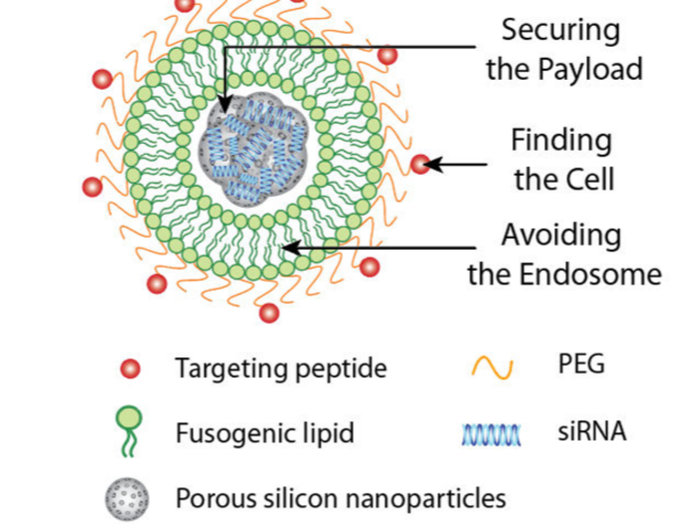
Fusogenic liposome-coated porous silicon nanoparticles represent a biodegradable drug delivery system for oligonucleotides, capable of bypassing endocytic pathways to facilitate direct cytoplasmic delivery. This system enables the release of the API from the nanoparticle core into the cell cytoplasm. The fusogenic liposome layer, which surrounds the silicon-based core, is functionalized with polyethylene glycol (PEG) to enhance stability and circulation time
Technology highlight
1. The API is encapsulated within the porous structure of the fusogenic liposomal nanoparticle. 2. The API is released into the cytoplasm through the shedding of the nanoparticle's fusogenic lipid coating, facilitating direct intracellular delivery. 3. The nanoparticle exhibits a high API loading capacity, allowing for the efficient delivery of therapeutic agents. 4. The formulation demonstrates low cytotoxicity, ensuring biocompatibility for in vitro and in vivo applications. 5. The fusogenic nanoparticles achieve 90–100% transfection efficiency due to enhanced cellular uptake through membrane fusion and endosomal escape.
Technology main components
a) Silicon-containing core b) Porous surface that is chemically linked to the core c) Plurality of cargo molecules that are physically associated with silicon-containing core material d) Metal silicate e) Fusogenic liposome coating with silicon-containing core material
Information on the raw materials sourcing, availability and anticipated price
The raw materials are obtained from Alza Corporation and Nova Pharmaceuticals.
Delivery device(s)
No delivery device
APIs compatibility profile
API desired features
Nucleic acids
Oligonucleotides such as small interfering RNA (siRNA) therapeutics are targeted for this fugogenic nanoparticle drug delivery system. Some examples of siRNA peptides that are targeted against Irf5 gene and Rev3l gene.
Proteins
Fusogenic porous silicon nanoparticles have the capacity to securely deliver proteins to the targeted site, but the choice of protein for this delivery system is not disclosed.
Additional solubility data
Not provided
Additional stability data
Not provided
API loading: Maximum drug quantity to be loaded
75-90 wt%
API co-administration
1 single API :
LogP
Not provided
Scale-up and manufacturing prospects
Scale-up prospects
Not provided
Tentative equipment list for manufacturing
1. Teflon Etch 2. Square Wave Generator 3. Sonicator Bath 4. Liposome Extruder
Manufacturing
Fusogenic Nanoparticle Manufacturing in Small Scale includes: Etch a silicon wafer in HF using square wave currents (50 mA/cm² for 0.6 s, 400 mA/cm² for 0.36 s) for 500 cycles. Detach the porous layer (3.7 mA/cm², 250 s), rinse with ethanol and water, and store silicon chips in RNase-free water. Sonicate chips (35 kHz, 12 h). Prepare DMPC, DSPE-PEG, and DOTAP lipid film, hydrate with siRNA-loaded calcium-coated nanoparticles, and extrude 20× through a polycarbonate membrane. Conjugate targeting peptides (1 mg/mL, 20 min), purify via 30 kDa filtration, and store at -80°C.
Specific analytical instrument required for characterization of formulation
1. Dynamic Light Scattering (DLS) 2. Zeta Potential Analyzer 3. Transmission Electron Microscopy (TEM) 4. Confocal Laser Scanning Microscopy (CLSM) 5. Fourier Transform Infrared Spectroscopy (FTIR) 6. Ultraviolet-Visible Spectroscopy (UV-Vis) 7. Inductively Coupled Plasma Mass Spectrometry (ICP-MS) 8. Differential Scanning Calorimetry (DSC) 9. Nanoparticle Tracking Analysis (NTA) 10. High-Performance Liquid Chromatography (HPLC)
Clinical trials
Not providedExcipients
Proprietary excipients used
No proprietary excipient used
Novel excipients or existing excipients at a concentration above Inactive Ingredients Database (IID) for the specified route of administration
No novel excipient or existing excipient used
Residual solvents used
No residual solvent used
Additional features
Other features of the technology
- Biodegradable
- Drug-eluting
Release properties
Preclinical studies show that the fusogenic lipid-coated nanoparticles have very little initial burst release rate. It also proves that up to 75% of the API is released into the cells at 168 hours and complete release after 336 hours, i.e., 14 days.
Injectability
Fusogenic porous silicon nanoparticles can be administered via intravitreal, intravenous, and subcutaneous injection.
Stability
Product Stability: Details regarding the formulation's stability are not disclosed. Nanoparticle Stability: The stability of the nanoparticles can be modified by adjusting their size to optimize the API payload.
Storage conditions and cold-chain related features
Not provided
Safety, Efficacy and Evidence Summary
Safety
Not provided
Efficacy
Not provided
Evidence Summary
Not provided
Potential application(s)
Therapeutic area(s)
Use case(s)
Not provided
Use of technology
Ease of administration
- Administered by a community health worker
- Administered by a nurse
- Administered by a specialty health worker
Frequency of administration
Weekly, Monthly
User acceptance
Targeted user groups
Age Cohort- Adults
- Older Adults
- All
Pregnant individuals
Unspecified
Lactating individuals
Unspecified
Healthy individuals
Unspecified
Comment
Not provided
Potential associated API(s)
C-FNP (Chemosensitizing siRNA)
Class(es)
Oligonucleotides
Development stage
Pre-clinical
Clinical trial(s)
Not provided
Foreseen/approved indication(s)
Solid Tumors
Foreseen user group
Not provided
Foreseen duration between application(s)
Once weekly
Applications to Stringent Regulatory Authorities (SRA) / regulatory approvals
Not provided
T-FNP (Immune-modulating siRNA)
Class(es)
Oligonucleotides
Development stage
Pre-clinical
Clinical trial(s)
Not provided
Foreseen/approved indication(s)
Solid Tumors
Foreseen user group
Not provided
Foreseen duration between application(s)
Once weekly
Applications to Stringent Regulatory Authorities (SRA) / regulatory approvals
Not provided
VEGF-A (Vascular endothelial growth factor A siRNA) (VEGF-siRNA)
Class(es)
Oligonucleotides
Development stage
Pre-clinical
Clinical trial(s)
Not provided
Foreseen/approved indication(s)
Diabetic retinopathy
Foreseen user group
Not provided
Foreseen duration between application(s)
Once weekly
Applications to Stringent Regulatory Authorities (SRA) / regulatory approvals
Not provided
Patent info
Description
Fusogenic liposome-coated porous silicon nanoparticles
Brief description
The disclosure describes a fusogenic liposome-coated porous silicon nanoparticles for high loading efficiency of anionic payloads (small molecules, dyes, nucleic acids), and for non-endocytic delivery of hydrophilic and lipophilic payloads by membrane fusion. The liposome coating can be further modified with targeting peptides or antibodies via covalent binding chemistry between the ligands and functionalized poly(ethylene glycol). The surface moieties can be transferred to the cellular membrane surface by fusogenic uptake. The composition of the disclosure can be applied in the treatment of diseases by delivering entrapped/encapsulated payloads.
Representative patent
US10702474B2
Category
Formulation
Patent holder
University of California San Diego UCSD
Exclusivity
Not provided
Expiration date
July 8, 2038
Status
Anticipated expiration
Supporting material
Publications
Kim, B., & Sailor, M. J. (2019). Synthesis, Functionalization, and Characterization of Fusogenic Porous Silicon Nanoparticles for Oligonucleotide Delivery. Journal of visualized experiments : JoVE, (146), 10.3791/59440. https://doi.org/10.3791/59440
Link: https://doi.org/10.3791/59440
With the advent of gene therapy, the development of an effective in vivo nucleotide-payload delivery system has become of parallel import. Fusogenic porous silicon nanoparticles (F-pSiNPs) have recently demonstrated high in vivo gene silencing efficacy due to its high oligonucleotide loading capacity and unique cellular uptake pathway that avoids endocytosis. The synthesis of F-pSiNPs is a multi-step process that includes: (1) loading and sealing of oligonucleotide payloads in the silicon pores; (2) simultaneous coating and sizing of fusogenic lipids around the porous silicon cores; and (3) conjugation of targeting peptides and washing to remove excess oligonucleotide, silicon debris, and peptide. The particle’s size uniformity is characterized by dynamic light scattering, and its core-shell structure may be verified by transmission electron microscopy. The fusogenic uptake is validated by loading a lipophilic dye, 1,1'-dioctadecyl-3,3,3',3'-tetramethylindocarbocyanine perchlorate (DiI), into the fusogenic lipid bilayer and treating it to cells in vitro to observe for plasma membrane staining versus endocytic localizations. The targeting and in vivo gene silencing efficacies were previously quantified in a mouse model of Staphylococcus aureus pneumonia, in which the targeting peptide is expected to help the F-pSiNPs to home to the site of infection. Beyond its application in S. aureus infection, the F-pSiNP system may be used to deliver any oligonucleotide for gene therapy of a wide range of diseases, including viral infections, cancer, and autoimmune diseases.
Kim, B., Sun, S., Varner, J. A., Howell, S. B., Ruoslahti, E., & Sailor, M. J. (2019). Securing the payload, finding the cell, and avoiding the endosome: peptide‐targeted, fusogenic porous silicon nanoparticles for delivery of siRNA. Advanced Materials, 31(35), 1902952. https://doi.org/10.1002/adma.201902952
Link: https://doi.org/10.1002/adma.201902952
Despite the promise of ribonucleic acid interference therapeutics, the delivery of oligonucleotides selectively to diseased tissues in the body, and specifically to the cellular location in the tissues needed to provide optimal therapeutic outcome, remains a significant challenge. Here, key material properties and biological mechanisms for delivery of short interfering RNAs (siRNAs) to effectively silence target-specific cells in vivo are identified. Using porous silicon nanoparticles as the siRNA host, tumor-targeting peptides for selective tissue homing, and fusogenic lipid coatings to induce fusion with the plasma membrane, it is shown that the uptake mechanism can be engineered to be independent of common receptor-mediated endocytosis pathways. Two examples of the potential broad clinical applicability of this concept in a mouse xenograft model of ovarian cancer peritoneal carcinomatosis are provided: silencing the Rev3l subunit of polymerase Pol ζ to impair DNA repair in combination with cisplatin; and reprogramming tumor-associated macrophages into a proinflammatory state.
Additional documents
Useful links
There are no additional links
Additional information
Illustrations
Structure of Fusogenic Nanoparticles for Oligonucleotide delivery
Kim, Byungji, et al. "Securing the payload, finding the cell, and avoiding the endosome: peptide‐targeted, fusogenic porous silicon nanoparticles for delivery of siRNA." Advanced Materials 31.35 (2019
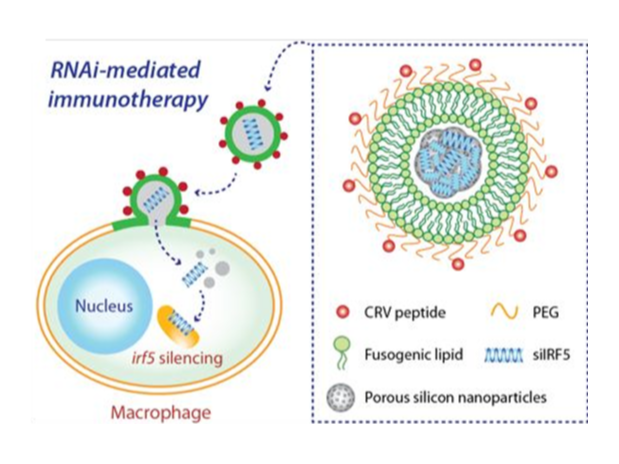
The peptide-targeted, fusogenic porous silicon nanoparticles (F-pSiNPs) and their mode of action in delivering and silencing the Irf5 gene in macrophages, as a broad-class strategy for treatment of Gr
Kim, Byungji, et al. "Fusogenic porous silicon nanoparticles as a broad-spectrum immunotherapy against bacterial infections." Nanoscale horizons 6.4 (2021): 330-340.