
access-principles-1access-principles-2access-principles-3backcarrierdevelopmentease_of_administrationexportimplantableinjectablenon-implantablenon_carriernon_injectableother_featuresprintroute_of_administrationtherapeutic_areatype_of_tech
Developed by

MPP logo
UOL CELT logo
Supported by

Unitaid logo
Leap logo
Coefficient Giving logo
https://www.natap.org/2026/CROI/croi_189.htm

Ultra-Long Acting Buprenorphine Prodrug (AM-510)


Developer(s)

University of Nebraska Medical Center

Originator
https://www.unmc.edu/

United States of America

Nebraska Medical Center began with UNMC, founded in 1869 and chartered in 1881 as Omaha Medical College. It joined the University of Nebraska in 1902. The modern center formed in 1997 when University Hospital merged with Clarkson Hospital. Today, UNMC/Nebraska Medicine is known for care, research, and drug discovery through pharmacy, nanomedicine, cancer, and drug design programs.

Exavir Therapeutics, Inc.

Originator
https://www.exavirtherapeutics.com/

United States of America

Exavir Therapeutics, Inc. is a San Francisco-based biotechnology company co-founded by Howard Gendelman, Benson Edagwa, and Alborz Yazdi. Originating from UNMC-linked HIV nanomedicine research, it develops ultra-long-acting antivirals, including prodrug formulations for HIV PrEP and treatment. Its pipeline includes VH-310, XV-122, and XV-207, with ViiV Healthcare partnering on VH-310.


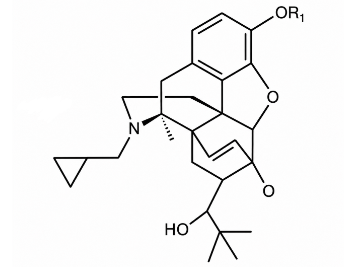
Drug structure

Structure of Buprenorphine analog/prodrug series of 5α,6β,14β,18R)-17-(cyclopropylmethyl)-18-[(2S)-2-hydroxy-3,3-dimethylbutan-2-yl]-6-methoxy-18,19-dihydro-4,5-epoxy-6,14-ethenomorphinan-3-ol

Structure of Buprenorphine analog/prodrug series of 5α,6β,14β,18R)-17-(cyclopropylmethyl)-18-[(2S)-2-hydroxy-3,3-dimethylbutan-2-yl]-6-methoxy-18,19-dihydro-4,5-epoxy-6,14-ethenomorphinan-3-ol

https://www.natap.org/2026/CROI/croi_189.htm
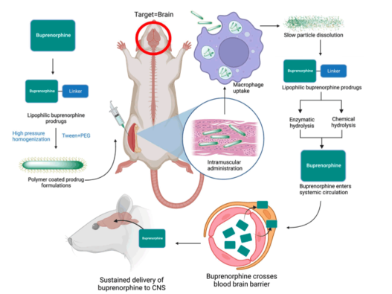
Sequential Steps of Ultra long acting buprenorphine PK profile

Sequential Steps of Ultra long acting buprenorphine PK profile

https://www.natap.org/2026/CROI/croi_189.htm


Drug information

Associated long-acting platforms

Polymer-based particles

Administration route

Subcutaneous, Intramuscular

Therapeutic area(s)

Substance use disorders
Pain management

Use case(s)

Not provided

Use of drug

Ease of administration

Administered by a community health worker
Administered by a nurse
Administered by a specialty health worker
Self-administered
To be determined

Frequency of administration

Every 6 months

User acceptance

Not provided

Dosage

Available dose and strength

AM-510 - 45mg/kg IM; 90 mg/kg IM & SC preclinical doses

Maximum dose

90 mg/kg IM

Recommended dosing regimen

1) 45 mg/kg SC STAT 2) 45 mg/kg IM STAT 3) 90 mg/kg IM STAT

Additional comments

Not provided

Dosage link(s)

Not provided


Drug information

Drug's link(s)

https://go.drugbank.com/drugs/DB00921

Generic name

Buprenorphine; AM-510

Brand name

Buprenorphine

Compound type

Small molecule

Drug class/category

Mu-Opioid Receptor Partial Agonist

Summary

Buprenorphine prodrug (AM-510) is under preclinical investigation for cell-based drug uptake, retention and cytotoxicity. Further PK and safety testings were conducted in rats which indicates that intramuscular administration of Formulation 1 showed dose‑dependent increases in exposure, with Cmax rising from 13.9 to 26.9 ng/mL and AUC₀–∞ from 530 to 893.9 ng·day/mL when the dose increased from 45 to 90 mg/kg BUP equivalents, alongside prolonged half‑life and MRT. In contrast, subcutaneous delivery of Formulation 2 at 45 mg/kg produced a lower Cmax but markedly extended half‑life (74.8 days) and MRT (73.6 days), indicating more sustained systemic exposure consistent with an ultra long‑acting release profile.

Approval status

Not approved yet (under preclinical investigation)

Regulatory authorities

Not approved yet (under preclinical investigation)

Delivery device(s)

Not provided


Scale-up and manufacturing prospects

Scale-up prospects

Not provided

Tentative equipment list for manufacturing

High‑pressure homogenizer

Manufacturing

Manufacturing of Buprenorphine prodrug involves: Mixing Coordinated buprenorphine–hydrophilic linker prodrug complex with Tween® and polyethylene glycol (PEG) and processed by high‑pressure homogenization to yield a polymer‑coated prodrug formulation.

Specific analytical instrument required for characterization of formulation

LC-MS/MS


Clinical trials

Not provided

Excipients

Proprietary excipients used

Not provided

Novel excipients or existing excipients at a concentration above Inactive Ingredients Database (IID) for the specified route of administration

1) Tween 2) Polyethylene Glycol

Residual solvents used

Not provided


Patent info

There are either no relevant patents or these were not yet submitted to LAPaL


Supporting material

Publications

There are no publication

Additional documents

No documents were uploaded

Useful links


Access principles

Collaborate for development

Consider on a case by case basis, collaborating on developing long acting products with potential significant public health impact, especially for low- and middle-income countries (LMICs), utilising the referred to long-acting technology

Not provided

Share technical information for match-making assessment

Provide necessary technical information to a potential partner, under confidentiality agreement, to enable preliminary assessment of whether specific medicines of public health importance in LMICs might be compatible with the referred to long-acting technology to achieve a public health benefit

Not provided

Work with MPP to expand access in LMICs

In the event that a product using the referred to long-acting technology is successfully developed, the technology IP holder(s) will work with the Medicines Patent Pool towards putting in place the most appropriate strategy for timely and affordable access in low and middle-income countries, including through licensing

Not provided


Comment & Information

Not provided