WONDERS1
Identifier
NCT06544733
Link
https://clinicaltrials.gov/study/NCT06544733
Phase
Phase II/III
Status
Active, not recruiting
Sponsor
Gilead Sciences
More details
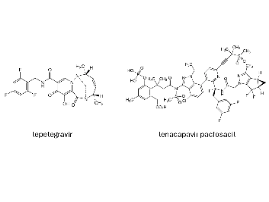
The goal of this clinical study is to learn more about the experimental drugs GS-1720 and GS-4182; to compare the combination of GS-1720 and GS-4182 with the current standard-of-care treatment bictegravir/emtricitabine/tenofovir alafenamide (B/F/TAF, BVY), to see if the combination of GS-1720 and GS-4182 is safe and if it works for treating human immunodeficiency virus type 1 (HIV-1) infection.
This study has two phases: Phase 2 and Phase 3.
The primary objectives of this study are:
Phase 2: To evaluate the efficacy of switching to oral weekly GS-1720 in combination with GS-4182 versus continuing BVY in virologically suppressed people with HIV-1 (PWH) at Week 24.
Phase 3: To evaluate the efficacy of switching to oral weekly GS-1720/GS-4182 Fixed-dose combination (FDC) tablet regimen ve
Purpose
Study of Oral Weekly GS-1720 and GS-4182 Versus Biktarvy in People With HIV-1 Who Are Virologically Suppressed
Interventions
Intervention 1
GS-1720
Intervention 2
GS-4182
Intervention 3
Placebo to Match BVY
Intervention 4
Bictegravir/emtricitabine/tenofovir alafenamide
Intervention 5
GS-1720/GS-4182 FDC
Countries
United States of America
Puerto Rico
Sites / Institutions
Not provided
Trials dates
Anticipated Start Date
Not provided
Actual Start Date
2024-08-20
Anticipated Date of Last Follow-up
2026-04-14
Estimated Primary Completion Date
2028-01-01
Estimated Completion Date
2029-06-01
Actual Primary Completion Date
Not provided
Actual Completion Date
Not provided
Studied populations
Age Cohort
Genders
Accepts pregnant individuals
Unspecified
Accepts lactating individuals
Unspecified
Accepts healthy individuals
No
Comments about the studied
populations
Key Inclusion Criteria:
* Documented plasma HIV-1 RNA \< 50 copies/mL for ≥ 24 weeks before and at screening.
* Receiving BVY for ≥ 24 weeks prior to screening.
Key Exclusion Criteria:
* Prior use of, or exposure to LEN, GS-1720, or GS-4182.
* History of virologic failure while on an integrase strand-transfer inhibitor (INSTI)-based regimen.
* Documented integrase strand-transfer inhibitor (INSTI) resistance, specifically, resistance-associated mutations (RAMs) E92G/Q, G118R, F121Y, Y143C/H/R, S147G, Q148H/K/R, N155H/S, or R263K in the integrase gene.
* Prior use of any long-acting (LA) parenteral antiretrovirals (ARV) such as monoclonal antibodies (mAbs) or broadly neutralizing antibodies (bNAbs) targeting HIV-1, injectable cabotegravir (including oral cabotegravir lead-in), or injecta
Health status
Not provided
Study type
Interventional (clinical trial)
Enrollment
675
Allocation
Randomized
Intervention model
Sequential assignment
Intervention
model description
Not provided
Masking
Double-blind masking
Masking description
Not provided
Frequency of administration
Weekly
Studied LA-formulation(s)
Tablet
Studied route(s) of administration
Oral
Use case
Treatment
Indication(s)
HIV
Key resources
Not provided
WONDERS2
Identifier
NCT06613685
Link
https://clinicaltrials.gov/study/NCT06613685
Phase
Phase II/III
Status
Terminated
Sponsor
Gilead Sciences
More details
The goal of this clinical study is to learn more about the experimental drugs GS-1720 (an oral, long-acting integrase strand transfer inhibitor (INSTI)) and GS-4182 (a prodrug of Lenacapavir (LEN)); to compare the combination of GS-1720 and GS-4182 with the current standard-of-care treatment bictegravir/emtricitabine/tenofovir alafenamide (B/F/TAF) (Biktarvy), to see if the combination of GS-1720 and GS-4182 is safe and if it works for treating human immunodeficiency virus type 1 (HIV-1) infection in treatment-naive people with HIV-1 (PWH).
This study has two phases: Phase 2 and Phase 3.
The primary objectives of this study are:
Phase 2: To evaluate the efficacy of oral weekly GS-1720 coadministered with GS-4182 versus continuing Biktarvy (BVY) in treatment-naive PWH at Week 24.
Phase
Purpose
Study of Oral Weekly GS-1720 and GS-4182 Compared With Biktarvy in People With HIV-1 Who Have Not Been Treated
Interventions
Intervention 1
GS-1720
Intervention 2
GS-4182
Intervention 3
Bictegravir/emtricitabine/tenofovir alafenamide
Intervention 4
GS-1720/GS-4182 FDC
Intervention 5
Placebo to Match BVY
Countries
United States of America
Canada
Germany
Poland
Portugal
Puerto Rico
Romania
South Africa
Spain
Sites / Institutions
Not provided
Trials dates
Anticipated Start Date
Not provided
Actual Start Date
2024-10-21
Anticipated Date of Last Follow-up
2026-03-26
Estimated Primary Completion Date
2029-01-01
Estimated Completion Date
2030-08-01
Actual Primary Completion Date
2026-03-16
Actual Completion Date
2026-03-16
Studied populations
Age Cohort
Genders
Accepts pregnant individuals
Unspecified
Accepts lactating individuals
Unspecified
Accepts healthy individuals
No
Comments about the studied
populations
Key Inclusion Criteria:
* HIV-1 RNA ≥ 500 copies/mL at screening.
* Antiretroviral (ARV) treatment-naive, except the use of oral pre-exposure prophylaxis (PrEP) or postexposure prophylaxis (PEP) with emtricitabine/tenofovir disoproxil fumarate (FTC/TDF) or F/TAF, up to 1 month prior to screening.
Key Exclusion Criteria:
* Prior use of any long acting parenteral antiretrovirals (ARVs) such as monoclonal antibodies, broadly neutralizing antibodies targeting HIV-1, LEN, injectable cabotegravir (including oral cabotegravir lead-in), and/or injectable rilpivirine.
* Documented resistance to the integrase strand-transfer inhibitor class, specifically, resistance-associated mutations E92G/Q, G118R, F121Y, Y143C/H/R, S147G, Q148H/K/R, N155H/S, or R263K in the integrase gene.
* Any of the follow
Health status
Positive to
: HIV
Study type
Interventional (clinical trial)
Enrollment
73
Allocation
Randomized
Intervention model
Sequential assignment
Intervention
model description
Not provided
Masking
Double-blind masking
Masking description
Not provided
Frequency of administration
Weekly
Studied LA-formulation(s)
Tablet
Studied route(s) of administration
Oral
Use case
Treatment
Indication(s)
HIV
Key resources