
|
Developed by 

|
Supported by 


|
TMB-365
Developer(s)

|
Drug structure
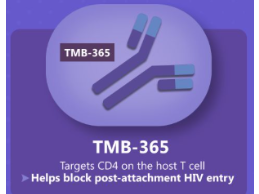
TMB-365 targets the CD4 receptor on host T cells, acting as a post-attachment entry inhibitor to help block HIV from entering the cell.
TaiMed Biologics Linkedin Account
Drug information
Associated long-acting platforms
Monoclonal antibodies and antibody drug conjugates
Administration route
Intravenous
Therapeutic area(s)
Use case(s)
Use of drug
Ease of administration
Frequency of administration
User acceptance
Dosage
Available dose and strength
Investigational: 2,400, 3,200 and 4,800 mg IV single doses; 4,800 mg IV every 8 weeks (core regimen).
Maximum dose
4,800 mg IV
Recommended dosing regimen
No approved regimen. TMB-365 4,800 mg + TMB-380 4,800 mg by IV infusion every 8 weeks.
Additional comments
Administered without prior susceptibility screening in the phase 2a study.
Dosage link(s)
Not provided
Drug information
Drug's link(s)
Not provided
Generic name
Brand name
Compound type
Drug class/category
Lifecycle status
Summary
Approval status
Regulatory authorities
Safety
Efficacy
Evidence Summary
Delivery device(s)
No delivery device
Scale-up and manufacturing prospects
Scale-up prospects
TaiMed operates its own cGMP biologics facility and CDMO business and manufactures ibalizumab, which is relevant to supply capacity. Two 4,800 mg IV doses per visit imply large protein quantities per patient-year, a significant cost-of-goods consideration for LMIC access.
Tentative equipment list for manufacturing
Not reported for this product. Standard therapeutic mAb train may be assumed: production bioreactors, disc-stack centrifugation and depth/membrane filtration for harvest clarification, Protein A and polishing chromatography, viral inactivation and filtration, ultrafiltration/diafiltration, sterile fill-finish.
Manufacturing
Recombinant antibody manufactured by TaiMed Biologics (Hsinchu County, Taiwan). Process details not published.
Specific analytical instrument required for characterization of formulation
Not reported for this product. Standard mAb characterisation applies: ion-exchange chromatography and capillary isoelectric focusing (charge variants), size-exclusion chromatography (aggregates), DSC (thermal stability), subvisible particle counting, ELISA for serum concentrations, TZM.bl neutralisation assays for susceptibility. Validated ELISA used for TMB-365 and TMB-380 PK.
Clinical trials
VISTA
Identifier
NCT07215468
Link
https://clinicaltrials.gov/study/NCT07215468
Phase
Phase II
Status
Active, not recruiting
Sponsor
TaiMed Biologics Inc.
More details
TMB-365 is a monoclonal antibody that binds to the CD4 receptor. TMB-380, aka VRC07-523LS is a monoclonal antibody that binds to HIV. Both interfere with HIV entry. This study is designed to test the combination of the antibodies as maintenance therapy in HIV infected suppressed individuals discontinuing oral cART for 48 weeks. Researchers will compare TMB-365/TMB-380 given IV every 8 weeks to continuation of daily oral cART to see if TMB-365/TMB-380 can also maintain viral suppression. Participants will: 1. Receive TMB-365/TMB-380 infusion or take oral cART as scheduled for 48 weeks 2. Visit the clinic as schedule for checkups and tests
Purpose
HIV-1 Virologic Suppression With TMB-365 and TMB-380 Antibodies Study
Interventions
Intervention 1
Intervention 2
Intervention 3
Countries
Sites / Institutions
Not provided
Trials dates
Anticipated Start Date
Not provided
Actual Start Date
2025-12-16
Anticipated Date of Last Follow-up
2026-08-05
Estimated Primary Completion Date
2027-05-01
Estimated Completion Date
2027-05-01
Actual Primary Completion Date
Not provided
Actual Completion Date
Not provided
Studied populations
Age Cohort
- Adults
- Older Adults
Genders
- All
Accepts pregnant individuals
Unspecified
Accepts lactating individuals
Unspecified
Accepts healthy individuals
No
Comments about the studied populations
Inclusion Criteria: 1. At least 18 years of age on the day of Screening. 2. Asymptomatic HIV-1 infection, documented by any licensed rapid HIV test or HIV enzyme or chemiluminescence immunoassay (E/CIA) test kit at any time prior to study entry and confirmed by Geenius™ or a second antibody test by a method other than the initial rapid HIV and/or E/CIA test, or by HIV-1 antigen, plasma HIV-1 RNA viral load at or prior to screening. 3. On continuous suppressive cART for at least 6 months prior to Screening with one documented HIV-1 RNA level \<50 copies/mL within 6 months of Screening. Continuous cART is defined as no interruptions greater than 3 consecutive days. cART is defined as a DHHS recommended regimen. Study participants should be on a stable oral regimen for at least 3 months prio
Health status
Not provided
Study type
Interventional (clinical trial)
Enrollment
88
Allocation
Randomized
Intervention model
Parallel Assignment
Intervention model description
Not provided
Masking
Open label
Masking description
Not provided
Frequency of administration
Studied LA-formulation(s)
Studied route(s) of administration
Use case
Treatment
Key resources
Excipients
Proprietary excipients used
Not provided
Novel excipients or existing excipients at a concentration above Inactive Ingredients Database (IID) for the specified route of administration
Not provided
Residual solvents used
Not provided
Patent info
There are either no relevant patents or these were not yet submitted to LAPaL
Supporting material
Publications
There are no publication
Additional documents
No documents were uploaded