
|
Developed by 

|
Supported by 


|
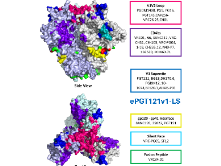
ePGT121v1LS
Developer(s)
|
|

|
Drug structure
An Overview of Human Anti-HIV-1 Neutralizing Antibodies against Diverse Epitopes of HIV-1
Swarandeep Singh
Drug information
Associated long-acting platforms
Monoclonal antibodies and antibody drug conjugates
Administration route
Intravenous, Subcutaneous
Therapeutic area(s)
Use case(s)
Use of drug
Ease of administration
Frequency of administration
User acceptance
To be determined. No acceptability data published. Caregiver, community and health-worker acceptability of infant bNAb administration is a formal endpoint of the ENABLE project, in which IAVI leads community engagement through a stakeholder task force focused on bNAbs for peri- and post-natal HIV prophylaxis.
Dosage
Available dose and strength
Investigational. Adults: 5, 20, 40 mg/kg IV; 125 mg per SC injection, 375 mg per SC dose (three injections); 125 mg SC in 3 Abs comb. Clinical trial material at 125 mg/mL. Infant doses not discd
Maximum dose
40 mg/kg IV (HVTN 141/HPTN 105 Part A, Group 3)
Recommended dosing regimen
No approved regimen. Regimens under investigation in HVTN 141/HPTN 105: ePGT121v1-LS 5, 20 or 40 mg/kg IV at week 0 and week 24 (alone, Groups 1-3); ePGT121v1-LS plus PGDM1400LS plus VRC07-523LS at 5 mg/kg each, 20 mg/kg each or 40 mg/kg each IV, sequentially in that order, at week 0 and week 24 (Groups 4-6); ePGT121v1-LS 375 mg SC as three 125 mg injections at week 0 and week 12 (Group 7); ePGT121v1-LS 125 mg plus PGDM1400LS 100 mg plus VRC07-523LS 100 mg SC, sequentially in that order, at week 0 and week 12 (Group 8).
Additional comments
Adult dose-finding is explicitly intended to inform paediatric dose and route selection. The SC three-antibody regimen (125 + 100 + 100 mg, 12-weekly) is the configuration most relevant to a future infant prophylaxis product, because fixed low-volume SC dosing is what makes administration feasible at birth and at routine immunisation contacts. Infant dosing in ENABLE 1 and ENABLE 2 has not been disclosed.
Dosage link(s)
Not provided
Drug information
Drug's link(s)
Not provided
Generic name
Brand name
Compound type
Drug class/category
Lifecycle status
Summary
Approval status
Regulatory authorities
Safety
Efficacy
Evidence Summary
Delivery device(s)
Not provided
Antibody profile
Antibody characteristics
Molecular identity
Epitope and engineering
Delivery
Scale-up and manufacturing prospects
Scale-up prospects
GMP production at 2,000 L (2KL) batch scale was reported in 2023, with clinical trial material formulated at 125 mg/mL. High formulation concentration supports low-volume subcutaneous administration, which is a practical requirement for neonatal and infant dosing. To be confirmed.
Tentative equipment list for manufacturing
Bioreactors, incubators, filtration units, formulation vessels, vial filling and sealing equipment.
Manufacturing
Engineered from parental PGT121 by IAVI with Scripps Research using yeast surface display and directed evolution to enhance affinity, with glycoengineering to improve Fc effector function (ADCC) and LS (M428L/N434S) Fc mutations to extend half-life. Expressed in mammalian cell culture, purified by affinity chromatography. GMP clinical trial material formulated at 125 mg/mL. Cell line and process details are not publicly disclosed.
Specific analytical instrument required for characterization of formulation
HPLC, mass spectrometry, yeast surface display and FACS (used in the directed-evolution engineering), deep sequencing, surface plasmon resonance, TZM-bl neutralisation assay for serum neutralising activity.
Clinical trials
ENABLE 2
Identifier
NCT07655141
Link
https://clinicaltrials.gov/study/NCT07655141
Phase
Phase I/II
Status
Not yet recruiting
Sponsor
Hospital Universitario 12 de Octubre
More details
The goal of this clinical trial is to learn if subcutaneous ePGT121v1-LS and VRC07-523-LS added to standard antiretroviral therapy (ART) is safe and helps improve HIV viral suppression in infants living with HIV in Mozambique and Cameroon. The study will also learn how the body processes ePGT121v1-LS and VRC07-523-LS and whether caregivers and health workers find this treatment approach acceptable. The main questions it aims to answer are: * Are ePGT121v1-LS and and VRC07-523-LS safe and well tolerated in infants living with HIV? * Does adding ePGT121v1-LS and VRC07-523-LS to standard ART increase the number of infants who achieve HIV viral suppression by week 48? * How long does it take participants receiving ePGT121v1-LS and VRC07-523-LS to achieve viral suppression compared with stand
Purpose
Early Neutralizing Antibodies in Infants Living With HIV to Enhance Their Life (2)
Interventions
Intervention 1
Intervention 2
Intervention 3
Countries
Not provided
Sites / Institutions
Not provided
Trials dates
Anticipated Start Date
2027-01-01
Actual Start Date
Not provided
Anticipated Date of Last Follow-up
2026-08-19
Estimated Primary Completion Date
2029-07-01
Estimated Completion Date
2029-12-31
Actual Primary Completion Date
Not provided
Actual Completion Date
Not provided
Studied populations
Age Cohort
- Neonates (0 to 28 days)
- Infants (0 to 12 months)
- Children
Genders
- All
Accepts pregnant individuals
Unspecified
Accepts lactating individuals
Unspecified
Accepts healthy individuals
No
Comments about the studied populations
Inclusion Criteria: * Infants from 1 to 365 days old at the time of enrolment. * Living with HIV-1, diagnosed with an approved assay detecting HIV nucleic acids in blood. * Weight \> 2.5 kg at enrolment. * ART-naïve or ≤ 30 days of triple ART at screening (not including prophylaxis in HIV-exposed). * Clinically stable and can be managed as outpatient (participants identified in-hospital can start the trial at their first routine visit). * Parent or legal guardian able to provide Informed consent (IC). Exclusion Criteria: * Participation in other concurrent research studies that, in the opinion of the principal investigator and central team, would interfere with the objectives of this study. * Previous receipt of bNAbs against HIV. * Serious Adverse Reactions (SARs) to the investigationa
Health status
Not provided
Study type
Interventional (clinical trial)
Enrollment
73
Allocation
Randomized
Intervention model
Parallel Assignment
Intervention model description
Not provided
Masking
Quadruple-blind masking
Masking description
Not provided
Frequency of administration
Studied LA-formulation(s)
Studied route(s) of administration
Use case
Treatment
Indication(s)
HIV
Key resources
HVTN 141/HPTN 105
Identifier
NCT07390955
Link
https://clinicaltrials.gov/study/NCT07390955
Phase
Phase I
Status
Recruiting
Sponsor
National Institute of Allergy and Infectious Diseases (NIAID)
More details
This study is testing a lab-made antibody called ePGT121v1-LS that targets a specific part of HIV. Researchers will give it by vein (IV) and under the skin (SC), both on its own and together with two other antibodies, VRC07-523LS and PGDM1400LS, which target different parts of the virus. They will assess safety and side effects, determine the right dose, study how the body processes the drug (pharmacokinetics or PK), and measure how well it neutralizes HIV in the blood (serum neutralizing activity). The expectation is that ePGT121v1-LS, whether given alone or with PGDM1400LS and VRC07-523LS, by IV or SC, will be safe in generally healthy adults and that the antibodies will not interfere with each other when used together.
Purpose
A Study of Safety and Drug Levels of ePGT121v1-LS, PGDM1400LS, and VRC07-523LS in Adult Participants Without HIV-1
Interventions
Intervention 1
Intervention 2
Intervention 5
Countries
Sites / Institutions
Not provided
Trials dates
Anticipated Start Date
Not provided
Actual Start Date
2026-03-19
Anticipated Date of Last Follow-up
2026-08-31
Estimated Primary Completion Date
2027-08-30
Estimated Completion Date
2027-08-30
Actual Primary Completion Date
Not provided
Actual Completion Date
Not provided
Studied populations
Age Cohort
- Adults
Genders
- All
Accepts pregnant individuals
No
Accepts lactating individuals
No
Accepts healthy individuals
Yes
Comments about the studied populations
Inclusion Criteria: 1. Age 18 to 55 years. 2. Can visit a participating clinic and is willing to stay in the study for its full duration. 3. Understands the study and is able and willing to give informed consent. 4. Agrees not to join another experimental study until the final required clinic visit. 5. In good overall health based on medical history, physical exam, and screening lab tests. 6. Willing to receive HIV test results. 7. Willing to discuss personal risk of getting HIV and to have HIV prevention counseling. 8. Judged by clinic staff to have a low risk of getting HIV and agrees to avoid higher risk behaviors through the last clinic visit. 9. Hemoglobin levels: * Women: at least 11.0 g/dL * Men: at least 13.0 g/dL 10. White blood cell count between 2,500 and 12,000 cells/mm
Health status
Study type
Interventional (clinical trial)
Enrollment
83
Allocation
Non-randomized
Intervention model
Sequential assignment
Intervention model description
Not provided
Masking
Open label
Masking description
Not provided
Frequency of administration
Studied LA-formulation(s)
Studied route(s) of administration
Use case
Prevention, PrEP, Treatment
Indication(s)
HIV
Key resources
ENABLE 1
Identifier
NCT07655128
Link
https://clinicaltrials.gov/study/NCT07655128
Phase
Phase I/II
Status
Not yet recruiting
Sponsor
Hospital Universitario 12 de Octubre - Servicio Madrileno de Salud (SERMAS)
More details
The goal of this clinical trial is to learn if subcutaneous ePGT121v1-LS added to standard antiretroviral therapy (ART) is safe and helps improve HIV viral suppression in infants living with HIV in South Africa. The study will also learn how the body processes ePGT121v1-LS and whether caregivers and health workers find this treatment approach acceptable. The main questions it aims to answer are: * Is ePGT121v1-LS safe and well tolerated in infants living with HIV? * Does adding ePGT121v1-LS to standard ART increase the number of infants who achieve HIV viral suppression by week 48? * How long does it take participants receiving ePGT121v1-LS to achieve viral suppression compared with standard treatment alone? * How does ePGT121v1-LS behave in the body after repeated subcutaneous injection
Purpose
Early Neutralizing Antibodies in Infants Living With HIV to Enhance Their Life
Interventions
Intervention 1
Intervention 2
Countries
Sites / Institutions
Not provided
Trials dates
Anticipated Start Date
2027-01-01
Actual Start Date
Not provided
Anticipated Date of Last Follow-up
2026-08-19
Estimated Primary Completion Date
2029-07-01
Estimated Completion Date
2029-12-31
Actual Primary Completion Date
Not provided
Actual Completion Date
Not provided
Studied populations
Age Cohort
- Neonates (0 to 28 days)
- Infants (0 to 12 months)
- Children
Genders
- All
Accepts pregnant individuals
No
Accepts lactating individuals
No
Accepts healthy individuals
No
Comments about the studied populations
Inclusion Criteria: * Infants from 1 to 365 days old at the time of enrolment. * Living with HIV-1, diagnosed with an approved assay detecting HIV nucleic acids in blood. * Weight \> 2.5 kg at enrolment. * ART-naïve or ≤ 30 days of triple ART at screening (not including prophylaxis in HIV-exposed). * Clinically stable and can be managed as outpatient (participants identified in-hospital can start the trial at their first routine visit). * Parent or legal guardian able to provide Informed consent (IC). Exclusion Criteria: * Participation in other concurrent research studies that, in the opinion of the principal investigator and central team, would interfere with the objectives of this study. * Previous receipt of bNAbs against HIV. * Serious Adverse Reactions (SARs) to the investigationa
Health status
Study type
Interventional (clinical trial)
Enrollment
87
Allocation
Randomized
Intervention model
Parallel Assignment
Intervention model description
The goal of this clinical trial is to learn whether subcutaneous ePGT121v1-LS added to standard antiretroviral therapy (ART) is safe and helps improve HIV viral suppression in infants living with HIV in South Africa. The study will also learn how the body processes ePGT121v1-LS and whether caregivers and health workers find this treatment approach acceptable. Part of the ENABLE project (Early Neutralizing Antibodies in Infants Living with HIV to Enhance their Life), a four-year, 21-partner project launched 1 January 2026 and funded by Global Health EDCTP3 and the European Union (grant agreement 101190620). Secondary endpoints address biomarkers of long-term remission and the feasibility of cure approaches.
Masking
Quadruple-blind masking
Masking description
Not provided
Frequency of administration
Studied LA-formulation(s)
Studied route(s) of administration
Use case
Infant post-exposure prophylaxis, Treatment, Paediatric treatment
Indication(s)
HIV
Key resources
Excipients
Proprietary excipients used
Not provided
Novel excipients or existing excipients at a concentration above Inactive Ingredients Database (IID) for the specified route of administration
Not provided
Residual solvents used
Not provided
Patent info
There are either no relevant patents or these were not yet submitted to LAPaL
Supporting material
Publications
There are no publication
Additional documents
No documents were uploaded